
In our most recent report, OAG’s CEO Filip Filipov sets the scene of the last 20 years in the travel industry and looks ahead to the next 20 to predict not the future ‘trends’, but the defining shifts that will take place in the AI era of travel.
Take a look at the insights from the full report here. Below, we have highlighted Filip’s 10 bets on the future of the travel industry.
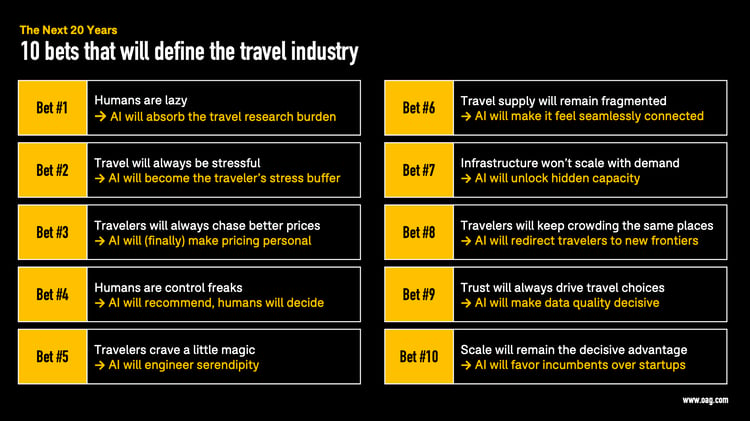
Bet #1: Humans are lazy (so AI will absorb the travel research burden)
- Travel planning has become overwhelmingly complex and time-consuming - travellers spend hours comparing flights, hotels, and extras, often visiting hundreds of pages per trip.
- As a result, travellers are already turning to AI tools to handle repetitive research tasks.
- AI will increasingly take over this burden, allowing people to optimise outcomes without expending effort.
Bet #2: Travel will always stay stressful (but AI will become our stress buffer)
- Travel itself will never be stress-free - growing demand, constrained infrastructure, weather, delays, and operational disruptions won’t disappear.
- What will change is how travellers deal with them. Agentic AI will take over disruption management:
- Anticipating issues
- Rebooking flights
- Handling refunds
- Coordinating ground transport
- Proposing real-time alternatives.
- AI won’t remove stressors, but it will remove the work of managing them.
.jpg?width=900&height=225&name=10-bets%20(1).jpg)
Bet #3: Travellers will always chase lower prices (and AI will finally make pricing personal)
- Price sensitivity won’t change, and comparison won’t disappear - instead, AI will handle searching and filtering behind the scenes, including access to private and loyalty-based offers.
- More importantly, conversational AI provides deep intent signals - budget, flexibility, loyalty, preferences - enabling true personalisation.
- Pricing will finally move beyond averages toward dynamic, demand-aware approaches, powered by quality data and scalable technology.
Bet #4: Humans are control freaks (so AI will recommend, but we decide)
- AI will handle execution, but humans will retain decision authority.
- Travel choices are emotional, personal, and high-stakes. Even with advanced automation, travellers will still want to approve the booking.
- The future division of labour is clear: AI does the work; humans will still decide.
Bet #5: Travellers crave a little magic (and AI will learn to deliver it)
- Beyond efficiency, travellers want discovery and surprise.
- As agentic systems mature, they will move from optimisation to curated serendipity - introducing thoughtful deviations and local experiences that align with interests without being explicitly requested.
- AI will enhance, not eliminate, spontaneity.

Bet #6: Travel supply will remain fragmented (but AI will finally make it feel seamlessly connected)
- Travel supply will always be fragmented across airlines, hotels, mobility and services.
- AI won’t consolidate supply, but it will unify the experience - assembling itineraries, detecting constraints, optimising combinations, and managing disruptions across providers as a single coherent workflow.
Bet #7: Infrastructure won’t scale with demand (but AI will unlock hidden capacity)
- Physical infrastructure evolves slowly and can’t keep up with demand. Capacity gains will come from intelligence, not construction.
- AI will optimise aircraft positioning, gate usage, crew rotations, and turnaround processes - predicting bottlenecks before they occur. None of this works without trusted, high-quality operational data.
Bet #8: Travellers will crowd the same places (and AI will guide us to new frontiers)
- Over-tourism persists because demand concentrates on a few destinations.
- AI agents, with real-time visibility into supply, congestion, and pricing, will redirect travellers toward better-matched, under-visited alternatives.

Bet #9: Travellers will always seek trustworthy providers (and data quality will make data quality decisive)
- Travellers will only trust agents that get things right consistently. Errors destroy trust instantly.
- The decisive factor will be data quality. Reliable, accurate data enables AI to reason safely, personalise effectively, and make dependable decisions.
- Trusted data becomes the foundation of trusted agents.
Bet #10: Scale will remain the decisive advantage (so AI will favour incumbents over startups)
- In the AI era, success depends less on invention and more on scale, data, integration and distribution.
- Incumbents already possess massive datasets, global reach, operational depth and brand trust.
- As AI becomes a commodity layer, these advantages compound - startups will still innovate, but incumbents are best positioned to deploy AI at industry scale.
Track shifts and trends in the air travel industry with OAG’s weekly digest, full of insight, analysis and infographics that bring the data to life. Subscribe below.