Travel 2045: A 20-Year Outlook for the AI Era

What the last 20 years reveal about the next 20, and the ten bets shaping travel’s AI future.

Filip-Filipov2

Every January, the travel industry is flooded with “trend outlooks.” Reports, predictions, and glossy lists of what might shape the next 12 months. Some are useful (at least for inspiration). Many simply repackage shifts that have been underway for years. Almost all are too short-sighted.

Because if the goal is to prepare for the future of travel, then a single year is the wrong unit of analysis.

The forces reshaping our industry don’t operate on annual cycles. They unfold over decades through deep structural shifts in technology, traveler behavior, labor dynamics, and the digital infrastructure that powers global travel. You don’t prepare an airline, airport, or OTA for next year. You prepare it for the next era.

That’s why this outlook takes a different approach.

Instead of asking “What will happen in 2026?”, we ask:

“Where will travel be in 20 years?”

Such a horizon forces us to zoom out.

It shifts our attention away from year-to-year fluctuations and toward the deeper forces that reshape industries over decades. We are talking about the kinds of shifts that determine which travel companies lead, which fall behind, and which new categories may emerge altogether.

This report is built around ten long-term bets that will shape the next two decades of travel technology.

At OAG, we believe these next 20 years represent a once-in-a-generation shift, powered by the rise of agentic travel. We’ll get to that shortly.

But before looking forward, we need to look back.

Because the past 20 years have already transformed travel in ways that are easy to forget and impossible to ignore.

To understand where the industry is going, we must first understand how it arrived here.

So we begin with five defining shifts that shaped travel between 2005 and 2025, and then turn to the ten bets that will shape the 20 years ahead.

THE FIVE TRAVEL TRENDS DEFINING THE LAST 20 YEARS IN TRAVEL


It’s easy to forget how recent the digital travel era really is. Because so much has happened in the past 20 years that 2005 feels like a different universe.

  • In 2005, a tiny website called YouTube had just launched. 
  • Facebook was still restricted to a handful of universities. 
  • The global internet ecosystem was only beginning to form.

Travel was just as early in its digital journey.

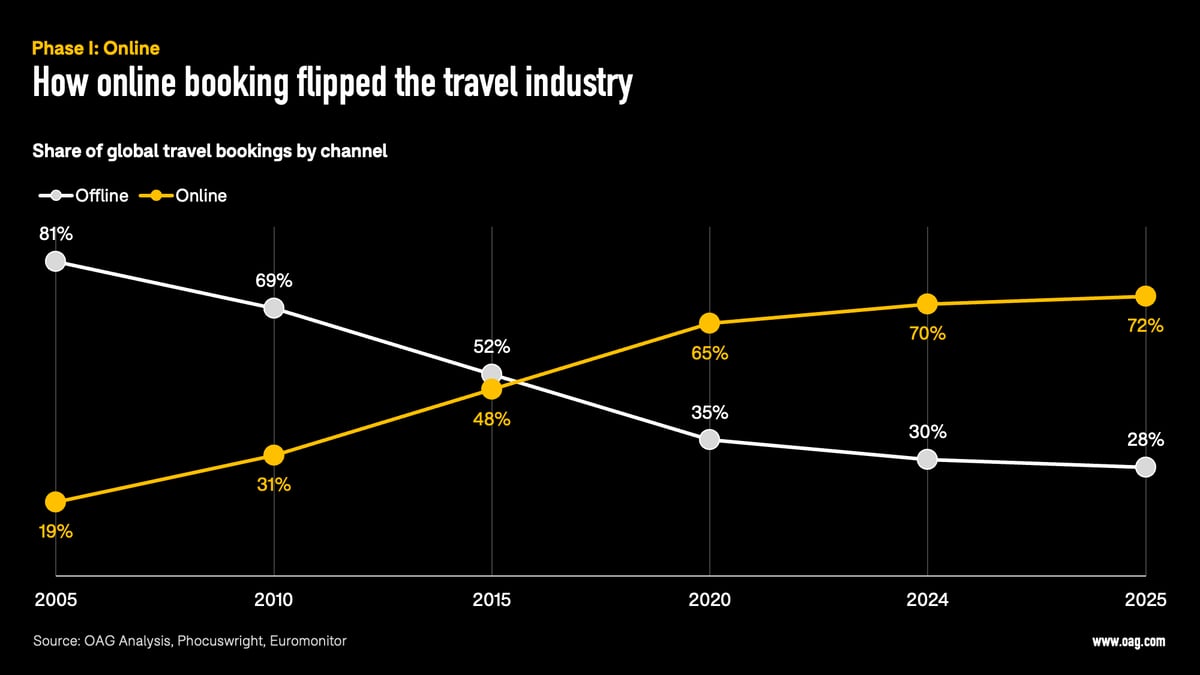
Online booking was still a niche behavior. Around that time, only one in five travel bookings happened online, meaning the vast majority of people still relied on phone calls, storefront travel agents, or paper brochures to plan trips. 

OTAs were early experiments, and even the most forward-leaning travelers were only beginning to trust digital channels. Skyscanner, for example, was barely two years old. Metasearch was an emerging idea, not an industry category. 

how online booking flipped the travel industry

Fast forward to today, and the roles have completely reversed.

Now, only one in four travel bookings still happens offline.

Online booking has become the global default, supported by six billion internet users and a mature digital distribution ecosystem that spans OTAs, meta platforms, direct channels, super apps, and, increasingly, AI-driven retailing. No doubt about it: the web changed the way we shop.

How many times have you looked at your smartphone today?

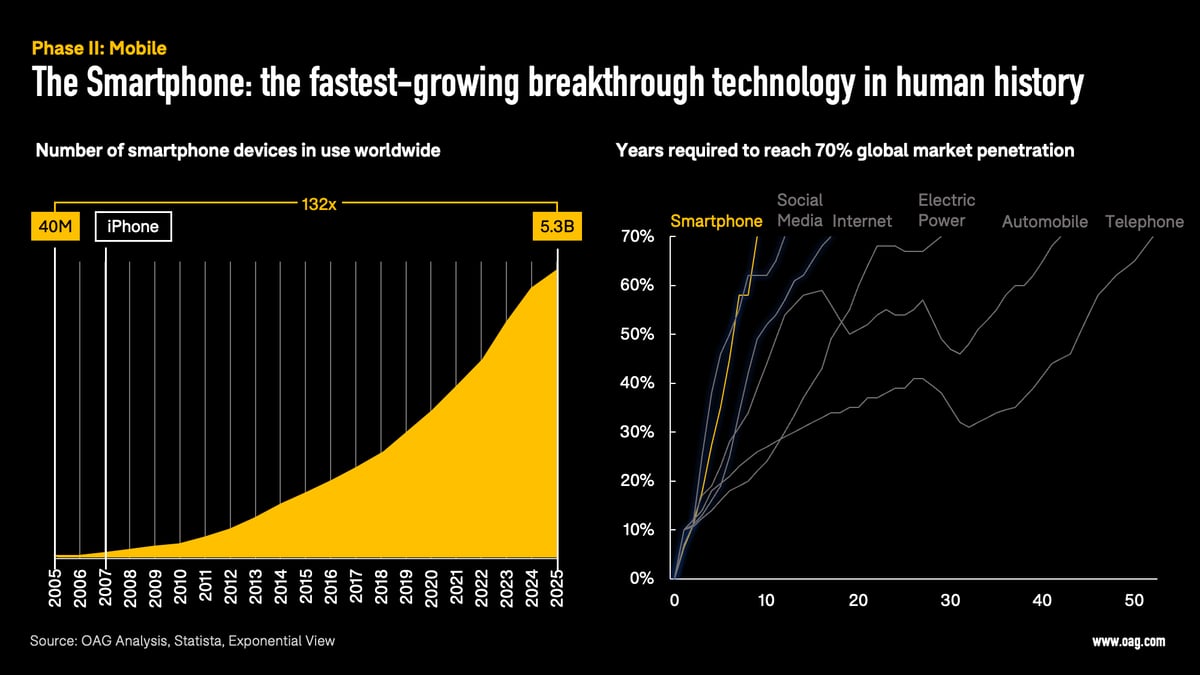
In 2005, the answer would have been simple: you couldn’t, because the first iPhone didn’t launch until mid-2007.

But once it did, everything changed. Smartphone adoption exploded, growing by a factor of 132 over the next two decades, reaching way over five billion smartphones in use today.

smartphone impact

To put this trajectory into perspective: the smartphone is the fastest-growing breakthrough technology in modern human history, reaching 70% mass-market penetration in under 10 years – something no previous (or subsequent) technology has achieved.

Today, almost anyone connected to the internet is connected through a smartphone.

Of course, this development came with its downsides.

  • Twenty years ago, we explored the world with our own eyes, not through a digital lens.
  •  Today, we spend 4.5 hours per day staring at our screens, pick up our phones 58 times a day, and 1.5 billion people would be considered clinically addicted based on their usage patterns.

But downsides aside, mobile reshaped travel for the better. And dramatically so, turning travel booking into a truly global, always-on activity. You could plan, search, and book flights around the world with your fingertips.

And those fingertips lead us directly to the third major transition of the past 20 years.

Looking up flights, hotels, and things to do on your phone is one thing. Booking them is another.

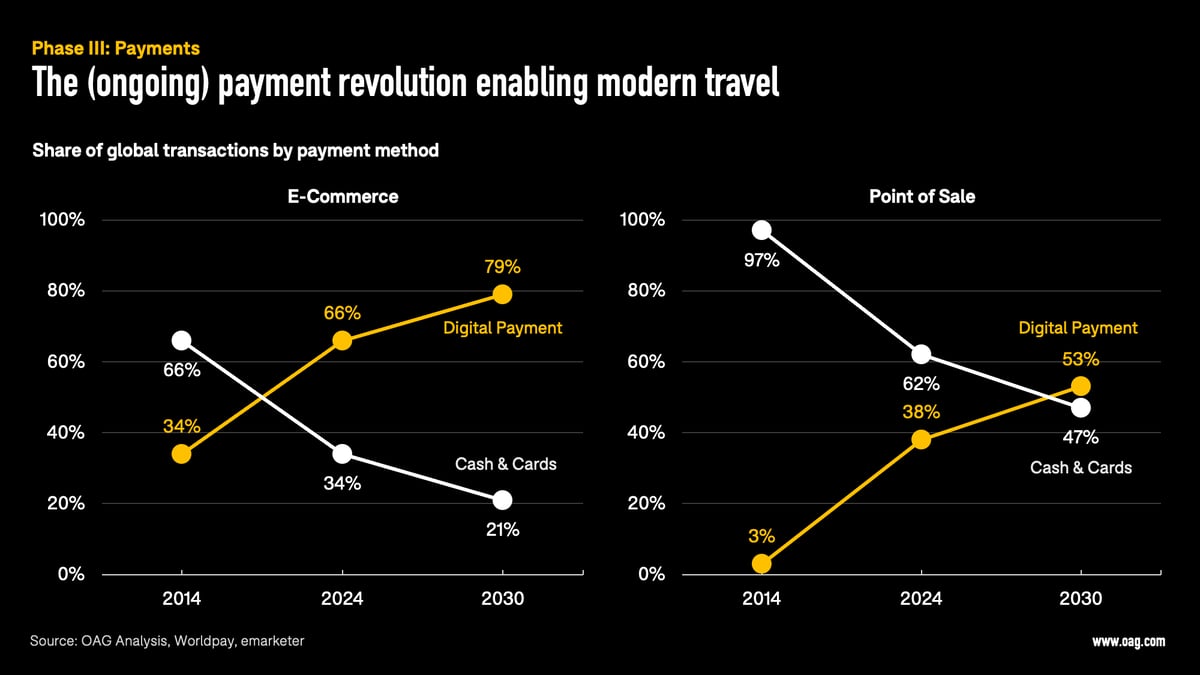
And the truth is: the mobile revolution in travel would not have worked without one additional breakthrough: frictionless digital payments.

Over the past two decades, online payments have quietly become one of the most transformative forces in global travel.

This shift unlocked two things that weren’t obvious at the time:

1) Seamless payments created the foundation for the seamless trip

Mobile wallets allowed travelers to pay effortlessly at (almost) every touchpoint of their journey. Think about how we travel today:

  • Tapping a mobile wallet to board an airport–city train in New York.
  • Buying a last-minute museum ticket or souvenir via Apple Pay or Google Pay.
  • Upgrading a seat or purchasing ancillaries at the airport gate (e.g., via Plusgrade).
  • Opening boarding passes directly from the wallet app, blending identity, payment, and verification into one interface (e.g., via Apple’s Digital ID).

This universal payment layer is what makes travel flow. And this trend will only accelerate, especially across Western markets where cash usage is still well established.

In twenty years, cash-in-travel may be as uncommon as paper boarding passes today.

payment revolution

2) Seamless payments unlocked a new revenue engine for travel providers

Frictionless mobile payments transformed more than convenience; they transformed commerce. Because once customers were able to pay on their phones, travel providers could sell more to customers already in the flow.

Take Airbnb for example: Around 20% of Airbnb’s total guest spend now comes from upsells beyond the core accommodation; think experiences, massages, add-ons, and services booked “on the move” during the trip.

This is the entire logic behind the industry’s most pursued ambition: the connected trip.

A world in which every part of the journey is stitched together more or less seamlessly because every step can be paid for instantly. And the potential here is far from exhausted.

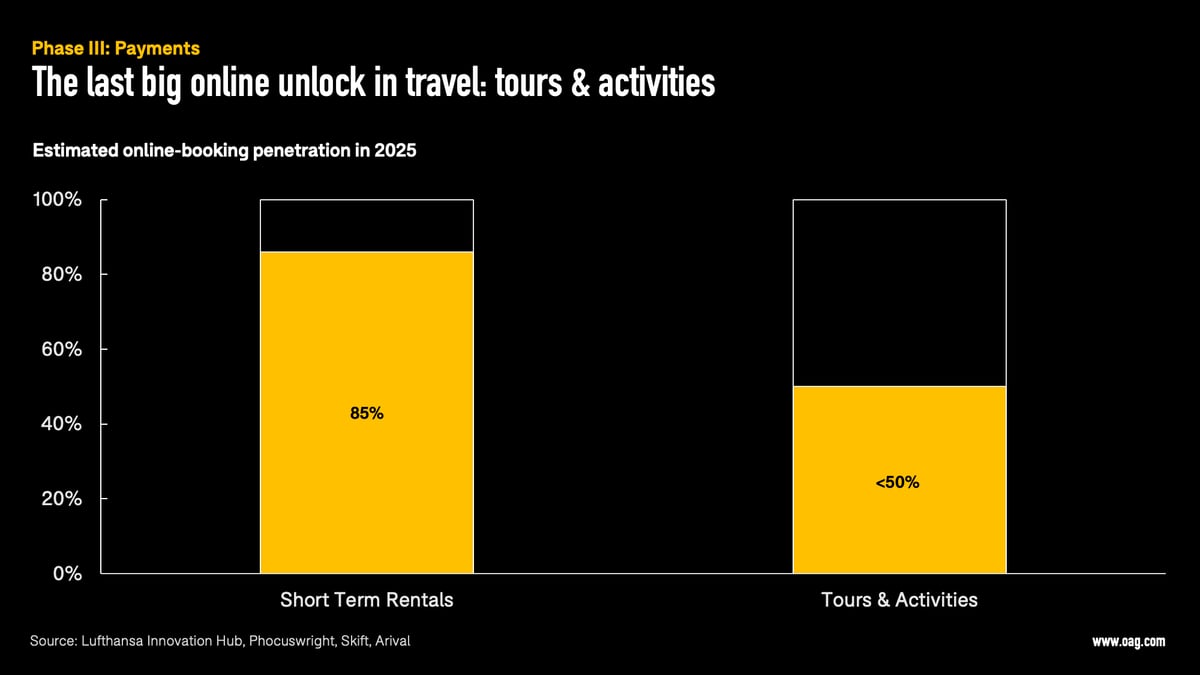
For example, travel’s tours and activities segment is still early in its digital transition, with less than 50% of bookings made online today, mainly due to its highly fragmented supplier landscape. That said, platforms such as GetYourGuide, Klook, and Tiqets have made significant progress in aggregating this long tail of supply, with Expedia’s recent acquisition of Tiqets underlining just how strategically important this category has become for the broader travel ecosystem.

seamless payments

And that brings us to the fourth major transition, which is not driven by how we book or pay, but by how much more we can travel, thanks to one of the biggest expansions of supply that our industry has ever seen.

One of the most overlooked shifts of the past 20 years is how much new supply entered the travel ecosystem. Not just more flights or hotels, but entirely new categories invented by tech companies that didn’t exist two decades ago.

These players fundamentally expanded what “travel” could mean:

  • Airbnb turned spare rooms, couches, treehouses, and every imaginable space into a new global lodging category.
  • Uber unlocked a new layer of urban mobility: accessible, on-demand, and available in thousands of cities.
  • com and Dohop commercialized virtual interlining (or, as we prefer to say, Alternative Interlining), stitching together airline combinations that traditional carriers couldn’t or wouldn’t offer.
  • Klook and GetYourGuide pulled large parts of the fragmented world of tours and activities online, creating global marketplaces for experiences that were once invisible to the internet.

In other words: travel tech didn’t just digitize existing supply; it created entirely new supply.

The expansion is visible in classic categories, too.

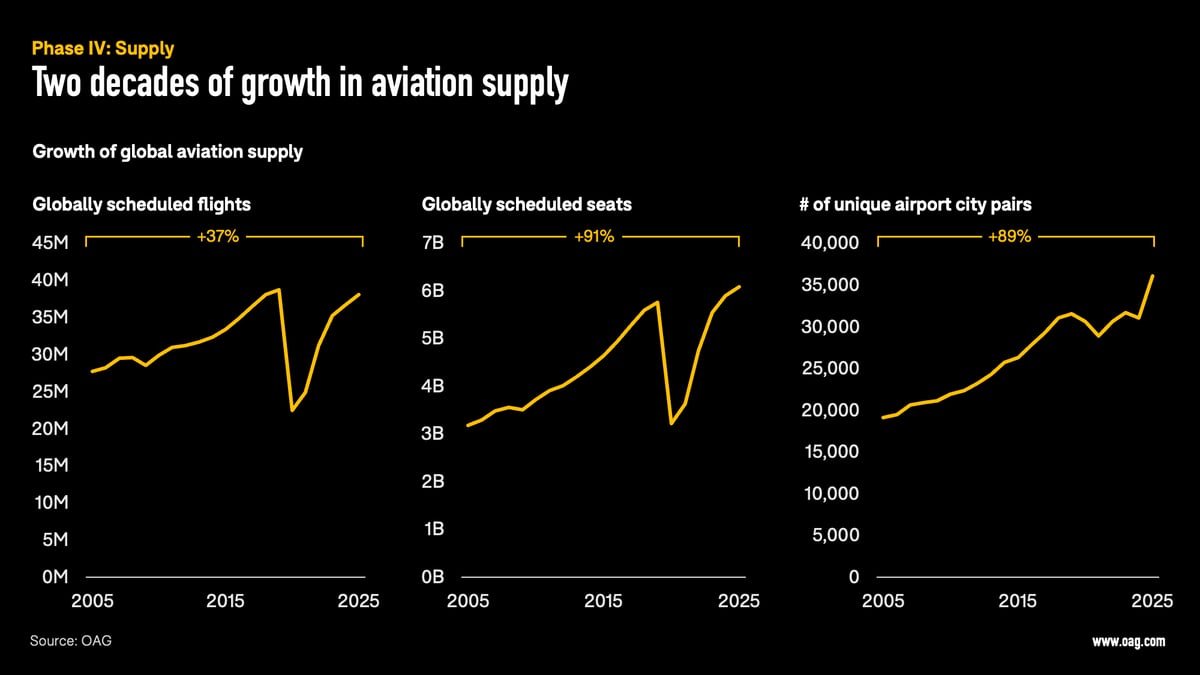
Scheduled flights, airline seat capacity, and number of unique airport city pairs have been on a steady long-term growth trajectory (COVID dip aside).

growth in aviation supply

More aircraft. More seats. More frequencies. More city pairs. More low-cost markets unlocked. Travel supply expanded accessibility. And the demand side is nowhere near slowing down either. If anything, future demand will outpace today’s supply.

  • Measured in total passengers, global air travel reached 8 billion passengers in 2025, nearly crossing the historic 10 billion milestone.
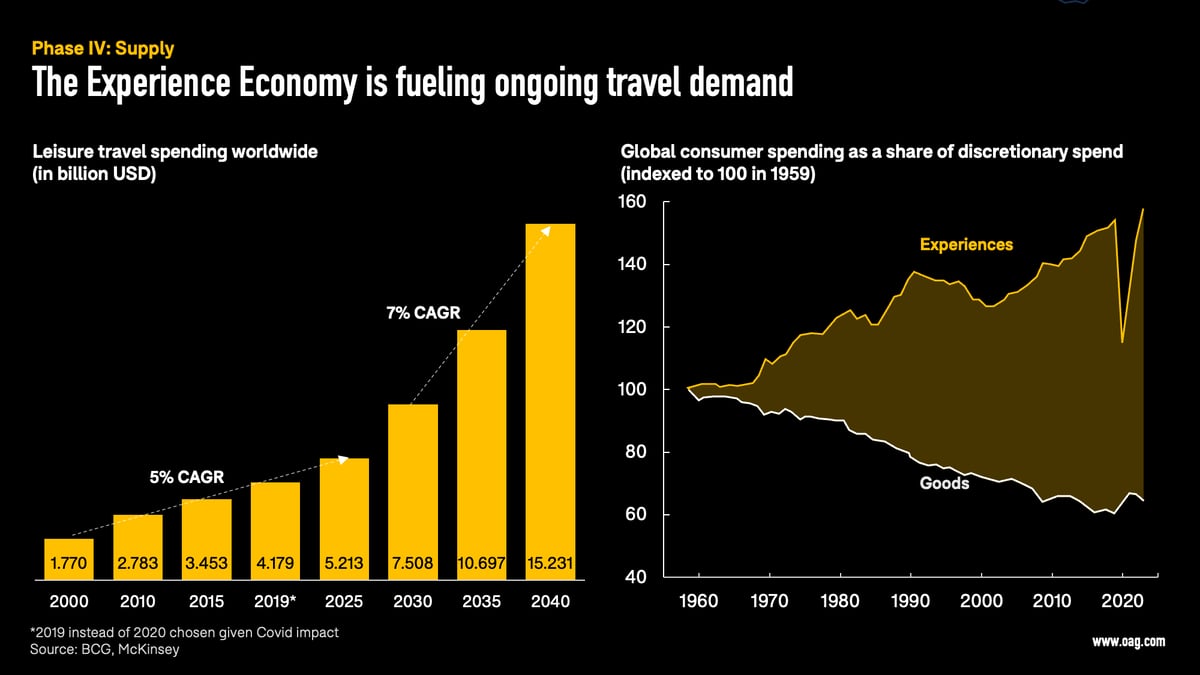
  • BCG projects that global leisure travel spending will more than triple from $5 trillion USD today, to over $15 trillion USD by 2040.
  • This is driven by a rapidly growing middle class in emerging markets, but also by a clear generational shift toward spending on experiences over ownership.

To expand on the latter, younger generations (particularly Millennials and Gen Z) are increasingly prioritizing travel, experiences, and personal enrichment over traditional assets such as cars or home ownership, which are often significantly harder to afford than for previous generations. Travel has become a core part of personal identity, social signaling, and lifestyle expression, reinforcing its role not as a discretionary luxury but as a central component of how younger consumers choose to spend their money.

experience economy


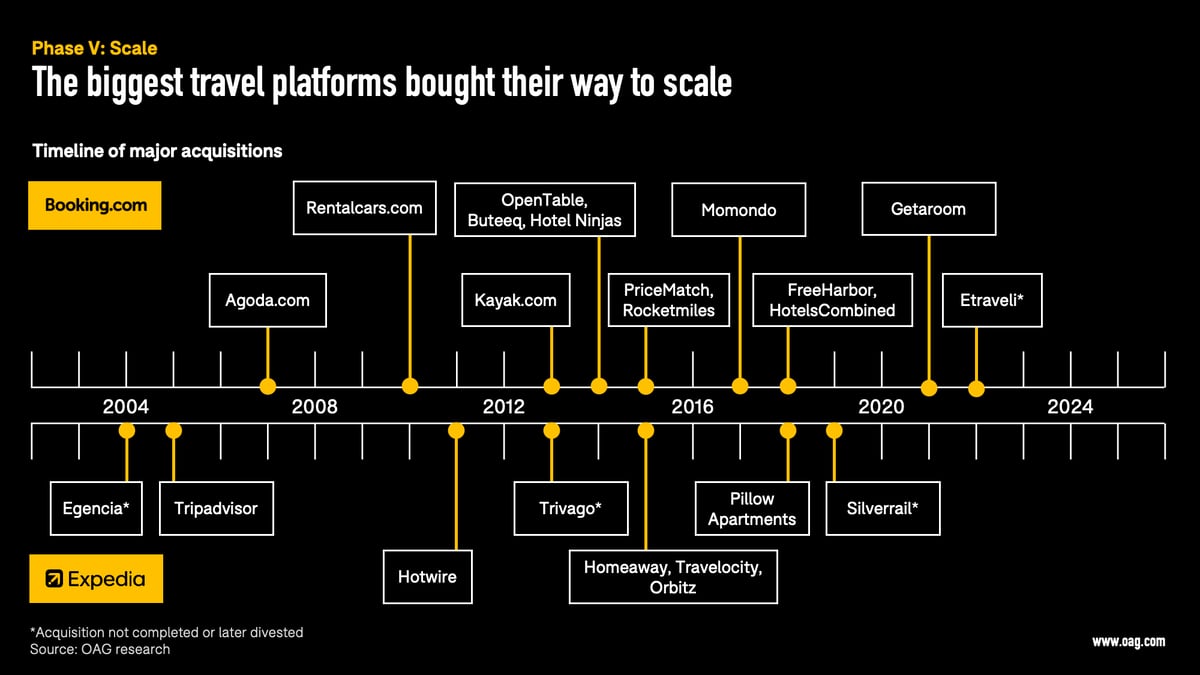
If there’s one lesson the past 20 years have made crystal clear, it’s this: scale won.

The travel tech winners of today (across platforms, infrastructure, and consumer brands) all share one defining characteristic: they have become big.

Look at the sector’s largest booking players:

  • Booking Holdings expanded aggressively through acquisitions like Kayak, Agoda, Priceline, and Rentalcars.
  • Expedia Group followed the same path, acquiring Hotels.com, Orbitz, Travelocity, Vrbo, CarRentals.com, and more, building one of the most powerful multi-brand portfolios in travel.

travel platforms

The same pattern shows up everywhere in travel:

  • Airbnb, despite positioning itself as an asset-light alternative, acquired companies across payments, property management, and experience platforms to strengthen its ecosystem and accelerate scale.
  • The European airline groups in the strongest positions today (whether IAG, Lufthansa Group, or Air France–KLM) are the ones that spent two decades acquiring, merging, and consolidating their way into network strength.

Even more recent travel-tech disruptors that started as startups realized quickly that scale is not optional; it’s structural. One of the clearest recent examples comes from hospitality tech. Mews, valued as a unicorn since 2024, has used a significant share of its $410 million USD in VC funding to acquire 12+ companies in just a few years, accelerating product depth, regional coverage, and market penetration.

travel tech unicorn

Why? Because in travel tech, size determines bargaining power, distribution reach, inventory access, operational leverage, brand trust, and ultimately: the ability to build profitable, defensible businesses.

In a sector defined by network effects, multi-sided marketplaces, global supply, and low-margin economics, scale is the flywheel that enables everything else.

No doubt: size matters in travel tech.

When the Last Two Years Changed Everything


If the past twenty years reshaped travel through digitalization, mobile, and scale, the past two years have done something different: they have reshaped the trajectory of technology itself.

Because what we’ve witnessed since late 2022 is not just another trend cycle.

It is the beginning of a new technology super-cycle, and one that the world has been waiting for.

For years, many assumed the next major shift would be the metaverse or blockchain.

None of them were. The real super-cycle, the one that actually materialized, is AI.
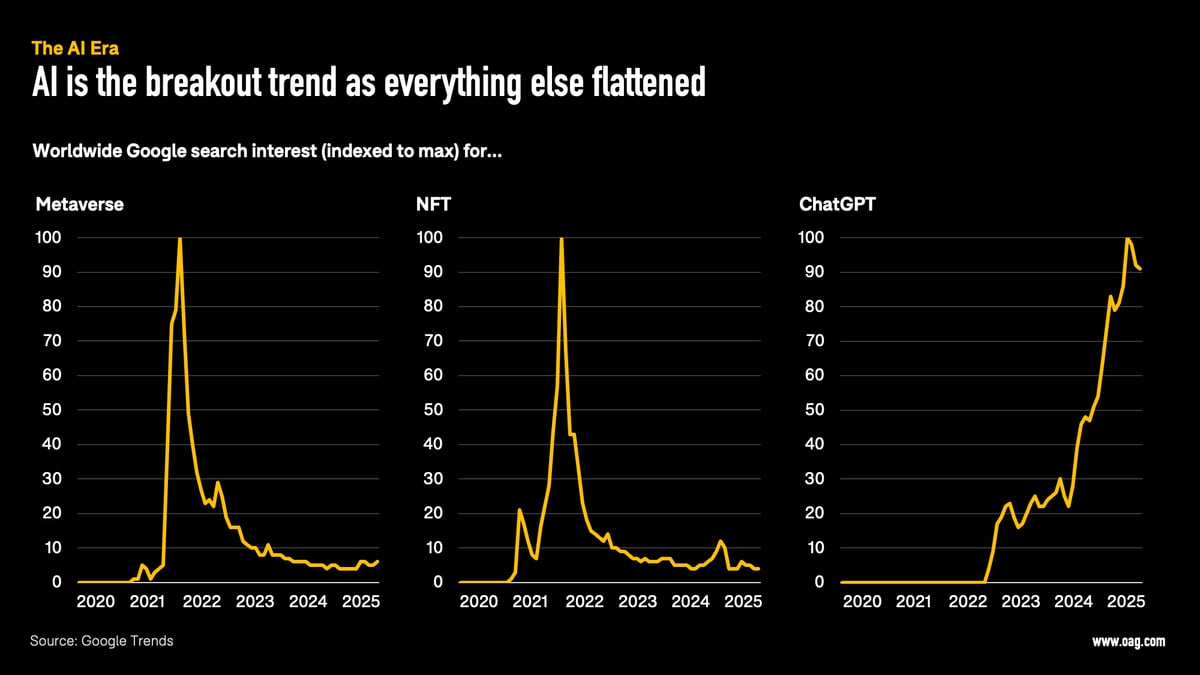
 

AI is the breakout trend


Nothing illustrates this better than adoption speed. What took major tech companies and social platforms many years to accomplish – reaching 100 million users – took ChatGPT just two months.
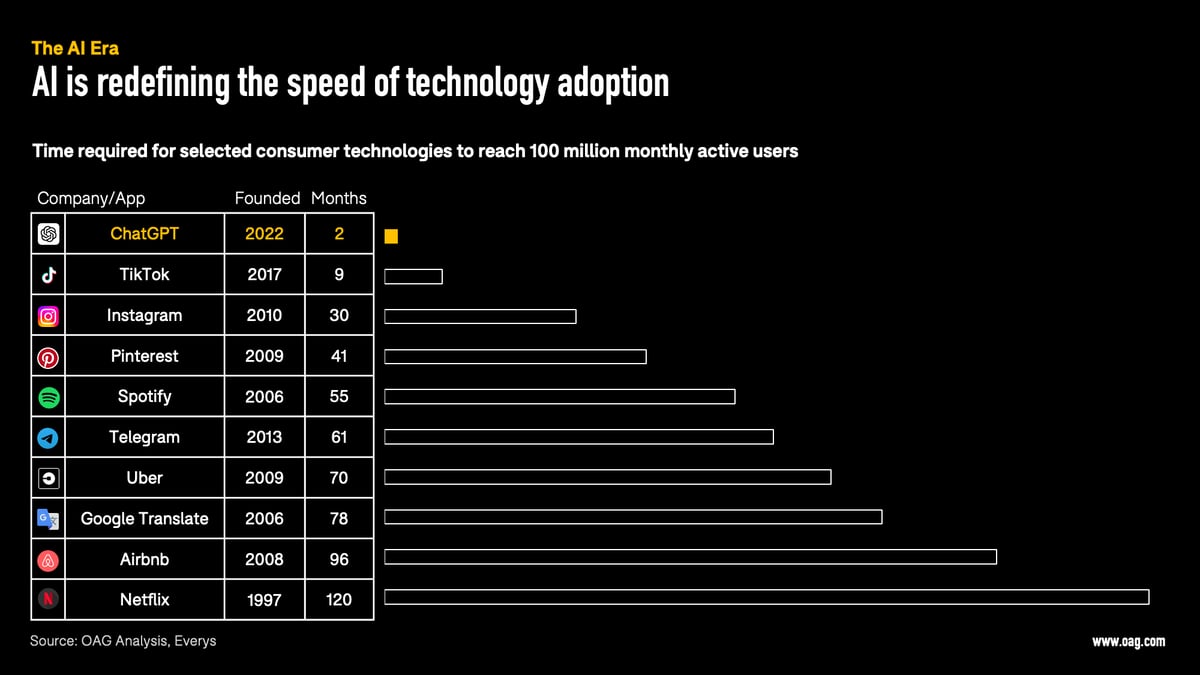
 

AI redefining the speed of tech


And the acceleration hasn’t stopped. AI growth has shifted from linear to near-vertical.

By the end of 2025, ChatGPT’s weekly active user base had reached one billion people, which is unprecedented in the history of consumer technology.

On the enterprise side, the shift is just as dramatic. Almost 90% of companies worldwide now use AI in at least one core business function, essentially doubling in only three years.

AI is no longer experimental; it is foundational.

The rise of “AI-native” companies further proves the point.

  • Take Mercor, a rapidly scaling AI-powered hiring platform automating resume screening and technical role matching.
  • It reached $500 million USD in ARR in just 17 months, which is a pace unimaginable in any previous tech era.
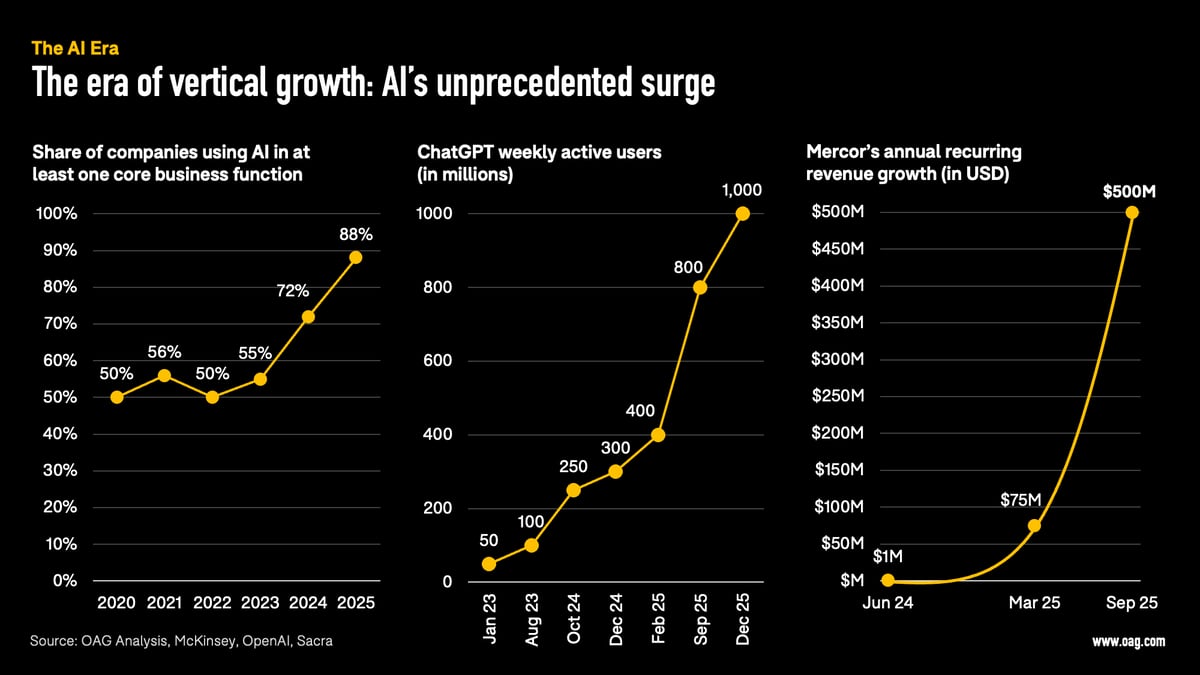
 

AI era of vertical growth


Without a doubt, the pace at which AI is progressing (and infiltrating every part of technology, business, and culture) is unlike anything the global economy has ever experienced.

And its impact on travel tech is only beginning.

The next era in travel will not be defined by marketplace scale. It will be defined by AI systems that plan, optimize, and act on behalf of travelers and travel providers.

Travel companies must buckle up, because the time to act is now.

This brings us to what really matters for the next twenty years: the ten long-term bets that will shape the future of travel in the AI super cycle.
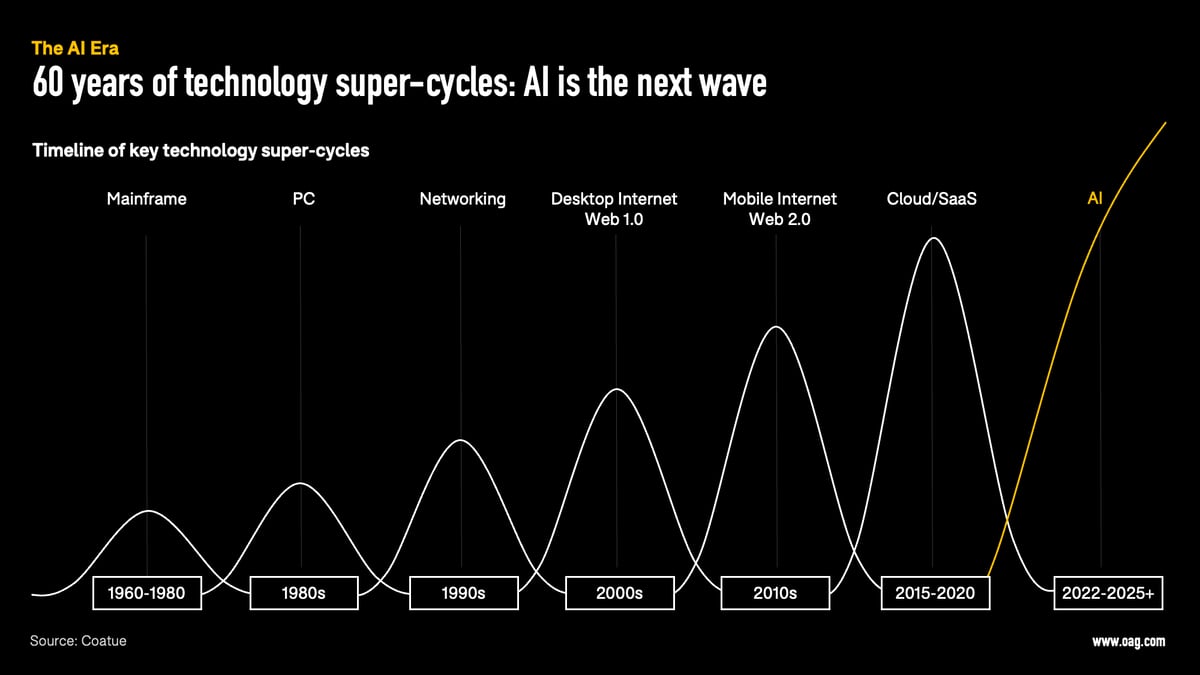
 

60 years of tech super-cycles


The 10 Bets That Will Shape the Next 20 Years


When we look at the impact of GenAI on travel, most of us have felt it immediately. Searching for trips, planning itineraries, and increasingly even booking travel is already happening directly inside AI interfaces. What once required dozens of tabs, apps, and tools is now collapsing into a single conversational layer.

And travelers are adopting this shift at a remarkable speed.

According to McKinsey, more than half of all travelers now use ChatGPT or similar AI tools at least occasionally for trip planning. Meanwhile, the segment of travelers who refuse to use AI for planning has shrunk to just 11% (basically one in ten consumers).

AI-assisted travel is not a future scenario. It’s already here.
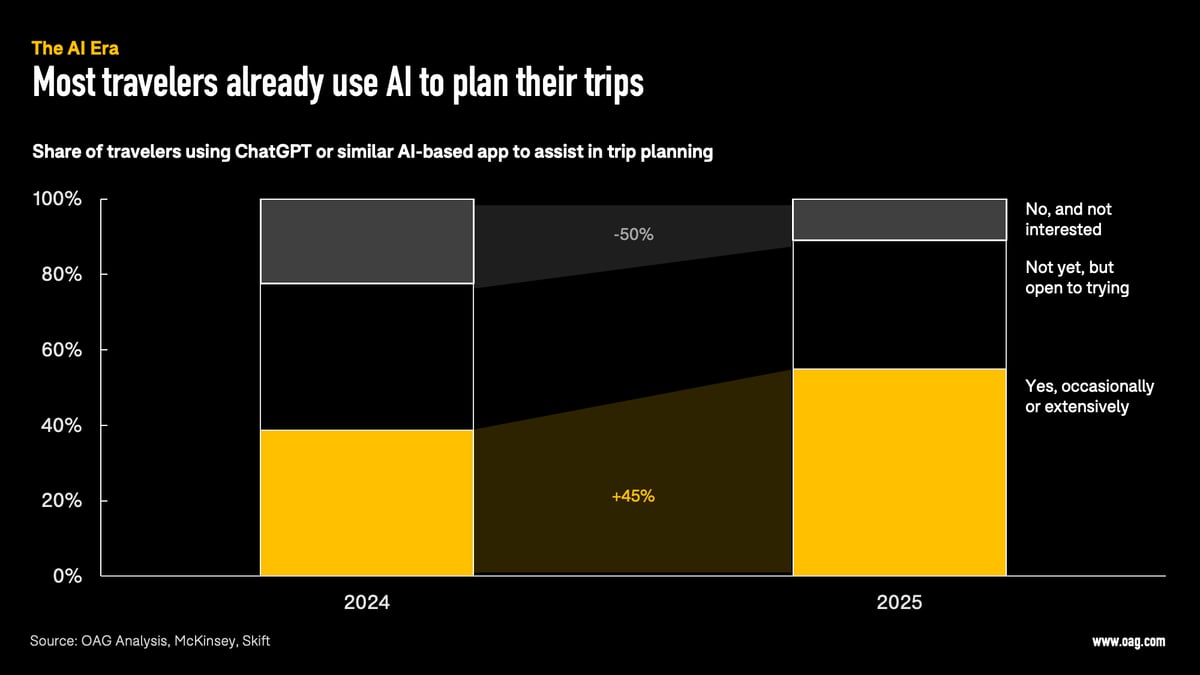
 

AI to plan travel

But what does all of this mean for the next 20 years?

Answering that question is harder than ever. The pace of AI innovation is so fast (and so unpredictable) that any detailed long-term forecast would be outdated almost immediately.

So instead of guessing the exact shape of travel in 2045, we take a different approach.

We look at the things that won’t change, and how AI will transform the way we deal with them.

Because even in an AI-supercharged world, some traveler behaviors, industry mechanics, and structural realities will remain remarkably stable. Those enduring forces form the backbone of travel.

What will change, however, is how we experience them.

And this is where the future becomes truly exciting.

These are the 10 bets that, in our view, will define the next era of travel because they anchor the conditions every travel provider will need to build for.
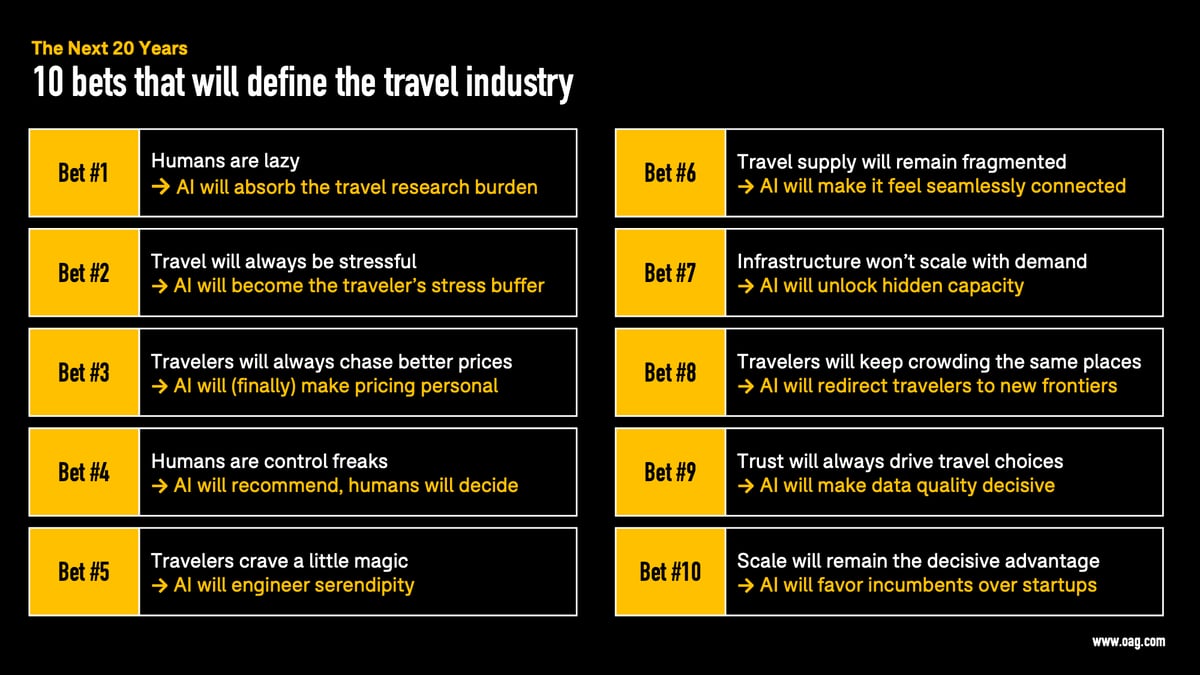

 

10 bets that will define the travel industry


Bet #1

Humans are lazy (so AI will absorb the travel research burden)

A simple but powerful truth about human behavior: we optimize for maximum output with minimum effort.

And nowhere is this clearer than in travel planning.

Research shows just how overwhelming the trip-research phase has become.

  • Expedia Group found that travelers spend an average of 128 minutes on airline websites during the path to purchase (so more than two hours hunting for fares).
  • While a handful of travelers may enjoy the chase, for most it’s pure frustration. In fact, more than three-quarters of travelers say comparing airline prices is too time-consuming.

And it doesn’t stop with flights.

Research suggests that travelers (on average) visited 141 web pages before booking a trip (flight + hotel + extras) in 2024, up from just 38 in 2013. In the U.S., that number spikes to 277 pages per trip.

This burden will be increasingly outsourced to AI.

It’s also the primary reason why more than 50% of travelers already use ChatGPT or similar tools during their trip planning (as mentioned above). People don’t want to do the repetitive work, and AI is finally capable of doing it for them.

BET-1

Bet #2

Travel will always stay stressful (but AI will become our stress buffer)

No matter how much technology evolves, travel itself will never be stress-free.

More people will travel over the next 20 years. Airports will remain constrained by space, regulation, and physical infrastructure. Traffic jams on the way to the airport won’t disappear. Weather disruptions, gate changes, missed connections, and cascading delays will remain part of the travel reality.

These aren’t “problems” the industry can eliminate (even though AI will increasingly help mitigate them, as we showed in our AI for Airline Operations deep report). They are structural constraints of a system under constant capacity pressure.

So it’s an illusion to think the travel journey will suddenly become smooth and pleasant for everyone. If anything, as demand grows faster than infrastructure expands, complexity and stress will increase.

But here is what will change:

AI, especially agentic AI, will become travel’s built-in stress-buster.

Instead of spending hours rebooking disrupted flights, waiting on hold, refreshing apps, or juggling multiple confirmation emails, travelers will offload the entire operational burden to autonomous agents.

Agentic systems will:

  • Anticipate disruptions before travelers even notice.
  • Rebook flights automatically based on preferences, loyalty status, and fare rules.
  • Renegotiate missed connections.
  • Handle refunds or vouchers.
  • Coordinate mobility options from curb to gate.
  • Provide real-time alternative plans (“Here are the three fastest ways to still make your meeting in Chicago”).

In other words, AI won’t eliminate the causes of travel stress. But it will eliminate the burden of managing that stress.

Bet #3

Travelers will always chase lower prices (and AI will finally make pricing personal)

One thing about travelers won’t change: we will always prefer a lower price for the same quality.

Deal-hunting is a universal (human) behavior, and as global travel supply expands (more flights, more hotel rooms, more experiences, more mobility options), the incentive to compare prices only increases.

So it’s unrealistic to think that price-comparison sites, metasearch platforms, or fare-shopping tools will disappear. If anything, their relevance grows as supply becomes more fragmented and competitive.

But two things will change:

1) AI interfaces will take over large parts of searching, filtering, and curating prices for us.

Instead of manually scanning dozens of tabs, travelers will increasingly ask an AI system to find the best combination based on their preferences, constraints, loyalty benefits, and timing. Price comparison won’t vanish, but it will become far less overwhelming. We are already seeing early versions of this logic in action. Google’s new Flight Deals and AI-powered search experiences, for example, proactively surface price drops, alternative dates, and better-value routing options without requiring travelers to actively hunt for them.

But price comparison also won’t disappear entirely. More fares, bundles, and exclusive offers will increasingly move behind log-in environments, think loyalty portals, member-only spaces, and personalized dashboards. AI agents will be able to access and evaluate these offers privately on the traveler’s behalf, but they won’t surface them publicly the way metasearch platforms do today.

So comparison won’t vanish; it will shift into a personalized, behind-the-scenes process handled by AI.


2) The biggest impact of AI on travel pricing will come from true personalization.

For years, the industry has talked about personalized pricing and offers, but it never materialized. Context was too shallow. Signals were too scattered. Platforms didn’t know why a traveler was searching or what actually mattered to them.

That changes when travelers converse with AI systems.

Suddenly, the interface understands:

  • The purpose of the trip.
  • Budget sensitivity.
  • Flexibility.
  • Loyalty status.
  • Preferred airlines and cabins.
  • Willingness to pay for convenience.
  • Appetite for upgrades.
  • Historical behavioral patterns.

With richer context and deeper intent signals, pricing becomes tailor-made.

And on the supply side, technology finally matures to enable dynamic packaging and dynamic pricing at scale.

At OAG, we believe Shopping Data will play a critical role here, unlocking a new era of pricing innovation and enabling more responsive and intelligent pricing models – something theorized for more than a decade but still early-stage in practice.

In short, travelers will continue to seek value. At the same time, AI will increasingly support market-wide pricing decisions, allowing suppliers to move beyond broad averages toward more dynamic, demand-aware approaches.

Bet #4

Humans are control freaks (so AI will recommend but we will make the final decision)

Despite all our technological progress, one human trait remains remarkably stable: we like to stay in control.

And that won’t change in the next 20 years.

Even as agentic AI becomes capable of searching, filtering, negotiating, optimizing, sequencing, and rebooking on our behalf, travelers will still want one thing: the final say.

This creates an important nuance in the agentic future.

  • Yes, AI agents will take over the heavy lifting.
  • Yes, they will automate the operational burden of travel.
  • And yes, they will often execute tasks faster and more accurately than humans ever could.

But execution is not the same as decision-making.

AI agents will recommend. Humans will still decide.

Why? Because travel decisions like where to go, which airline to fly, which hotel to trust, what risk level to accept, and how much to spend all sit at the intersection of identity, emotion, and budget. No algorithm can fully replace those subjective trade-offs.

So even in a world where agents do 90% of the work, travelers will still expect a sense of agency, a moment of human confirmation (“Yes, book this”).

And there’s another twist: the more personalized travel becomes, the more people want to double-check. Tailored recommendations feel high-stakes. If an agent misinterprets intent, the consequences are real: a missed connection, an unsuitable hotel, a poor location, a misaligned budget.

Long story short: AI will execute the journey, but humans will approve the journey.

This division of labor will define the next 20 years of travel.

Bet #5

Travelers crave a little magic (and AI will learn to deliver it)

Travel isn’t only about efficiency. At its core, it’s about discovery and seeing something new, unexpected, or unplanned. Yes, most travelers still visit the famous places they’ve researched in advance. But almost everyone also craves a moment off the beaten track: a hidden café, an unexpected view, a local ritual you didn’t have on the itinerary.

This might look counterintuitive, but AI agents will actually add more serendipity, not less.

The first wave of agentic systems focuses on efficiency (as we already see today in the perfectly crafted travel itinerary), aiming to reduce friction, cut research time, and optimize routes. But as these systems mature, the next frontier will be curated surprise. AI won’t just echo back what we already like or what we explicitly asked for. It will start to introduce small, well-judged deviations from our patterns.

A simple example:

If a traveler has a free afternoon in Tokyo, the agent might propose:

“You said you love modern art, but there’s a tiny pottery studio two streets away holding an open workshop today. Highly rated by locals. Takes 45 minutes. Want me to slot it in before your dinner reservation?”

How exactly this will be implemented remains to be seen…

BET 5

Bet #6

Travel supply will remain fragmented (but AI will finally make it feel seamlessly connected)

Travel supply has always been, and will always remain, deeply fragmented.

Hundreds of airlines. Millions of hotels. Tens of millions of tours, activities, and restaurants. Plus loyalty programs, ancillaries, insurance products, rail systems, ferry networks, rental cars, local transit…the list keeps growing.

A trip will always consist of countless individual pieces owned by different suppliers.

And no amount of technology (not even AI) will consolidate this complexity away.

But here is what will change:

For the first time, AI can make fragmented supply feel unified.

  • Historically, every layer of the trip required its own search, its own booking, its own confirmation, and its own support channels, meaning a mess of disconnected micro-decisions. 
  • Even sophisticated travel platforms have struggled to connect these pieces “fluently.”

Agentic AI can finally operate across this fragmentation.

It can:

  • Pull availability from multiple suppliers at once.
  • Assemble multi-step itineraries dynamically.
  • Detect hidden constraints between suppliers (timing, policies, location gaps).
  • Optimize combinations that humans or traditional systems would not surface.
  • Handle rebooking across multiple providers as one coherent action.
  • Unify communication and service across disparate systems.

In other words: the supply side stays fragmented, but the traveler experience becomes more unified.

The industry doesn’t become simpler. It just becomes simpler to navigate.

Bet #7

Infrastructure won’t scale with demand (but AI will unlock hidden capacity)

While technology and AI accelerate at breathtaking speed, physical infrastructure will not.

Aircraft, airports, hotels, rail systems, and runways; none of these evolve on a 5-year or even 10-year cycle.

  • The aircraft we will fly in 20 years have largely already been ordered today.
  • Most airports expanding capacity now will finish construction late in the 2030s.
  • Hotel pipelines move slowly, with lead times of 5–10 years even for mid-sized developments.

Infrastructure simply cannot keep pace with demand. And it never will. The timelines don’t move at the same speed.

So the only way to unlock more capacity is not by building more infrastructure, but by managing existing infrastructure far more intelligently.

This is where AI steps in. In the airline operations context, we already see countless use cases where AI takes planning and efficiency to a new level (see our collaboration report with Microsoft). 

The next 20 years will push this much further.

AI will help decision-makers answer questions such as:

  • Where should aircraft be positioned to minimize disruptions?
  • Which gates should be reassigned to optimize flows and reduce delays?
  • How can turnaround processes be improved in real time?
  • Which crew rotations minimize risk under irregular operations?
  • How do we predict bottlenecks hours before they materialize?

And underlying all of this is one foundational requirement: trusted, high-quality data.

Without reliable schedules, gate information, flight status, delay patterns, airport capacity data, and airline operational inputs, none of these AI systems can function.

So infrastructure won’t accelerate. Intelligence will.

Bet #8

Travelers will keep crowding the same places (and AI will guide us to new frontiers)

Over-tourism is one of travel’s biggest structural challenges. Today, 70% of global travelers are believed to visit just 4% of all destinations, creating overcrowded hotspots while countless equally remarkable places remain overlooked.

This imbalance won’t fix itself.

And traditional marketing, recommendation engines, or city-level incentives have never truly shifted global demand.

But AI agents will change this dynamic.

Because agents won’t only optimize for personal preference or convenience, they will increasingly optimize for opportunity.

As they gain a more complete understanding of global supply, real-time demand patterns, congestion levels, pricing dynamics, and traveler intent, agents will have the power to:

  • Surface under-visited but high-quality destinations.
  • Redirect travelers to places that match their interests without the crowding.
  • Time-shift demand away from peak periods.
  • Propose alternatives when a preferred hotspot is overloaded or overpriced.

In other words, AI will act as a new kind of invisible hand, gently steering travelers toward the world’s hidden gems (not through restrictions or guilt, but through better matches).

BET 8 (1)

Bet #9

Travelers will always seek trustworthy providers (and AI will make data quality decisive)

Automation and agentic systems will take over large parts of the travel workflow, but travelers will only outsource tasks if they trust the provider, whether it's the payment platform, the booking environment, or most importantly, the agent itself.

Which agents will we trust? The ones that consistently prove their reliability over time. And the margin for error is almost zero.

  • If an agent books the wrong flight, misunderstands a constraint, or mishandles a disruption, trust evaporates instantly. 
  • Travelers won’t give second chances to systems that get core travel decisions wrong.

So which agents will earn (and keep) traveler trust?

Those with deeper context, better training, and, crucially, the best data to work with.

This brings us back to one essential truth for the AI era: trusted data becomes the foundation of trusted agents.

In our recent report on aviation’s AI future, we found that data inaccuracies are the number-one concern among companies running AI projects today. The industry knows it: without accurate, high-integrity data, AI systems cannot reason reliably, cannot personalize safely, and cannot make decisions travelers can depend on.

The key point: Travelers will continue to choose providers they trust. And in the AI era, trust will be earned through data quality.

Bet #10

Scale will remain the decisive advantage (so AI will favor incumbents over startups)

If the past 20 years have taught us anything, it’s this: the breakthroughs that reshaped travel rarely came from within the industry. It was outsiders and early believers who recognized what the online era could mean:

  • They created the first online booking and price comparison sites.
  • They foresaw how critical seamless mobile payments would become.
  • They reimagined entire travel categories that didn’t exist before, from home-sharing and ride-hailing to virtual interlining and experiential marketplaces.

But the next 20 years may look very different.

In the AI super-cycle, incumbents are structurally positioned to outperform.

Why? Because the success of agentic systems won’t depend on scrappiness or intuition, it will depend on scale, data, integration, and distribution.

Incumbents already have:

  • Massive datasets spanning inventory, behavior, pricing, and operations.
  • Aggregation layers across flights, hotels, mobility, and payments.
  • Global distribution and loyalty ecosystems.
  • The financial and organizational capacity to deploy AI at scale
  • Trust and brand recognition that accelerate adoption.

Also, AI is becoming a horizontal capability and a commodity layer accessible to everyone.

It’s no longer the secret advantage of two brilliant founders in a garage, quietly building something no one else can. The “surprise moment” that powered past startup waves becomes far less potent when:

  • The core technology is broadly available,
  • Models and tools are open-access, and
  • Implementation (not invention) becomes the differentiator.

This strengthens the hand of incumbents because the prerequisites for high-impact AI are already sitting inside the big players.

This doesn’t mean startups won’t innovate. Many will. But the companies best positioned to reimagine AI-powered travel at industry scale are the ones that already have the infrastructure, the data, and the distribution for AI to amplify.

Believers will still be needed.

But in this cycle, many of those believers will sit inside the incumbents, not outside them.

Would you like a copy of the charts included in this report?

Where Will Travel Be in 20 Years_ (1)

About Filip Filipov

Filip Filipov is Chief Executive Officer (CEO) at OAG, where he leads the company's strategic direction and drives innovation in products and technology for the travel ecosystem. His career spans roles across data analytics, product innovation, and travel technology, giving him a unique perspective on how data powers smarter decisions in aviation and beyond.

Filip-Filipov1

MORE FROM OAG


Stay ahead of aviation’s technological evolution. Our reports explore innovations shaping airline operations, from AI integration to dynamic pricing and alternative interlining.

<h3><span>AI and Airline Operations in collaboration with Microsoft</span></h3>

AI and Airline Operations in collaboration with Microsoft

This extensive report explores how AI transformation and the right data are building resilient airline operations.

VIEW NOW

<h3><span>How Shopping Data Unlocks Truly Dynamic Offers</span></h3>

How Shopping Data Unlocks Truly Dynamic Offers

This report explains how moving towards a truly data-driven, dynamic offer model could redefine how flights and ancillaries are priced on airline websites.

VIEW NOW

<h3><span>The Rise of Alternative Interlining</span></h3>

The Rise of Alternative Interlining

In this report discover the current Virtual Interlining landscape, airport adaptations and airline involvements, key drivers boosting the Alternative Interlining trend and what does the future hold?

VIEW NOW

GET YOUR WEEK OFF TO A FLYING START Receive a weekly digest packed full of our latest aviation insights and analysis.

Try our data or find a data set for your business today