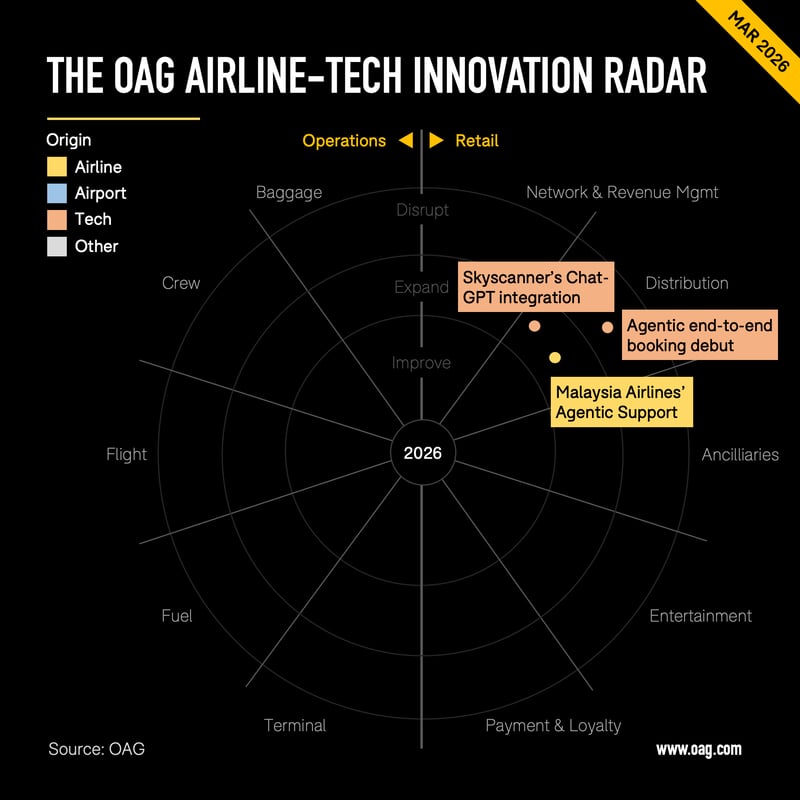
Some months, the innovation signal is scattered. This is not one of those months. Welcome to the March 2026 edition of the OAG Airline Tech Innovation Radar, where the conversation in travel tech is dominated by a single word: agentic.
In the past few weeks, three announcements landed that, taken together, suggest agentic AI in travel has crossed a threshold. Agentic is no longer a concept deck at travel-tech conferences. Actual infrastructure, actual deployments, and actual partnerships are coming together, connecting real travellers, real inventory, and real payments.
This matters in the context of where we left things in our January radar, where we reviewed 2025 and concluded that distribution remains the category where the most consequential travel-tech innovation is happening. The three innovations we highlight this month reinforce that conclusion and sharpen it.
Key summary:
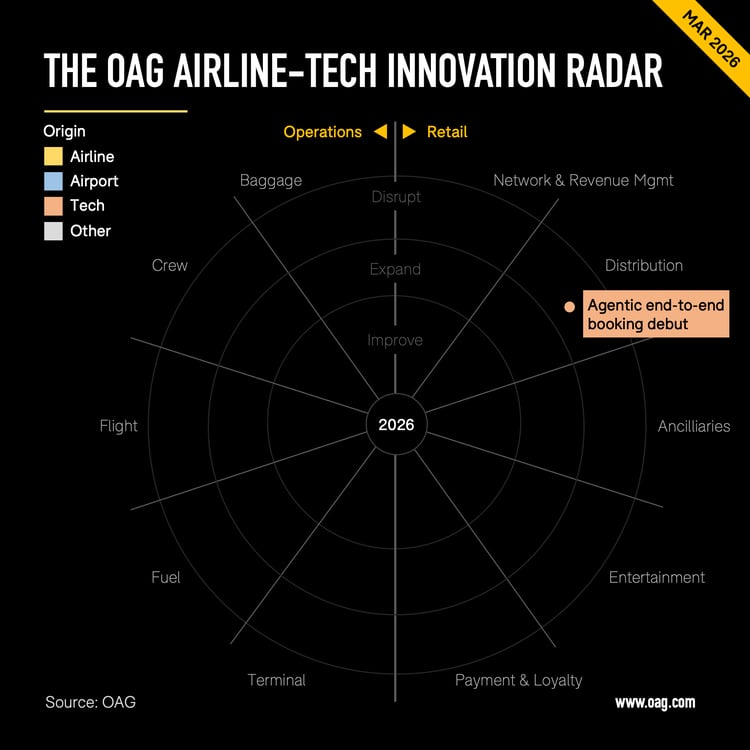
- Sabre, PayPal, and MindTrip are building the travel industry’s first end-to-end agentic AI booking pipeline, combining conversational AI trip planning, real-time travel inventory (420+ airlines, 2M hotels), and integrated payment into a single chat-based experience—potentially redefining how travel is discovered, booked, and paid for when it launches in Q2 2026.
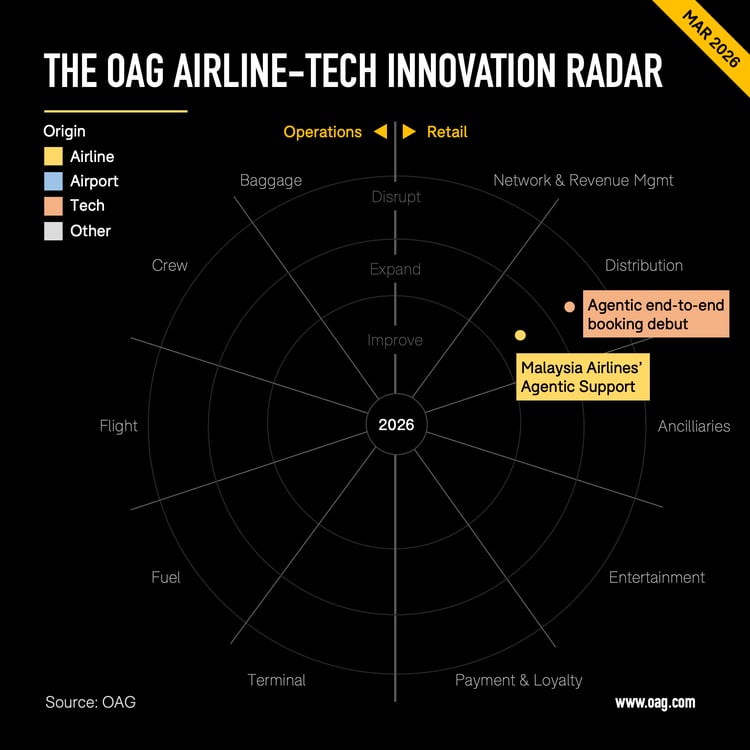
- Malaysia Airlines launched “Mavis,” an agentic AI customer service agent, built on Ada’s ACX platform, that autonomously handles travel queries and booking tasks across web, app, and email—marking a shift from basic chatbots to AI agents that can act on real airline systems.
- Skyscanner launched a ChatGPT app that lets users search for flights through natural language within ChatGPT, signalling a shift from traditional form-based metasearch to conversational travel discovery.
Innovation #1: Sabre, PayPal, and MindTrip build the first end-to-end agentic booking pipeline
There has been so much talk about agentic AI in travel the past few weeks and months, but as Filip Filipov (CEO at OAG), rightfully concluded in his Signals & Systems Newsletter at the end of last year:
Our industry is excited about AI, but we still lack a strong vision for what the consumer travel experience should become. We've got demos, experiments, and prototypes. What we don't have is a North Star, a compelling argument for how, in this cycle, the customer experience will evolve. And this matters because without a vision for the front end, we can't build the right back end and infrastructure.
The core challenge thus far is this: no single player in the travel stack owns the full chain.
- You need content (flights, hotels)
- You need intelligence (conversational AI that understands traveller intent)
- And you need commerce (a way to actually pay).
Until now, these pieces have existed in separate silos. On February 12, Sabre, PayPal, and MindTrip announced a partnership that potentially connects all three into what they describe as the travel industry's first end-to-end agentic AI booking system, with a planned launch in Q2 2026. It might be the agentic North Star our industry has been waiting for.
Here's how it's supposed to work:
- A traveller describes their trip in natural language through MindTrip's conversational AI interface.
- MindTrip queries Sabre's Mosaic APIs, which provide access to more than 420 airlines and two million hotel properties worldwide.
- The AI presents curated, personalised options based on traveller preferences, context, and availability.
- PayPal's agentic commerce infrastructure handles payment within the conversational flow, completing the entire search-book-pay loop without the traveller ever leaving the conversation.
Why does this innovation stand out?
Two things make this partnership so significant.
First, it aims to solve the integration problem. The travel industry has seen plenty of AI chatbots that can talk about travel, and plenty of booking engines that can process transactions. But connecting real-time GDS inventory, conversational AI, and payment into a single, seamless pipeline is new. Importantly, this is not a demo or a prototype. Sabre is putting its full Mosaic content library behind this, and PayPal is deploying its agentic commerce stack (a system designed specifically for AI-to-system transactions).
Second, this partnership signals a structural shift in who controls the booking funnel. Traditionally, that has been the domain of OTAs, airline direct channels, and metasearch. If a conversational AI agent can handle discovery, comparison, and purchase in a single interaction, the role of traditional booking interfaces changes fundamentally. The real question is whether consumers will trust an AI to select, book, and pay on their behalf (which they currently don’t). If they do, this type of integrated pipeline could become the default architecture for agentic travel commerce.
Sabre's involvement is worth noting. We featured Sabre in our November 2025 edition for its AI-enhanced continuous pricing engine, which optimises the back end. The PayPal-MindTrip collaboration is about reimagining the front end. Together, they paint a picture of a GDS provider positioning itself as core infrastructure for the AI era.
Innovation #2: Malaysia Airlines launches Mavis, an agentic AI customer service agent
While the Sabre-PayPal-MindTrip partnership focuses on the booking side of the traveller journey, Malaysia Airlines is applying agentic AI to a different challenge: customer service. On February 24, the airline launched Mavis, an AI-powered customer service agent built on Ada's Agentic Customer Experience (ACX) platform. Mavis is now live across the airline's web, mobile app, and email channels.
Here's how it works:
- Mavis handles a wide range of traveller queries: flight status, booking management, check-in assistance, gate information, and loyalty program questions.
- The system provides 24/7 support in English and Malay, with additional languages planned.
- Complex issues are escalated to live agents. Future enhancements include voice, agent-assist tools, and an itinerary builder.
Why does this innovation stand out?
The keyword in Ada's positioning is, wait for it, agentic, because Mavis is not a traditional chatbot (like almost any airline has introduced over the past two years) that quotes the carrier's FAQ page. Mavis is designed to actually resolve issues autonomously (the definition of agentic) by integrating directly with Malaysia Airlines' operational systems.
It's supposed to check a real booking, provide a real gate number, and assist with real check-in processes.
In theory, this marks the long-awaited shift from chatbots that deflect to AI agents that act.
What makes Mavis particularly noteworthy is its geographic context.
- Much of the airline AI innovation we have tracked on this Airline-Tech radar has come from US and European carriers.
- Malaysia Airlines, as a major Southeast Asian flag carrier, adopting an agentic AI platform signals that this technology is going global.
- Bryan Foong, CEO of Airline Business at Malaysia Aviation Group, described the launch as central to the airline's broader digital transformation strategy.
The trajectory here matters. We featured Delta's AI Concierge in February 2025 and Qatar Airways' Sama AI enhancement in March 2025. Mavis represents the next wave: carrier-owned AI agents powered by specialised third-party platforms, deployed as core customer service infrastructure.
Innovation #3: Skyscanner launches a dedicated ChatGPT app for flight search
If Innovation #1 shows how the infrastructure for agentic booking is being built, and Innovation #2 shows how airlines are starting to deploy agentic AI for customer service, Innovation #3 signals how an established metasearch player is adapting to the new AI era, and it connects directly to one of our 10 Bets for AI in Travel: that scale will remain the decisive advantage, and that AI will favour incumbents over start-ups.
Skyscanner is not a scrappy challenger anymore, trying to break into the market. It is a travel-tech incumbent with over 160 million monthly users, deep inventory relationships, and years of behavioural data, so exactly the kind of player structurally positioned to win in the AI super-cycle, because the prerequisites for high-impact AI are already sitting inside the business.
On February 27, Skyscanner launched a dedicated ChatGPT app that enables users to search for flights directly within OpenAI's conversational interface, initially in the UK and US markets.
Here's how it works:
- Users ask ChatGPT natural language questions like "find the cheapest flight to New York in December" or "weekend getaways from London under £200."
- ChatGPT routes the query to Skyscanner's app, which draws on data from the platform's 160 million monthly users.
- Results are presented within the conversational interface, and no separate tab or redirect is required.
Why does this innovation stand out?
Skyscanner's Chief AI Officer Piero Sierra described this as the company evolving "beyond form-fills toward dynamic, answer-led experiences."
That framing is bigger than it sounds.
For two decades, metasearch has operated on a simple model: structured form, structured results, click-through to OTA or airline. The ChatGPT app replaces that with conversation. The traveller describes what they want, and the AI returns options. No departure date pickers, no airport code lookups, no multi-tab comparison. It fundamentally breaks the old playbook.
What makes Skyscanner's approach strategically interesting is its platform diversity.
- This is not a one-off ChatGPT integration.
- Skyscanner was a launch partner for OpenAI's Operator agent in January 2025, integrated with Microsoft Copilot Actions, and now has a dedicated ChatGPT app.
- The company is systematically embedding itself across different AI platforms, deliberately avoiding dependence on any single AI ecosystem, so that wherever a consumer asks about flights, Skyscanner's data is the answer.
In our September 2025 edition, we featured Wingie Enuygun's MCP server as an early example of metasearch adapting to AI protocols. Skyscanner's multi-platform approach takes this further: not just supporting one protocol, but achieving presence across the entire AI assistant ecosystem.
The competitive implications are significant. In a world where AI agents mediate flight search, the companies that supply data to those agents gain distribution power.
That closes our March edition. The agentic travel stack is assembling fast, and we will be watching closely.
Join us in April, when we track how these early deployments mature and which new players enter the race.