Welcome to the first regular edition of the OAG Airline-Tech Innovation Radar in 2026, where each month we spotlight three real-world airline-tech innovations that genuinely move the needle.
As we enter a new year of separating real innovation signal from noise (think press releases, future-gazing keynotes, and hypothetical NDC scenarios), one thing appears very clear: AI continues to be the dominant force behind most airline innovation.
But there’s a structural constraint. Especially in airline retail, AI can only create meaningful impact if the underlying commercial stack is ready, meaning modernised offer and order management systems, scalable NDC/API distribution layers, and better-connected data. Without that architecture in place, even the most advanced AI models cannot move beyond surface-level enhancements.
This is precisely what our 2025 Innovation Radar review revealed. When we stepped back and analysed the 35 most relevant innovations of last year, one domain clearly stood out: distribution. Nearly half of those innovations (14 out of 35) focused on how flights are searched, priced, offered, and booked (spanning conversational discovery, continuous pricing, NDC deployments, and early-stage order transformation).
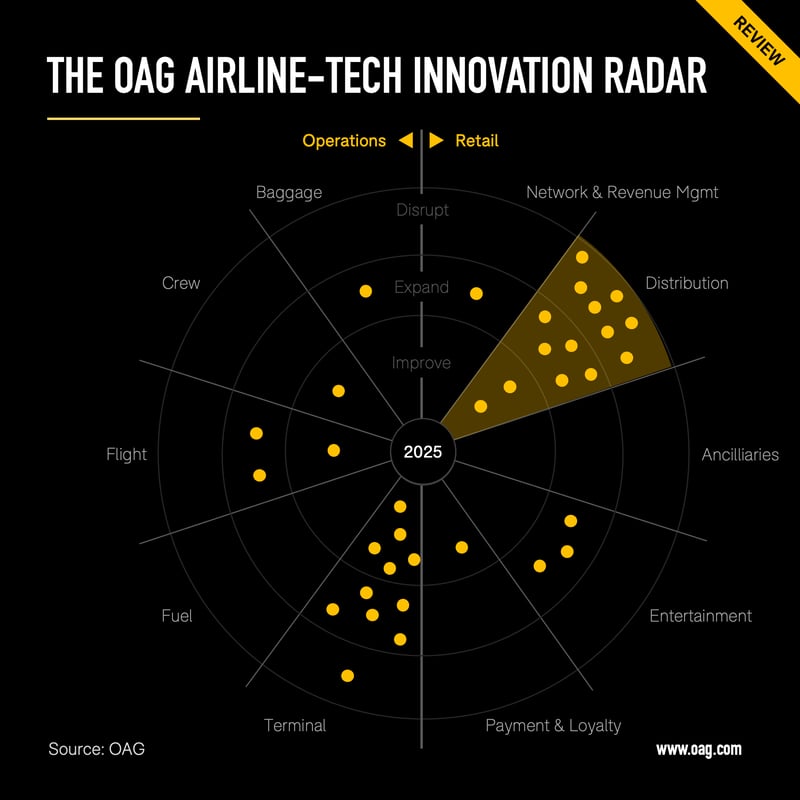
Across most of these distribution initiatives, one underlying motivation became visible: Simplification. But what does simplification actually mean in practice? Read on to Innovation #1 for a compelling example.
Key summary:
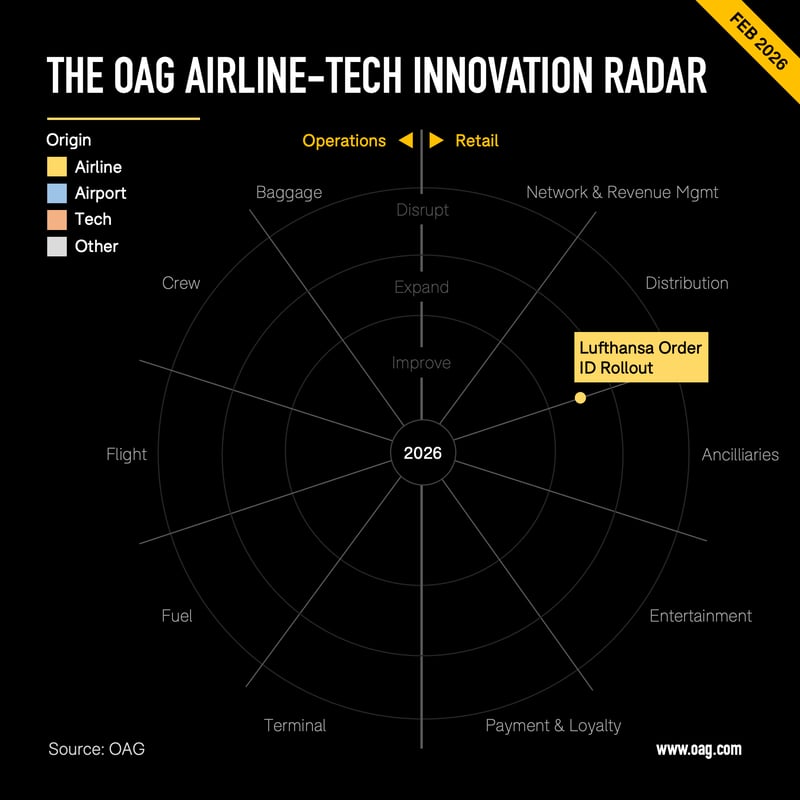
- Lufthansa and Amadeus introduce a single “Order ID” that unifies bookings and ancillaries into one record, simplifying operations, supporting ONE Order standards, and enabling more efficient, AI-ready retailing infrastructure.
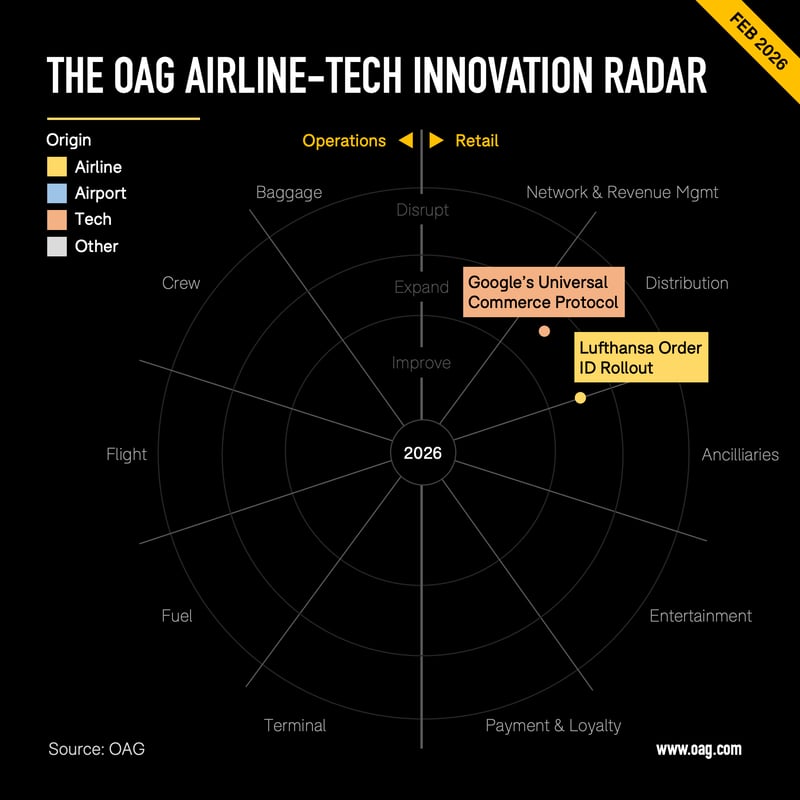
- Google launches the Universal Commerce Protocol (UCP), a standardised framework enabling AI agents to handle discovery, checkout, and payments across platforms - positioning Google to power agentic travel bookings while reshaping control over customer experience and commerce infrastructure.
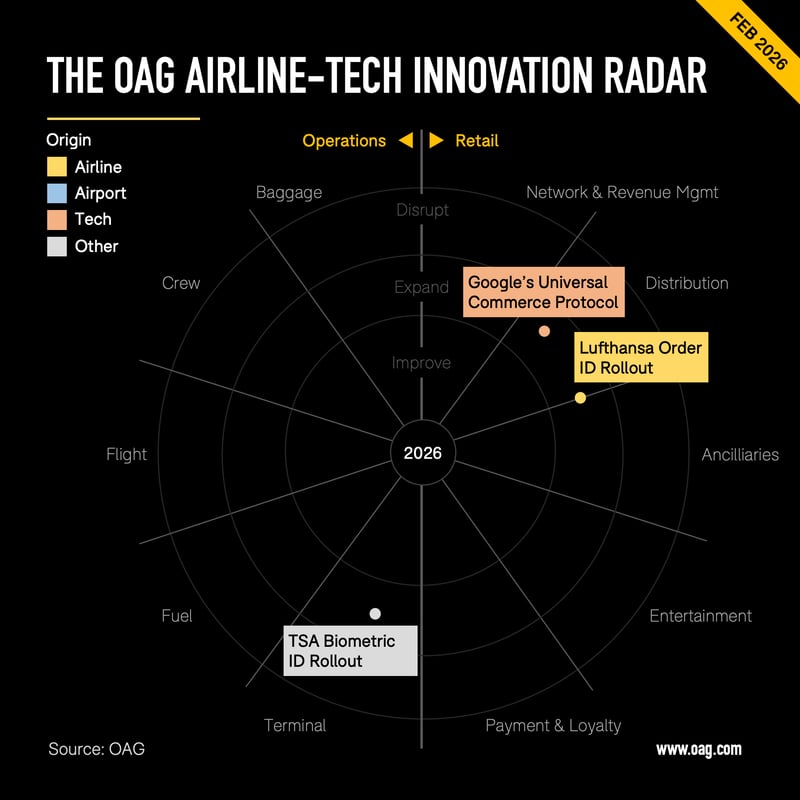
- TSA expands PreCheck Touchless ID to 65 U.S. airports, allowing eligible passengers to use facial recognition instead of physical ID at security - marking the largest U.S. biometric rollout to date and significantly reducing friction at airport checkpoints.
Innovation #1: Lufthansa Group and Amadeus introduce the Order ID
If “simplification” was the hidden driver behind many 2025 distribution innovations, Lufthansa Group’s latest move proves that point.
Behind every airline booking sits a (surprisingly) complex technical structure. Traditional airline reservation systems were built decades ago around Passenger Name Records (PNRs), e-ticket numbers, and separate Electronic Miscellaneous Documents (EMDs) for ancillary items such as seats and baggage. For most passengers, this complexity is invisible until something goes wrong.
The fragmentation becomes visible once something changes (think disruptions, rebookings, or when ancillaries are added after the initial purchase). In those cases, the trip results in multiple references, separate records, and different system layers. What looks like a single “trip” to the passenger is often stored as several loosely connected components behind the scenes.
In early January, Lufthansa Group and Amadeus announced a partnership aimed directly at solving this structural problem: the introduction of a unified Order ID.
Here’s how it works:
- A single Order ID replaces fragmented PNRs and e-ticket numbers, serving as the master reference for the entire trip.
- All components (flights, seat selections, baggage allowances, ancillaries) are stored in a single unified order record.
- The system runs on Amadeus’ Nevio platform and is aligned with IATA’s ONE Order standard.
- The rollout will gradually extend across all nine Lufthansa Group carriers: Lufthansa, Austrian, Brussels, Swiss, Edelweiss, Discover, Eurowings, Air Dolomiti, and Lufthansa CityLine.
Why does this innovation stand out?
Two things make this partnership significant.
First, scale. The industry has been discussing Modern Airline Retailing and ONE Order for years. Lufthansa Group is one of the first large airline groups to implement order-based retailing in production, at scale, across multiple carriers and millions of annual passengers (and with a major GDS partner fully embedded).
Second (and here we return to our original theme): structural simplification. While passengers may not immediately notice the change, airline operations will. A unified order structure dramatically simplifies rebooking, refund processing, and ancillary management, especially during disruptions when speed and clarity matter most. Agents gain a single, consolidated view of the trip instead of toggling between ticket, PNR, and EMD layers.
And strategically, this shift becomes even more important in the context of AI.
- As AI agents increasingly assist with booking modifications and dynamic retailing, fragmented legacy architectures become a bottleneck.
- A clean, order-based structure provides the machine-readable clarity required for automated workflows and agentic booking models.
The key learning: Lufthansa’s Order ID isn’t a flashy front-end feature. It’s a foundational move that aligns perfectly with the simplification thesis and a clear example of how meaningful airline-tech innovation often begins beneath the surface.
Innovation #2: Google unveils Universal Commerce Protocol for agentic AI
If Innovation #1 was about structural simplification inside airline systems, Innovation #2 extends that same simplification logic to the broader commerce layer.
Google has been a frequent feature on our radar, from the “Cheapest” tab in November 2024 to AI Mode travel features in June 2025 and September 2025. In January, the company made its most significant infrastructure move yet: announcing the Universal Commerce Protocol (UCP) at the National Retail Federation conference.
If the Order ID is about unifying airline backend systems, UCP is about unifying how AI agents interact with commerce platforms across the entire economy. The protocol establishes a common language for AI agents to handle product discovery, checkout, and post-purchase processes within conversational interfaces.
Here’s how it works:
- UCP creates a standardised protocol allowing AI agents to operate across consumer surfaces, businesses, and payment providers without requiring individual integrations.
- The protocol supports checkout features in Google Search AI Mode and the Gemini app, enabling users to complete purchases without leaving the conversation.
- UCP is designed to interoperate with other emerging standards, including Anthropic's Model Context Protocol (MCP), Agent2Agent, and Google's Agent Payments Protocol.
Google has confirmed that flight and hotel bookings are next in line for agentic capabilities, following the launch of restaurant reservations and event tickets.
Why does this innovation stand out?
The real question is not whether AI agents will book travel (they will, check out our 10 bets for the AI travel future until 2045), but who will control the infrastructure that enables them to do so. Google is positioning UCP as the operating system for agentic commerce, with major retail and payment partners already on board.
For travel, this creates both opportunity and challenge.
- On one hand, airlines with modern retailing infrastructure (such as Lufthansa Group's new Order ID system) will be better positioned to participate in agentic booking flows.
- On the other hand, merchants that participate in UCP may cede control over the user experience, checkout flow, and direct customer relationships to the AI interface layer.
As we noted when covering Wingie's MCP server in September, the race to establish standards for AI commerce is intensifying.
The timing of UCP also reflects where consumer behaviour is heading. While Skift research shows that travellers are not yet comfortable with fully autonomous AI bookings (only 2% of travellers currently allow AI to book on their behalf), the infrastructure is being built now for when that comfort level increases. Google, OpenAI, and Anthropic are all staking claims in this space, and the winners will shape how the next generation of books travels.
Innovation #3: TSA expands PreCheck Touchless ID to 65 airports
If the first two innovations focused on simplifying distribution and commerce infrastructure, Innovation #3 brings that same simplification logic to the physical side of the travel journey.
It’s about reducing friction, not in the booking flow, but at one of the most stressful points of travel: the security checkpoint.
In mid-January, the Transportation Security Administration (TSA) announced a major expansion of its PreCheck Touchless ID program, bringing biometric facial recognition to 50 additional airports during the first quarter of 2026.
The program enables eligible passengers to move through security checkpoints using facial recognition as their sole form of identification, eliminating the need to present physical documents. With this expansion, a total of 65 U.S. airports will offer the capability.
Here's how it works:
- Passengers enrolled in TSA PreCheck with an active airline profile and a valid passport can opt into biometric verification.
- The system photographs travellers' faces and cross-references images with government-issued photo records in under 10 seconds.
- Participating airlines include Alaska, American, Delta, Southwest, and United at select airports.
- Images are not used for law enforcement or surveillance and are deleted within 24 hours of the scheduled flight departure.
- Priority airports for expansion include Houston Bush Intercontinental, Washington Dulles, Boston, Miami, and Orlando, many of which are FIFA World Cup 2026 host cities.
Why does this innovation stand out?
This represents the largest single expansion of biometric airport technology in U.S. history. Adding 50 airports in a single quarter demonstrates aggressive deployment momentum, driven in part by preparation for the 2026 FIFA World Cup. With millions of international visitors expected for the tournament, airports in host cities must efficiently process unprecedented volumes without overstressing existing systems.
The expansion also reflects the maturation of the technology and operating model.
- TSA has addressed privacy concerns with 24-hour image deletion policies, opt-in enrollment, and transparency about data handling.
- Studies show the system maintains consistent performance across demographic groups, though civil rights organisations continue to monitor accuracy and potential bias.
We have tracked similar biometric developments internationally, from Zurich Airport's AI security scanners in July 2024 to Apple's TSA-approved digital passports in July 2025. The difference now is not the technology itself, but its normalisation. What began as isolated trials is rapidly becoming standardised airport infrastructure.
For travellers, the benefit will be very tangible: no fumbling for documents, faster lane processing, and one less friction point in the airport journey.
Building the next era of air travel
What does this early 2026 Radar indicate?
It shows that the year is kicking off with structural upgrades designed to simplify and standardise the foundations of air travel.
None of these three innovations is a headline-grabbing gimmick. They are system-level improvements. And history shows that when infrastructure evolves, visible innovation tends to follow.
We will continue tracking how these foundational shifts translate into measurable change for airlines and travellers alike. Stay tuned.