This first-of-the-year Airline-Tech Innovation Radar edition is different than usual. Instead of diving into another set of new innovations, we want to take a step back.
Throughout 2025, the OAG Innovation Radar tracked 35 innovations across airline operations and retail (from small, incremental improvements to genuinely disruptive shifts). Month by month, these developments appeared as individual signals in our Travel-Tech LinkedIn Newsletter series. But when viewed together, they reveal something far more meaningful than any single announcement ever could.
This opening 2026 edition takes a holistic look at everything we covered in 2025, mapping all innovations onto our radar to move from observation to interpretation.
What follows is our attempt to synthesize a full year of airline technology innovation into clear themes, tensions, and takeaways, offering you a sharper, more strategic perspective on where airline innovation is heading next.
Key summary:
- Airport terminals were the biggest innovation focus in 2025 on the operations side, with tech like LiDAR crowd-flow systems and flexible ground-crew models improving passenger experience and reducing congestion.
- Distribution and booking tech became a major AI battleground, with tools from Google, Fliggy and airline AI assistants reshaping how flights are found and purchased.
- Some areas saw little innovation, including ancillaries (e.g., baggage & seat upgrades), fuel and sustainability, and payments and loyalty systems — highlighting untapped opportunities.
- Innovations are increasingly collaborative, with over half involving big tech partners, underlining that airline breakthroughs now often come from ecosystems, not single players.
- Foundational tech (infrastructure) gained prominence, with innovations deeper in the stack enabling future products and improvements.
Reading the radar: where innovation actually concentrated in 2025
At the heart of this review sits the 2025 Airline-Tech Innovation Radar: our key visual mapping all 35 innovations we covered throughout the year.
Each dot represents one real-world innovation launch, positioned by impact horizon (improve, expand, disrupt) and by domain (airline operations vs. airline retail).
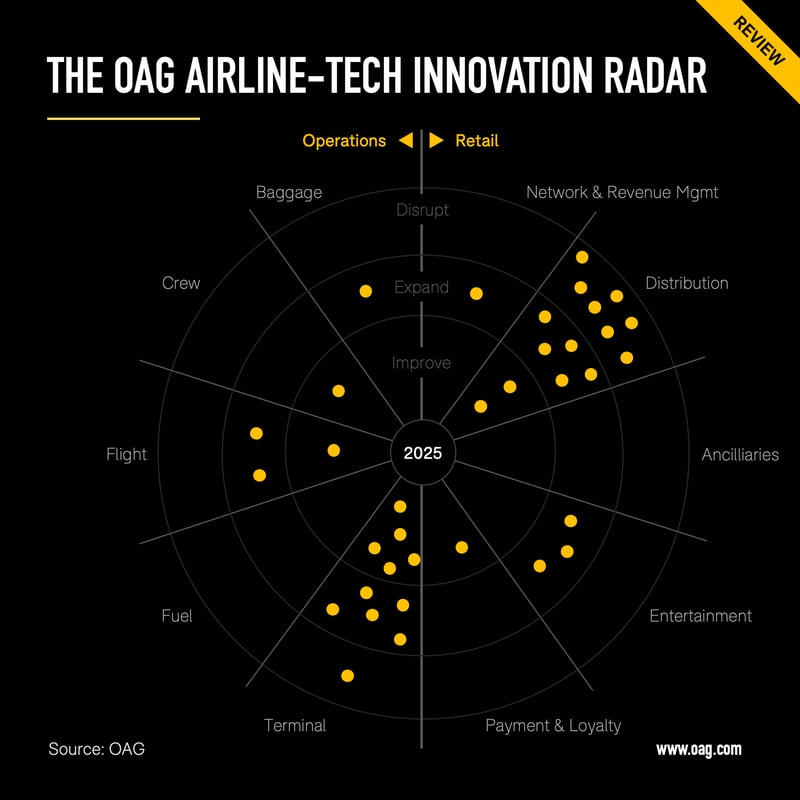
Even at first glance, the picture is revealing.
Two areas clearly stand out as the busiest (and most strategically relevant) zones of innovation in 2025: the airport terminal on the operations side, and distribution on the retail side.
Let’s look at each category separately.
1) The airport terminal emerges as an innovation hotspot
On the operational side, the airport terminal dominates the radar. Over the course of the year, we tracked roughly a dozen terminal-related key innovations, most of which fell under the improve and expand horizons category.
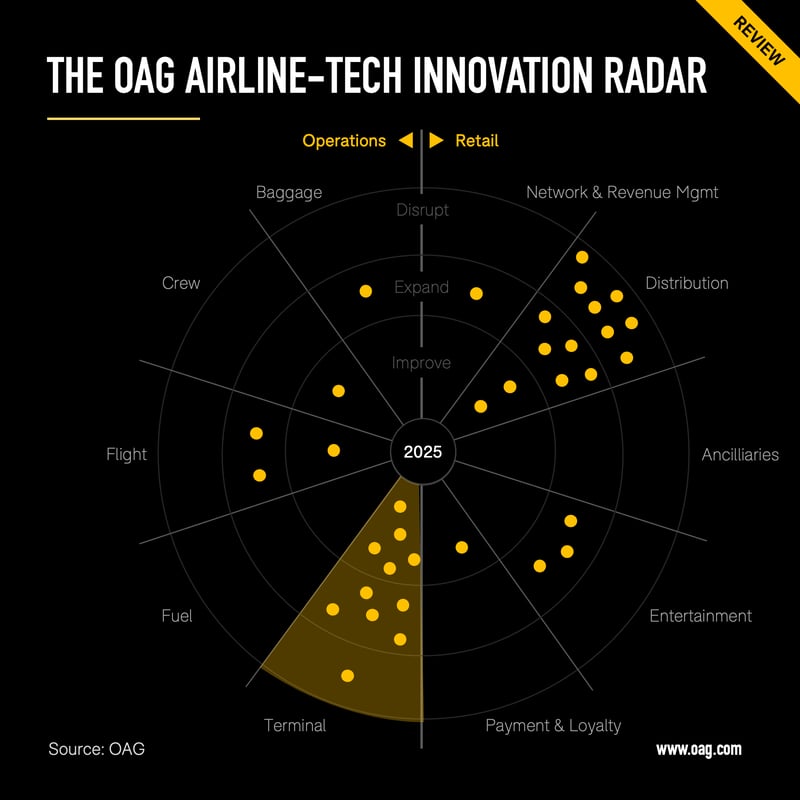
Two particularly representative examples:
- Queenstown Airport’s LiDAR passenger-flow system demonstrates how airports are tackling congestion with privacy-preserving technology rather than intrusive surveillance.
- easyJet’s mobile ground-crew model (in collaboration with SITA), which replaces fixed check-in desks with flexible, human-centric service, fundamentally rethinking how terminal space is used.
These are not flashy moonshots. But they directly address some of aviation’s most persistent pain points: congestion, queues, and inefficient use of terminal space.
One terminal-adjacent innovation even landed firmly in the disrupt zone: SITA’s Connect Fly. As a cloud-native connectivity backbone, it modernizes the digital plumbing of airports and airlines. In doing so, it enables many of the other innovations on the radar to scale in the first place. It’s a reminder that the most disruptive changes are often the least visible.
What makes the terminal cluster particularly exciting is what it represents beyond technology.
For years, the airport terminal has been one of the most stressful, opaque, and frustrating parts of the entire travel journey (crowded, unpredictable, and slightly resistant to meaningful improvement).
The concentration of innovation we saw in 2025 suggests that this is finally changing.
- Airlines, airports, and technology providers are now actively redesigning the physical traveler experience, not just optimizing systems behind the scenes.
- This includes ensuring smoother passenger flow, more flexible human-service models, and an invisible digital infrastructure.
In other words, some of the most tangible progress in aviation innovation is happening exactly where travelers feel it most: on the ground, at the airport, in the moments that often define whether a trip starts smoothly or in frustration.
2) Retail: distribution becomes the primary AI battleground
The second dense cluster appears on the retail side, specifically around distribution: how flights are discovered, searched, priced, and ultimately booked.
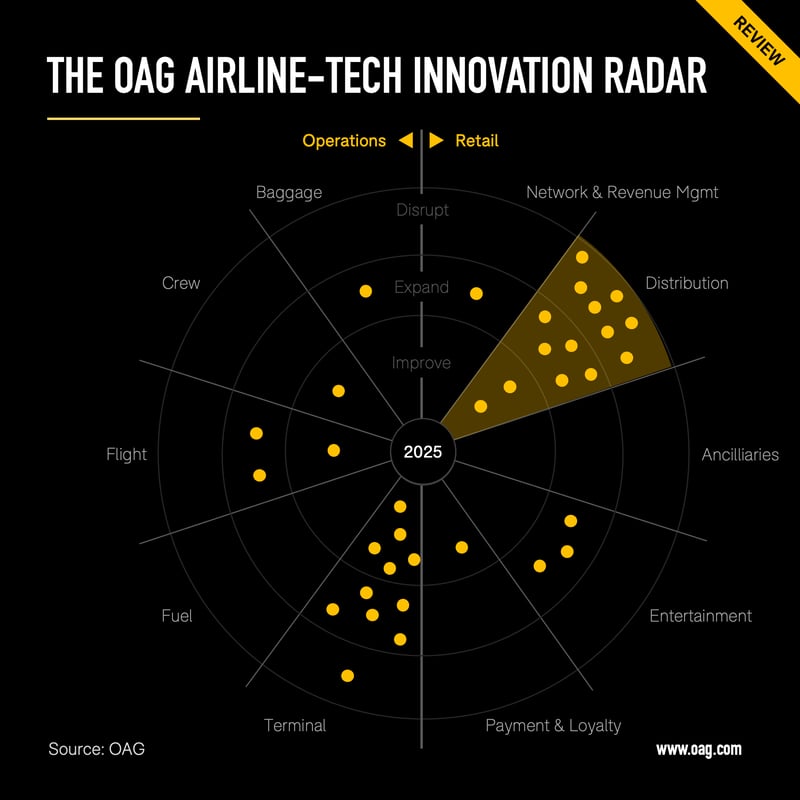
That dominance is no accident. Distribution sits at the intersection of data, intent, and automation, exactly where AI delivers the greatest leverage (thus far).
Three of the most consequential examples from the radar:
- Google’s AI suite for Travel, collapsing search and booking into a single conversational funnel.
- Fliggy’s AskMe, showing how agentic AI can generate fully bookable itineraries end-to-end.
- Iberia’s native AI assistant on ChatGPT, signaling that discovery may soon happen (deliberately) outside airline-owned channels altogether.
All three innovation examples suggest that distribution is becoming an intelligence layer with far-reaching implications for airlines, OTAs, and anyone positioned downstream of the booking decision.
The white spaces on the radar: where innovation has yet to break through
An innovation-bullish view also requires honesty about what didn’t happen.
When we step back and look at all 35 innovations mapped on the 2025 radar, a few areas stand out as remarkably quiet. These white spaces are also important to recognise because many of them touch core levers of airline profitability and long-term resilience.
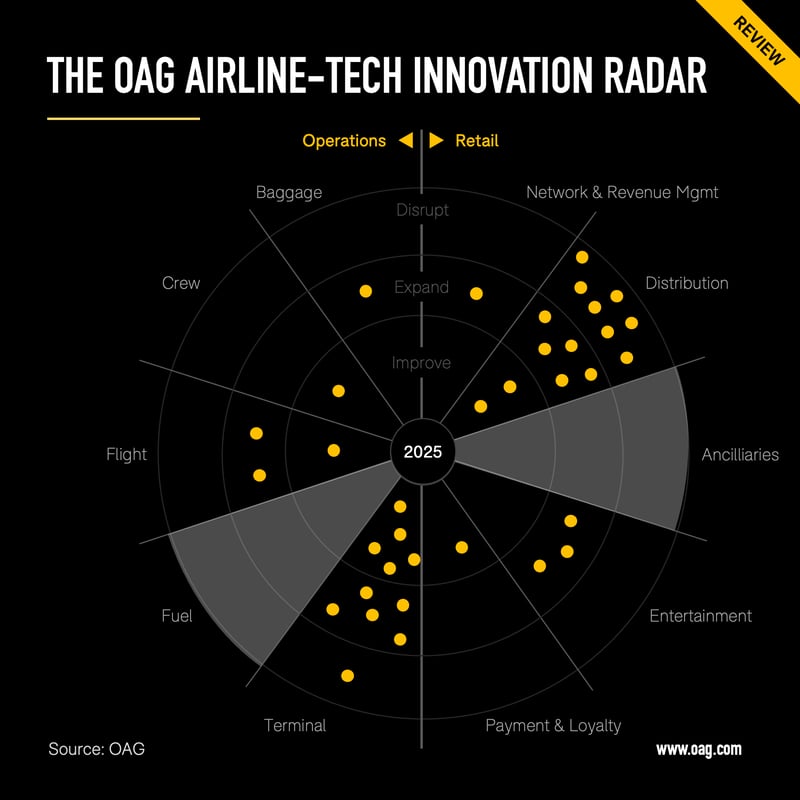
One of the most striking gaps sits in ancillaries. Despite years of discussion about personalization, bundling, and dynamic offers, we saw very little genuine innovation in how airlines actually sell add-ons such as seat upgrades, baggage, meals, or onboard services.
This is surprising. AI should, in theory, be perfectly suited to ancillaries (matching context, traveler intent, price sensitivity, and timing). Yet in practice, most ancillary offerings often remain rules-based. In 2025, AI largely stopped at flight search, not at booking or the overall experience.
The opportunity remains wide open.
Perhaps the most notable silence was around fuel and sustainability.
Compared to previous years, 2025 saw very few meaningful innovations related to SAF, fuel efficiency, or emissions reduction. The sustainability narrative has clearly slowed over the past two years, and the radar reflects that cooling.
Another quiet zone is payments and loyalty (two areas deeply intertwined).
One of the only exceptions in our view was Air India’s AI-powered (voice) booking experience, which deliberately tied seamless, low-friction booking to loyalty membership. That move hinted at a broader idea: convenience itself becoming a loyalty benefit, and payment simplicity acting as a retention lever.
But beyond that, we saw little innovation in:
- New payment flows,
- Alternative payment methods,
- Loyalty redemption experiences,
- Or AI-driven optimization of earn-and-burn mechanics.
Given how central payments and loyalty are to airline economics, this lack of momentum suggests untapped upside rather than saturation.
Finally, crew management and baggage saw only isolated progress.
- On the crew side, Japan Airlines’ AI-powered reporting app stood out as a rare example of AI delivering tangible productivity gains for frontline staff. But it remained an exception rather than the start of a broader movement.
- On baggage, Apple-Delta’s AirTag integration marked an important step forward; yet it also highlighted a deeper issue: meaningful progress occurred only after airlines partnered with a consumer tech solution travelers already used.
Taken together, these white spaces tell a clear story. Innovation in 2025 gravitated toward areas where:
- Data is abundant,
- Experimentation is fast,
- And value creation is immediately visible.
For an innovation-bullish industry, that’s not a critique. It’s a roadmap.
Especially for ancillaries, we expect this to change quickly. As AI moves deeper into the booking infrastructure and airlines gain access to richer customer data, the conditions for smarter, more contextual, and more profitable ancillary offers are finally falling into place. This is one of the areas where we expect to see significantly more innovation attention in 2026.
At OAG, we see shopping data as a particularly powerful enabler in this shift, bridging traveler intent with real-time offer creation in a way the industry has long struggled to achieve. For a more forward-looking perspective on how AI could reshape travel beyond 2026, we also recommend reviewing the “10 AI Bets Until 2045” outlined by Filip Filipov, our CEO.
Stepping back again: what the 35 innovations reveal in aggregate
So far, we’ve looked at where innovation is concentrated and where it isn’t.
Now, let’s return to the 35 innovations we identified as the most meaningful in 2025 and look at them through a different lens: what patterns emerge when we view them together?
Several themes stand out. None of them is entirely new on its own, but taken together, they sharpen our understanding of how airline innovation is actually happening today.
1. Real innovation is increasingly a multi-player game
One of the clearest signals from the 2025 radar is that truly meaningful innovation rarely happens in isolation.
Throughout the year, many of the most impactful launches were not driven solely by airlines or airports, but by cross-industry collaboration, often involving major technology players outside the traditional travel ecosystem.
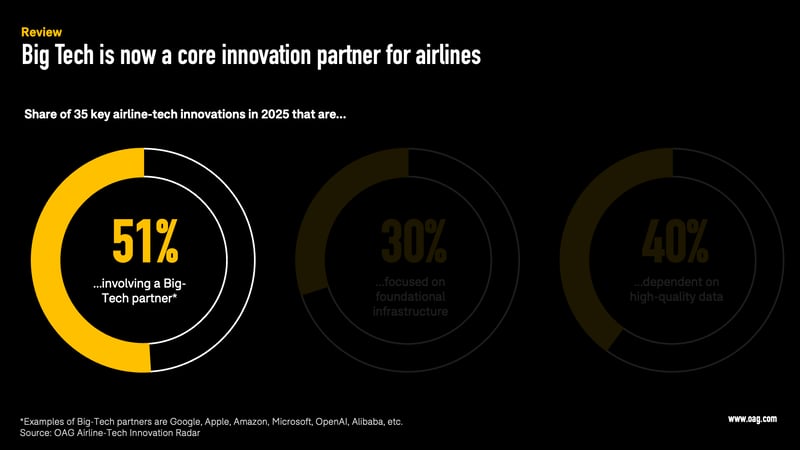
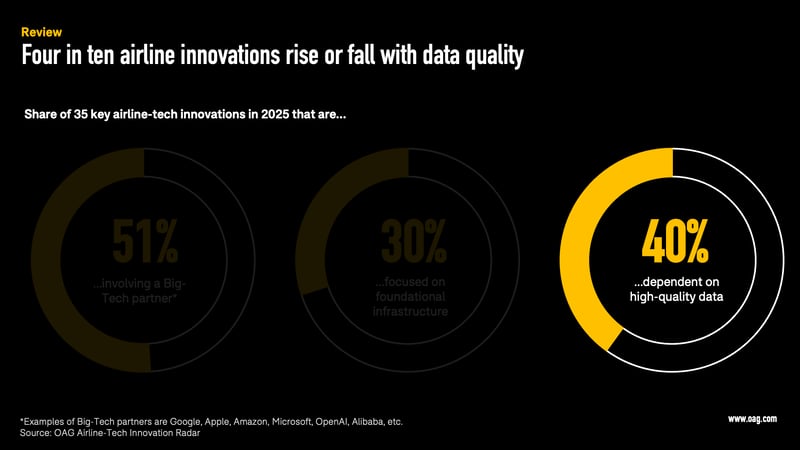
When we quantify this, the pattern becomes hard to ignore: 18 of the 35 innovations (just over 50%) involved at least one major technology provider such as Google, Apple, Amazon, Microsoft, OpenAI, or Alibaba.
These partnerships took many forms:
- Big Tech providing core AI models or cloud infrastructure (Google, OpenAI, Microsoft).
- Consumer platforms embedding themselves directly into the traveler journey (Apple Wallet, ChatGPT).
- Tech giants supplying foundational connectivity or interfaces that airlines build upon (Starlink, Amazon Kuiper).
The takeaway is that the complexity and speed of innovation now exceed what most travel players can deliver on their own. The most meaningful progress increasingly comes from ecosystems, not single actors.
2. Innovation is moving down the tech stack
A second pattern becomes apparent when we examine which type of innovation dominated the year.
Early AI narratives focused heavily on features such as chatbots, assistants, and front-end enhancements. But many of the most consequential innovations we tracked in 2025 sat one layer deeper: in infrastructure.
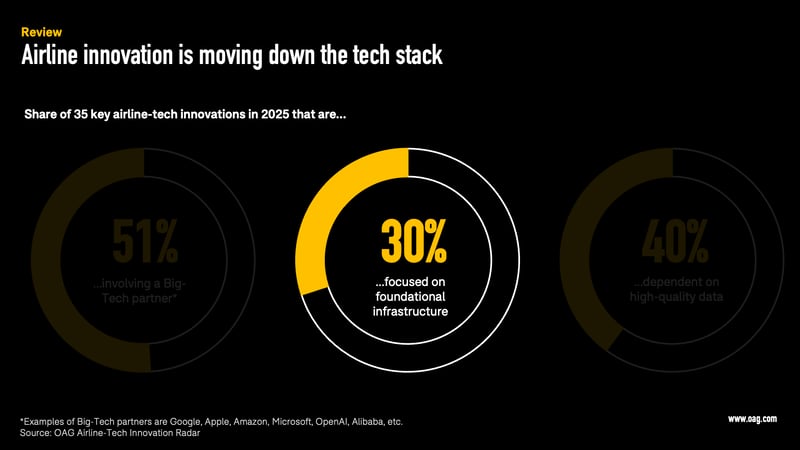
When we step back, roughly one in three innovations (~30%) we covered were not surface-level features, but foundational layers that enable other innovations to exist or scale.
Examples include:
- Apple Wallet boarding pass integrations, which turn the boarding pass into an interactive interface, combine identity, live flight updates, gate directions, and even baggage notifications directly on the passenger’s lock screen.
- Korean Air’s cloud and ChromeOS overhaul, a behind-the-scenes transformation that replaced legacy hardware and software to create a scalable, AI-ready foundation for customer service and future automation.
- British Airways’ digital twin for aircraft towing is an operational intelligence layer that materially improves punctuality, predictability, and network stability at one of the world’s most complex hubs.
This shift matters. Infrastructure innovations are slower, harder, and less visible, but they are the ones that enable entire categories of future products. The radar suggests that 2025 was about laying foundations.
3. The real innovation constraint is data
A third pattern cuts across many meaningful innovations we tracked in 2025, and it’s less about AI models themselves and more about data quality, availability, and connectivity.
As AI increasingly moves from experimentation into core airline workflows (see our use case overview with Microsoft), one thing became clear across the radar: the success of AI-driven innovation is now far more constrained by data than by algorithms.
- In many cases, the models are already good enough.
- What differentiates real progress is whether high-quality, real-time data is available and whether it can be connected across systems.
This is not a marginal effect. Approximately 40% of the innovations we tracked relied explicitly on clean, connected, and real-time data to operate.
Two examples illustrate this particularly well.
- First, Sabre’s AI-powered continuous pricing engine. While the headlines focus on AI, the real enabler is the system’s ability to ingest and react to live shopping and booking signals. Continuous pricing only works when demand signals, competitor context, and booking intent are clean, timely, and connected. Without that data foundation, AI-driven pricing reverts to rules-based logic. The innovation here is as much about data readiness as it is about intelligence.
- Second, Google’s AI Mode for Travel. The strength of Google’s approach doesn’t come from conversational ability alone; it comes from its ability to connect intent with deep, structured, and real-time data across search behavior, maps, pricing, inventory, and historical context. This is why the experience feels fundamentally different from most standalone AI travel tools. The interface is powered by data coherence (not just language fluency).
What these examples highlight is a broader shift: AI is only as good as the data it can reliably act upon. As outlined in our research on the future of AI in aviation, the industry is entering a phase in which data quality will determine who can scale innovation and who cannot.
Seen through this lens, many of the white spaces on the radar start to make sense. Areas such as ancillaries, loyalty, and payments remain underdeveloped because underlying data layers remain fragmented, inconsistent, or poorly integrated.
What 2025 made clear, and what comes next
What do we learn from all of this?
2025 revealed a critical insight: the next wave of airline innovation will be won by those who first fix their data foundations and build intelligence on top of them (not around them).
This insight will shape our approach to the 2026 edition of the OAG Airline-Tech Innovation Radar.
Going forward, we will place even greater emphasis on the data layers behind new innovation launches. In other words, we’ll continue to track not only what is being built in airline tech, but what it is built on.
Stay tuned.