If there’s one theme that keeps resurfacing in our Airline-Tech Innovation Radar, it’s the accelerating pace at which Big Tech is moving into the travel space. We’ve covered this shift before, but this month offers some of the clearest proof yet that the world’s largest technology companies are no longer sitting on the travel sidelines.
Across the past few weeks, we saw four major moves from Google and Apple alone, each one pushing deeper into core parts of the traveler journey. What’s especially interesting is that these innovations don’t just benefit passengers. They also open meaningful opportunities for airlines, airports, and travel operators to serve their customers in smarter, more efficient, and more personalized ways.
AI plays a central role in several of these developments, but the story is bigger than AI itself. It’s about global platforms reshaping how travel is searched for, planned, booked, and, most importantly, experienced.
Before teasing anything further, let’s explore each of this month’s standout innovations one by one.
Key summary:
- Qatar Airways partnered with Google to produce, edit, and upload a fully finished commercial during a flight, showing the potential for in-flight connectivity in the very near future.
- Google has expanded its AI-powered Flight Deals tool globally, now covering 200+ countries and territories and supporting 60+ languages.
- Apple announced two updates in recent weeks that could meaningfully improve how people move through airports:
- A new API that feeds AirTag location data directly into Delta’s baggage tracking tools.
- A new feature allowing users to store passport information in Apple Wallet for domestic U.S. flights.
Innovation #1: Qatar Airways Turns the Aircraft Cabin Into a High-Speed Creative Studio
At first glance, Qatar Airways’ latest announcement with Google looks like a flashy PR stunt: the “first-ever AI-generated commercials created during a flight.”
But underneath the headline lies something far more consequential for the future of travel: a glimpse of what happens when an aircraft cabin becomes a fully functional, high-bandwidth workspace at 35,000 feet.
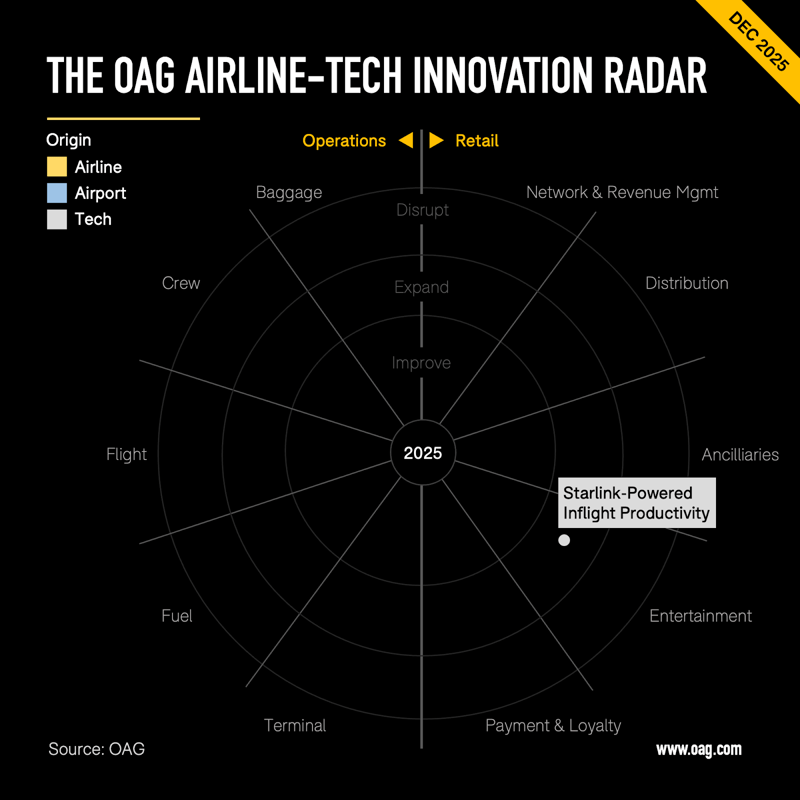
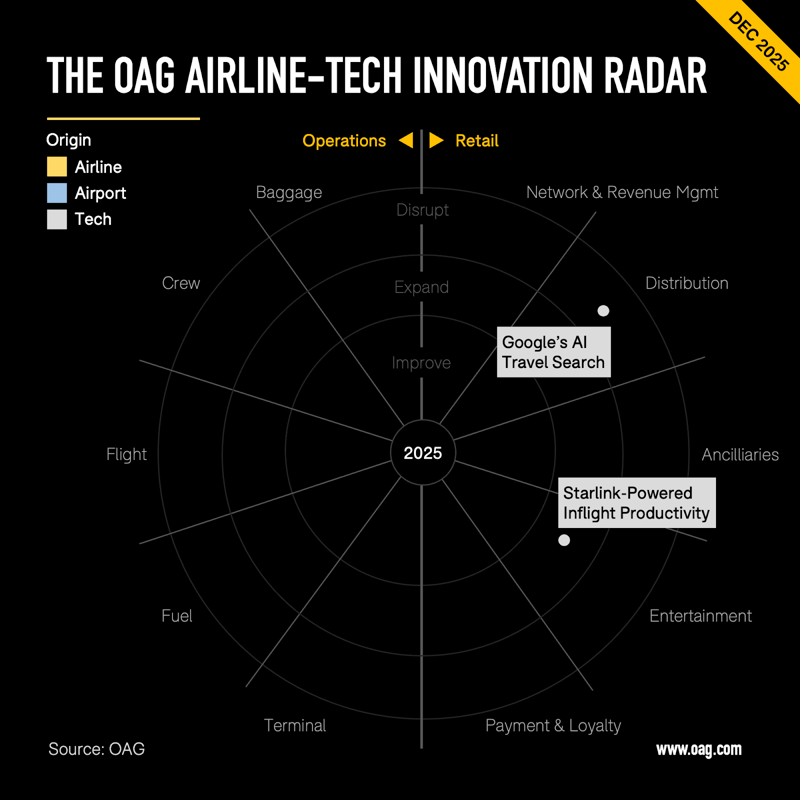
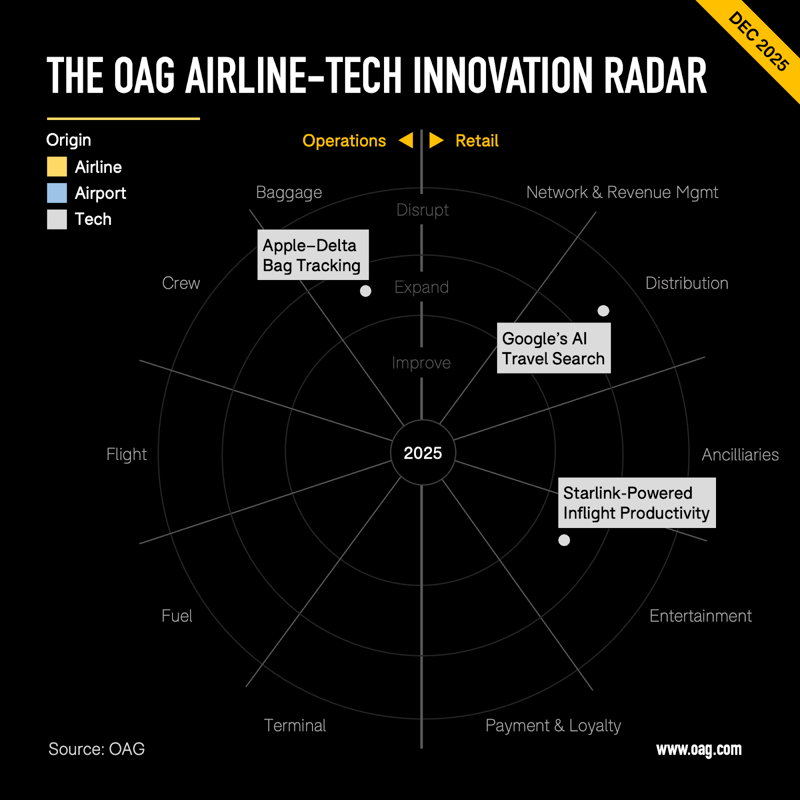
The airline partnered with Google to test whether Gemini’s AI video-generation capabilities could run end-to-end during an actual flight using Starlink’s high-speed satellite connectivity. The answer was a resounding yes.
How did it work?
Starlink’s ultra-low-latency, gate-to-gate connectivity enabled a full creative workflow that was previously impossible in the air:
- High-resolution video and image generation using Google’s Gemini AI models.
- Cloud-based editing, rendering, and file transfer (all mid-flight).
- Real-time publishing and collaboration while cruising at 35,000 feet.
Two well-known AI filmmakers produced, edited, and uploaded fully finished commercial videos before the aircraft even landed.
But to be clear, this isn’t an innovation story about AI filmmaking. It’s a story about bandwidth.
Qatar’s in-flight connectivity now rivals home internet!
Qatar Airways is quietly becoming the global leader in next-generation in-flight connectivity. The airline now operates over 100 Starlink-equipped widebody aircraft, representing more than half its entire fleet (likely the largest Starlink deployment of any airline today).
While many passengers still struggle to send a simple email on many global airlines, Qatar proved that you can produce commercials in the sky.

Why does this matter for the future of travel?
This experiment is a preview of what in-flight connectivity will unlock; not in 2035, but in the very near future.
- First, aircraft cabins become fully productive workspaces. If AI video generation, rendering, cloud editing, and high-volume file transfers can run mid-flight, then everyday business use cases (from virtual meetings to coding to collaborative workflows) become trivial. The line between “on the ground” and “in the air” will blur completely.
- Secondly, new personalization and retailing opportunities for airlines emerge. If this level of bandwidth becomes mainstream, airlines could generate personalized in-flight ads, offers, ancillaries, and content in real time, tailored to the traveler’s profile, destination, and behavior. Instead of static ad loops, airlines could dynamically generate seat-upgrade prompts, destination-specific retail offers, real-time duty-free suggestions, and content aligned to passenger interest signals.
In other words: AI-powered in-flight connectivity could become a revenue engine, not just a passenger amenity.
Innovation #2: Google Expands Its AI Travel Tools to the Entire World
For our second innovation, we’re staying with Google, because the company’s latest travel updates are simply impossible to ignore.
Last month, Google expanded its AI-powered Flight Deals tool globally, now covering 200+ countries and territories and supporting 60+ languages.
- Travelers can describe what they want (“a warm week-long trip in February, good food, nonstop only”), and Google’s AI surfaces the best matching bargains instantly.
- At the same time, Google introduced Canvas in AI Mode, a new all-in-one planning interface that pulls together real-time flights, hotels, Google Maps data, reviews, and web content into a single, coherent trip plan.
- AI Mode has also gained agentic booking capabilities, enabling it to already reserve restaurants, events, and appointments, with flight and hotel bookings coming next.
Why does this matter so much?
For the past three years, countless startups and AI tools have promised conversational travel planning, but none have had the scale, distribution, or data to make it stick. Google does. The global rollout of Flight Deals democratizes AI travel search in a way no other player can match (at this point).
Canvas’ ability to merge flights, hotels, maps, reviews, and web results into one plan could replace the multi-tab, multi-site research that travelers do today. And once direct booking becomes available, Google will be sitting directly in the OTA value chain.
For a long time, the industry narrative was that Google wouldn’t seriously threaten OTAs because the market simply wasn’t lucrative enough for them.
That fear is now resurfacing. With search dominance, integrated tools, and billions of users, this is a bold move into the heart of travel tech.
Innovation #3: Apple Deepens Its Travel Push With Smarter Bags and Digital Passports
For our final innovation, we’re switching to another tech giant doubling down on travel. This time, not in the booking flow, but in the on-the-go part of the journey where most traveler frustration actually occurs.
Apple quietly announced two updates in recent weeks that could meaningfully improve how people move through airports.
1. Apple x Delta: AirTag data enters airline baggage systems
Apple and Delta co-developed a new API that feeds AirTag location data directly into Delta’s baggage tracking tools. Built on Apple’s Share Item Location feature, the integration removes manual steps required by ground workers when locating lost bags. The tech was finalized only weeks ago, and although built with Delta, the API is not exclusive, meaning it can scale across other airlines in the future (as long as travelers use Apple devices).
Why does this innovation matter so much?
Airlines have struggled for decades to build reliable bag-tracking solutions. Travelers, frustrated, solved the problem themselves, and AirTags quickly became the de facto global standard.
In many cases, passengers knew their bag’s location long before the airline did.
Delta deserves credit for accepting this reality and integrating the tool travelers already trust. And Apple deserves credit for putting engineering resources behind something as unglamorous (but vital) as baggage operations.
2. Digital passports enter Apple Wallet (U.S. domestic flights first)
Apple also announced a new feature allowing users to store passport information in Apple Wallet for domestic U.S. flights. The feature digitizes ID documents and makes them accessible through the iPhone’s wallet app, laying the groundwork for deeper travel identity integration.
What makes this innovation so important?
Digital passports are a key building block for the coming shift toward paperless travel and biometric verification.
- By placing travel documents in a widely used consumer interface, Apple reduces friction in the airport experience and positions itself as the user-facing layer for digital identity.
- As airports invest heavily in biometrics and automated border systems, Apple Wallet could become the bridge between travelers and those airport infrastructures, and eventually expand into international travel as standards evolve.

If Google is transforming how we plan and book, and Apple is steadily reshaping how we move through airports, then together they signal a fundamental shift in the traveler journey.
The future of travel won’t be defined by airlines or airports alone. It will be shaped by the tech ecosystems that increasingly power every step in between.