Which are the busiest airports in Asia Pacific? Capacity data for the entire year of 2025 reveals that the region’s aviation market is shaped by a compelling mix of mega-hubs across East Asia, South Asia, and Southeast Asia. In terms of total scheduled seats, Japan’s flagship gateway holds the crown.
Top 10 busiest airports in Asia Pacific in 2025:
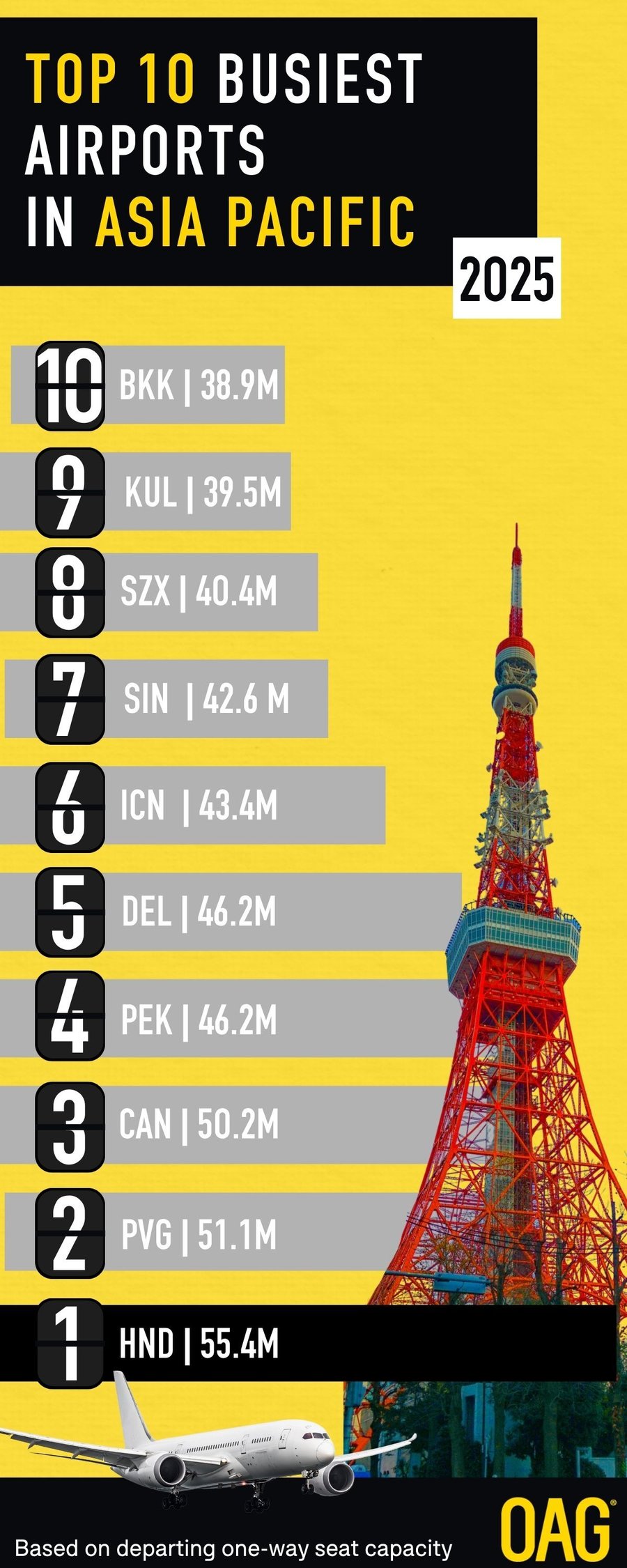
1st: Tokyo Intl (Haneda)(HND) | 55,357,501 seats
2nd: Shanghai Pudong International Apt (PVG) | 51,073,166 seats
3rd: Baiyun Intl (CAN)| 50,177,572 seats
4th: Beijing Capital Intl Apt(PEK) | 46,218,654 seats
5th: Delhi (DEL) | 46,187,658seats
6th: Seoul Incheon International Airport (ICN) | 43,400,991 seats
7th: Singapore Changi Apt(SIN) | 42,570,250 seats
8th: Shenzhen (SZX)| 40,406,220 seats
9th: Kuala Lumpur International Airport (KUL) | 39,497,119 seats
10th: Bangkok Suvarnabhumi International Apt (BKK) | 38,943,700 seats
Tokyo Haneda is the busiest airport in Asia Pacific
In 2025, Tokyo Haneda (HND) was the busiest airport in Asia Pacific with 55.4 million seats. Haneda’s dominance reflects the strength of Japan’s domestic market – one of the world’s largest – as well as the airport’s growing role as an international gateway following its post-pandemic expansion of long-haul routes. The airport sits around 4.3 million seats ahead of the airport in second place.
Shanghai Pudong (PVG) is second placed on the list of Asia Pacific's busiest airports, with 51.1 million seats, consolidating its position as the primary international hub for mainland China. Pudong’s steady rise from 3rd in 2019 to 2nd today underlines the continued recovery and growth of China’s international air services.
The third busiest airport for scheduled airline capacity is Guangzhou Baiyun (CAN) with 50.2 million seats. Baiyun has climbed two places since 2019, when it ranked 5th, reflecting the rapid expansion of southern China’s aviation market. The gap between Pudong and Baiyun is less than one million seats, making the race for second place one to watch.
Beijing Capital (PEK),once the region’s busiest airport (ranked 1st in 2019), has settled into 4th place with 46.2 million seats. The redistribution of traffic following the opening of Beijing Daxing International Airport in 2019 continues to reshape the capital’s aviation landscape, though Capital remains a formidable hub.
Perhaps the most notable mover in the top ten is Delhi (DEL), which ranks 5th with 46.2 million seats –a dramatic leap from 9th place in 2019. India’s surging domestic demand, driven by a rapidly expanding middle class and aggressive capacity growth from carriers such as IndiGo, has propelled Delhi into the upper tier of the region’s airport rankings. The gap between Delhi and Beijing Capital is now just 31,000 seats.
Seoul Incheon (ICN) and Singapore Changi (SIN) hold steady at 6th and 7th respectively, with 43.4 million and 42.6 million seats. Both airports are vital international connecting hubs.
Shenzhen (SZX), the technology capital of southern China is another significant climber, rising from 13th in 2019 to 8th in 2025 with 40.4 million seats.
Kuala Lumpur (KUL) rounds out the Southeast Asian presence in the top ten at 9th with 39.5 million seats, climbing from 11th in both 2024 and 2019. Malaysia’s push to position KLas a regional aviation hub appears to be gaining traction.
Bangkok Suvarnabhumi (BKK) completes the list in 10th place with 38.9 million seats. Thailand’s main international gateway has slipped from 8th in 2019, though its capacity continues to grow in absolute terms, supported by the rebound in tourism demand across Southeast Asia.
- China Aviation Market Dashboard | Updated Monthly
- India Aviation Market Dashboard | Updated Monthly
- Southeast Asia Aviation Market Dashboard | Updated Monthly
What can we learn from 2025's busiest Asia Pacific airports?
China dominates the top ten with four airports (PVG, CAN, PEK, and SZX), reflecting the sheer scale of its domestic and international aviation network. Japan holds the top spot, while Southeast Asia is well represented with three airports (SIN, KUL, and BKK). India’s sole entry at Delhi is arguably the region’s most compelling growth story, with the subcontinent poised for further gains as new airport infrastructure comes online.
Compared to 2019, the rankings show a clear trend: Chinese and Indian airports are climbing, while some traditional heavyweights have seen shifts due to infrastructure changes (Beijing) or increased regional competition (Bangkok). The stability of hubs like Incheon, Changi, and Haneda speaks to the enduring strength of their network positions.
In our annual round-up of the world’s busiest airports based on international and domestic capacity, Tokyo Haneda takes 3rd place globally, while Shanghai Pudong is 7th and Guangzhou Baiyun 9th. This means three of the global top ten busiest airports are in the Asia Pacific region, highlighting the immense scale of the market.
Each month we highlight the busiest airports, airlines, and flight routes across the globe in terms of airline capacity. We’ll let you know when new data is added to our regional aviation market dashboards when you subscribe to our weekly digest of aviation insights, analysis, and global capacity updates.