
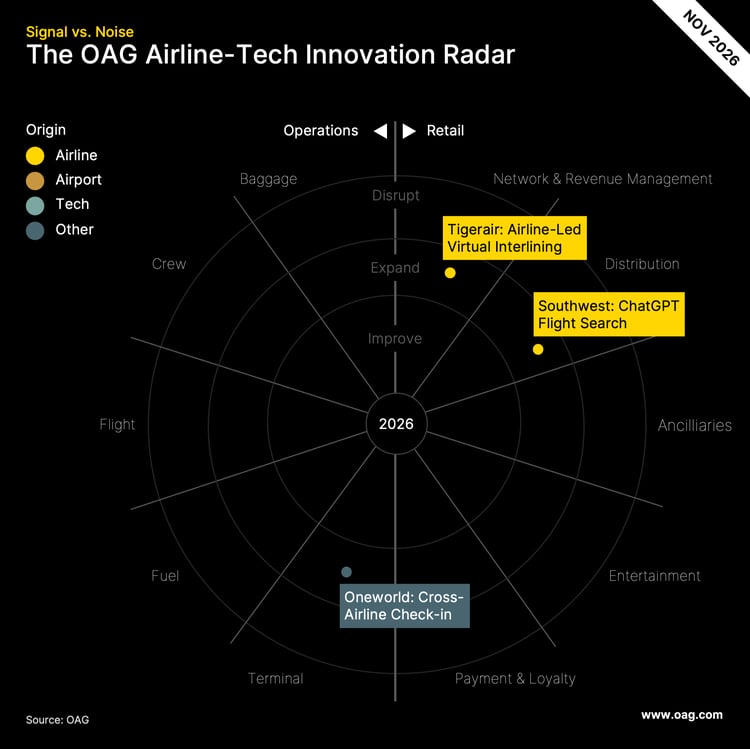
Welcome back to the OAG Airline-Tech Innovation Radar, where each month we spotlight three real-world product launches moving the aviation industry forward from a tech and innovation point of view.
Last month, in Airline Tech Takes Over the Waiting, we looked at software that takes on the watching and waiting people usually have to do themselves, including an agent that compares fares, an airline app that stands by for an earlier seat, and a traffic flow system that tries to spot congestion before it forms.
This month, we turn to the handover between companies. Why the handover? Many of the moments that still feel clumsy in air travel happen when one company has to pass the traveller on to another. Three examples illustrate the problem:
- A passenger connecting to a partner airline, even within the same alliance, may still need a separate check-in or a visit to a transfer desk because the first airline cannot issue the onward boarding pass. From the traveller’s perspective, it is an unnecessary extra step.
- A low-cost airline that wants to sell connections with another carrier has traditionally needed an interline agreement. Without one, travellers can end up stitching two separate bookings together and managing the connection themselves. This is another classic handover problem we explored in our Alternative Interlining deep dive.
- And when a traveller moves from an AI assistant to an airline’s booking page, the trip details and preferences they have already shared need to follow them. Otherwise, they are left entering the same information again.
These examples form the thesis behind this November edition:
The most interesting Airline-Tech product launches of the past few weeks focused on making these handovers smoother, so travellers no longer have to bridge the gaps between companies themselves.
Let’s look at the three cases in more detail.
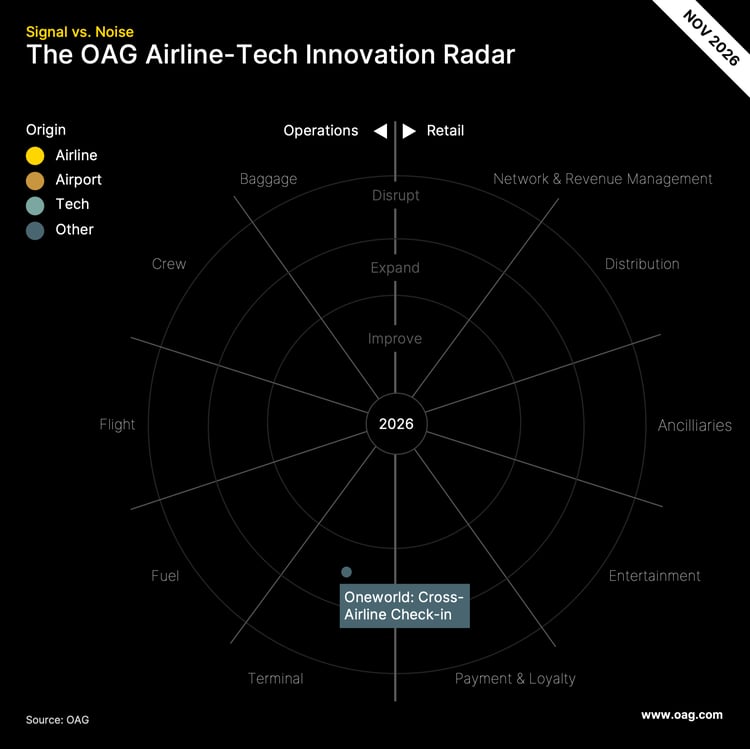
Innovation #1: oneworld turns its alliance into a single check-in
Let’s start inside the most familiar structure for connecting travel: the airline alliance.
For years, the customer-facing value of an alliance has mostly been explained through lounges, status recognition, and earning and spending miles across partner airlines. The digital journey has been less consistent. Whether a passenger could check in once for a trip on two different member airlines has depended on which airlines were involved, and often on which one operated the first flight.
oneworld has now made multi-carrier digital check-in available on all 15 of its member airlines, regardless of which carrier operates the first leg. The alliance announced the milestone at its Innovation Summit in Lisbon, with Malaysia Airlines as the first airline to adopt it.
Here’s how it works:
- A customer whose itinerary includes several oneworld airlines checks in once, in the app of the airline they prefer, including a passport scan.
- oneworld's technology platform lets member airlines' systems exchange that check-in and document information.
- The customer receives a boarding pass for every oneworld-operated flight, each branded by the airline operating it, and can save them all to a digital wallet.
- From there, the customer can go straight to bag drop or security without seeing a check-in agent.
In oneworld's own example, an American Airlines customer flying from Kuala Lumpur to Tokyo on Malaysia Airlines, then on to Dallas on American, completes the whole process in the American app.
Why does this innovation stand out?
On the surface, this feels like an improvement that should have happened years ago. Airlines sell a connecting journey as one trip, so passengers reasonably expect to check in for it once. Getting separate airline systems and processes to deliver that experience consistently has proved much harder.
This also extends an idea we have been tracking for a while.
-
In Airline Tech Stops Asking Twice, we looked at Hamad International and Qatar Airways linking more than 700 touchpoints to a single biometric identity, reducing repeated document presentation within one airport.
-
oneworld carries that principle across even more company boundaries, allowing information supplied to one airline to support the onward journey with another.
Refreshingly, this innovation needs no AI pitch to justify its value. The work involves connecting existing systems and making document verification usable across airline partners. In a year dominated by agentic AI announcements, it is worth giving that integration work some attention too.
Innovation #2: Tigerair Taiwan gives virtual interlining a fresh push
oneworld shows what a handover can look like when 15 airlines have formally agreed to work together. Our second innovation asks what happens when they have not.
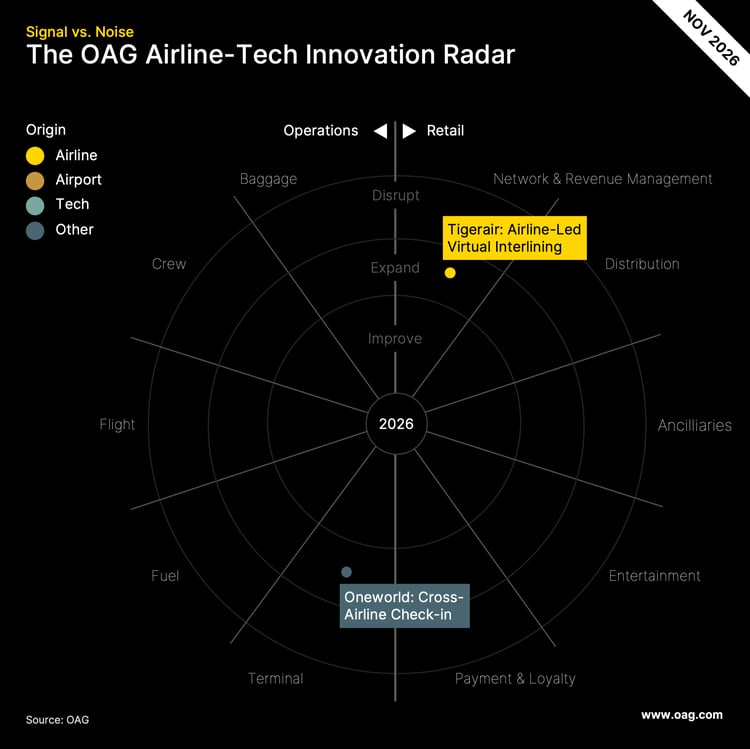
Tigerair Taiwan has launched Tigerhop, a platform built with Dohop, the Iceland-based travel technology company specialising in virtual interlining. It lets Tigerair sell journeys combining its own flights with onward services from Scoot, Singapore Airlines’ low-cost subsidiary, even though Tigerair has no traditional interline agreement with Scoot. Dohop’s technology brings their flights into one checkout while each airline keeps its own booking.
We should say up front that the idea itself is not new. Before the pandemic, virtual interlining was already one of the most hyped themes in European travel distribution. Dohop powered connection products for partners such as easyJet and Gatwick Airport, while Kiwi.com built its business around combining flights from airlines that did not traditionally cooperate.
The limitations were familiar too. Separate bookings make disruption harder to manage because each airline remains responsible for its own flight. Some airlines also objected to third parties assembling and selling their flights without permission. Southwest, for example, won a preliminary injunction in 2021 stopping Kiwi.com from scraping its flight information and selling its tickets.
That history makes Tigerhop worth examining more closely:
- Why does the model deserve renewed attention now, particularly in Asia?
- And what makes this launch relevant to the next phase of airline distribution?
- Trigger warning: AI may have a role here too.
But first things first. Here’s how Tigerhop works:
- Travellers access Tigerhop through Tigerair Taiwan’s own channels and search for journeys combining Tigerair and Scoot flights.
- Dohop’s RetailConnect technology brings those flights into one checkout, while each airline issues its own booking record.
- Travellers can add Dohop’s ConnectSure protection, which provides assistance and covers rebooking costs when a disruption causes a missed connection (subject to its terms).
- Initial connections link Taipei and Da Nang with Singapore, and connect Singapore via Taoyuan to Japanese regional destinations including Akita, Hanamaki and Tottori.
So why does this innovation stand out, especially right now?
First, virtual interlining gives airlines a way to expand their reach while aircraft remain hard to obtain. IATA put the industry’s order backlog at 18,100 aircraft in May 2026, and Tigerair Taiwan’s leadership frames Tigerhop explicitly as a way to reach new markets without adding a single aircraft.
That logic is particularly relevant in Asia.
- As WebInTravel reported in a recent profile of Dohop, low-cost carriers account for roughly 60% of Asia-Pacific capacity, most of them with minimal interline connectivity, in a region of island nations and dispersed populations that depends heavily on connections.
- Dohop says it has powered around one million connected passenger trips in a single year. That suggests the gap virtual interlining fills may be bigger in Asia than it ever was in Europe.
Second, who sells the connection has also changed. Before the pandemic, third parties assembled much of this inventory, often without the airlines' consent. Tigerhop, however, is sold by the airline itself, under its own brand, with protection attached. Chief Commercial Officer Bernard Hsu said the platform keeps customers booking inside Tigerair's environment rather than through an OTA.
Even airlines that previously fought unauthorised distribution have become more willing to cooperate on agreed terms. Ryanair’s partnership with Kiwi.com explicitly allows customers to combine Ryanair flights with Kiwi’s virtual interlining service. These arrangements give airlines a say in how their flights are sold and how customers receive booking information.
Third, AI could give virtual interlining a new distribution channel, although this remains a hypothesis rather than a demonstrated benefit of Tigerhop.
- Finding and comparing multi-airline connections manually takes time.
- AI agents could do much of that work on the traveller’s behalf, making combinations that previously required considerable searching easier to discover.
- An airline offering virtual interlining connections could therefore appear to an agent to serve a much larger network than its fleet alone suggests.
- Kiwi.com already provides a practical example of this distribution route through its MCP connector, which lets AI assistants search its inventory and return booking links.
For airlines to benefit, those combinations have to be visible where agents actually search. A connector that exposes only the airline’s own flights would leave its virtual interlining connections out of the results.
However, an agent with access to every airline’s schedules and fares could also assemble the same connections independently. That makes the route itself easier to replicate and raises a more important question about who takes responsibility when the connection fails.
Our hypothesis is that this could make Dohop, Kiwi.com and other virtual interlining specialists more valuable going forward.
- Their protected itineraries give travellers a named provider to turn to if something goes wrong.
- Depending on the protection purchased, support can include arranging alternative travel, covering eligible costs, or providing credit towards a replacement flight.
- The terms differ, but each adds a commitment beyond simply identifying two flights that connect.
A general-purpose AI agent assembling two independently booked flights creates no equivalent commitment simply by recommending them. If the first flight arrives late, the traveller could still be left to arrange and pay for the onward journey.
In the near term, we therefore see a potential commercial advantage for specialists offering connections that travellers and agents can recommend with greater confidence. As AI makes flight combinations easier to generate, the assurance attached to them could become more valuable.
That distinction may narrow as agents integrate third-party protection at some point in the future. However, such arrangements could also give the specialists another source of business, with their services supporting journeys that an agent assembled elsewhere.
For Tigerhop, this makes the quality of the protection an important part of the test. Dohop offers assistance when a covered disruption causes a missed connection, but the practical value depends on how reliably that support works when passengers need it.
With all that said, the commercial questions remain open too:
- How is the additional revenue shared when airlines sell each other’s flights?
- And will they continue expanding these connections once aircraft deliveries improve?
Passenger volumes, revenue contribution and the handling of disrupted journeys will tell us how much lasting value Tigerhop creates.
Innovation #3: Southwest builds its own handover into ChatGPT
So far, both handovers have happened between airlines. Our third innovation moves the handover to a platform no airline controls.
Southwest Airlines has launched what it describes as the first US airline plugin in ChatGPT, calling it the first step in a phased approach to AI-powered booking with OpenAI and Amazon Web Services (AWS).
This isn't the first airline inside ChatGPT. In AI Stops Talking and Starts Transacting, we covered Virgin Atlantic launching its own app there. But it appears to be the first of the large US carriers to make the move, and the way Southwest has drawn the line between the assistant and the airline is what makes it interesting.
Here's how it works:
- A traveller can use the plugin with a ChatGPT account, including the free version, to get destination ideas based on what kind of trip they want, where they are flying from, and when.
- The plugin searches Southwest flights for specific cities and dates, compares nearby dates and times to find lower fares, and shows all four of Southwest’s fare options: Basic, Choice, Choice Preferred, and Choice Extra.
- Availability and fares reflect the time of the search and do not constitute a confirmed reservation or a guaranteed fare.
- To book, the traveller moves to Southwest.com or the Southwest app. Rapid Rewards login, payment, reservations, and account management all stay there.
- If anything differs between ChatGPT and Southwest.com, the airline’s site takes precedence.
So what makes this move stand out?
First, it is a deliberate choice about where the handover sits. Discovery and comparison happen in the assistant, while the transaction, the loyalty account, and the direct booking relationship stay with the airline.
It is also a telling move from an airline that once went to court to stop a third party from scraping and selling its fares. Southwest is not refusing the new channel; it is insisting on building the bridge itself. In last month’s edition, we described three emerging routes for airline content to reach an AI agent. These were 1) a contracted API relationship through an intermediary, 2) conventional browser automation, and 3) platform-native tooling from technology providers. Southwest represents an airline-led version of that third route, building its own connector into the assistant and controlling what information and functionality it makes available.
Second, Southwest is not alone. Condor launched its own ChatGPT app, which it says is the first from an airline in Germany, Austria, and Switzerland, following the same pattern of search in the chat and booking on the airline’s website.
And when Meta launched its Muse agent in Singapore, it named Singapore Airlines among its first local connector partners. This extends a connector model that already included Duffel for US flight bookings. Meta says the Singapore connector features will roll out progressively and has not detailed the specific functionality Singapore Airlines will offer. Still, these moves suggest that airlines would rather build the bridge into the assistant themselves than rely entirely on someone else to represent them.
Third, it sits alongside a much deeper rebuild. In Airline AI’s Real Battle Moves Below the Interface, we covered Southwest’s move to an AWS-based cloud and agent architecture, with more than 2,700 developers already using agentic coding tools to modernise Southwest.com. The ChatGPT plugin is a customer-facing example of that broader technology direction, and Southwest’s own description of it as a first phase suggests the line between the assistant and Southwest.com may move over time.
An important disclaimer at the end. We should be careful about how much this proves.
- It does not yet prove that travellers will start their flight shopping in ChatGPT in meaningful numbers. Booking Holdings’ chief executive said at Skift Global Forum that AI referrals accounted for less than 1% of Booking’s room nights.
- It does not yet show what happens to the checkout and the loyalty relationship if booking itself ever moves inside the chat (a step Southwest’s phased approach leaves open).
- And it does not yet settle the economics, since Meta has already said it could take a share of the value its agent creates.
What these moves do suggest is that airlines see value in shaping the handover themselves, even as they rely on someone else’s platform to reach the traveller.
Wrapping up this month's radar
That’s it for this edition. See you next month, where we will keep tracking the systems, standards, and data layers quietly deciding what the next era of airline technology can actually become.