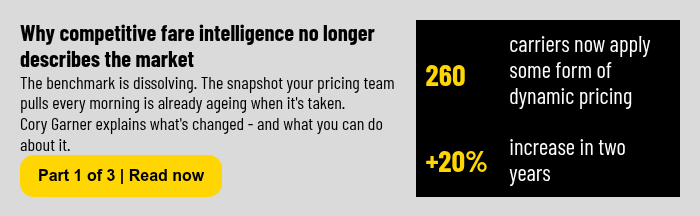

Welcome back to the OAG Airline-Tech Innovation Radar, where each month we cut through the noise and spotlight three real-world launches moving the aviation industry forward.
Last month, in our July edition, we argued that some of the most consequential AI work in aviation was happening out of sight, for example in air traffic flow management, fare-distribution architecture, and the systems that make the industry run smoothly. We closed by saying that in the AI era, the infrastructure layer will matter more, not less.
This month, that infrastructure moves closer to the traveller.
Three launches caught our attention, and on the surface they have very little in common:
- One is a corporate travel platform reorganising how servicing gets done.
- A second is a Gulf mega-hub replacing boarding passes with faces.
- The third is a US carrier rebuilding how customers pay for a ticket.
If we look more closely, the same benefit lies beneath all three: each removes a moment when travellers, agents, or airline systems have to repeat information the journey should already know.
That is the pattern behind this month’s Radar: Airline tech is starting to reduce the duplicated checks, handoffs, and questions that have long made air travel feel less digital than it should.
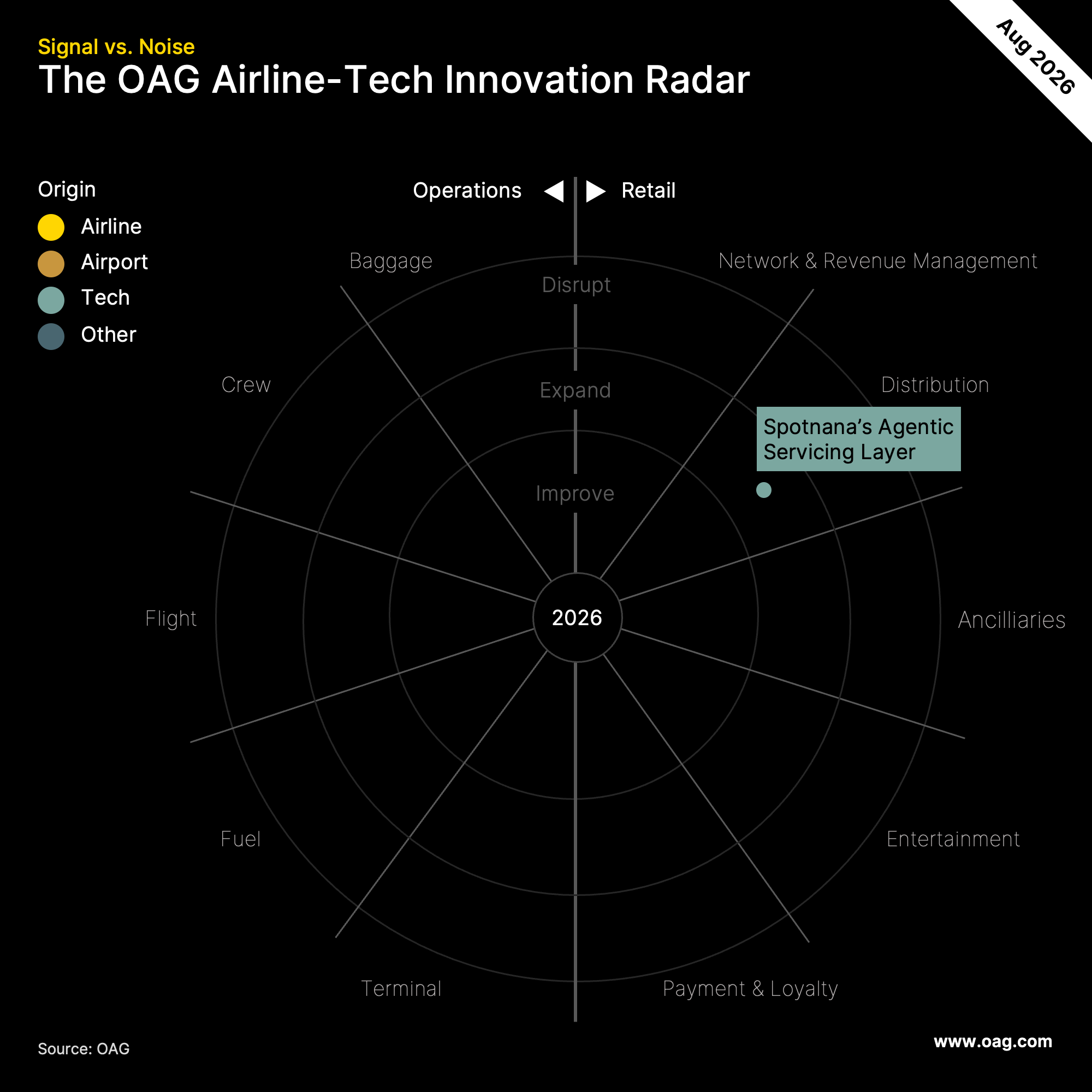
Innovation #1: Spotnana gives every servicing task its own agent
The agentic conversation in travel has been overwhelmingly about the front end. Can an AI agent inspire a trip? Can it shop on its own? Can it complete a booking? In June, we covered the moment when AI agents carried a traveller from idea to paid ticket without leaving the chat.
However, far less attention goes to what happens afterwards, which is where much of the cost actually lives. A booking is a single event. Servicing that booking is an open-ended stream of refunds, schedule changes, cancelled segments, unticketed segments, reissues and exceptions. Most of it is repetitive, rules-heavy and still handled by people.
That is the process Spotnana has gone after. The travel-as-a-service provider added a multi-agent AI architecture to its platform, alongside a first release of AI capabilities for travel agents. Features for travellers and travel managers are expected to follow later this year.
Here's how it works:
- Spotnana does not use one general-purpose assistant to answer every traveller or agent query. Its architecture splits the work across specialised agents, each responsible for a narrow servicing task.
- A central orchestration agent decides which specialist agent should handle the request and the sequence in which the work needs to happen.
- The servicing agent monitors operational task queues inside the platform. When it sees a routine issue, for example a cancelled segment after an airline schedule change or an unticketed segment that needs validation, it checks the structured booking data and triggers the relevant Spotnana workflow.
- Execution happens through mapped Spotnana APIs. That means the agent does not invent a refund amount, fare rule, or policy outcome. It can only trigger governed actions the platform already supports.
- The first release covers several concrete servicing jobs, such as processing cancelled segments, validating unticketed airline segments, issuing residual MCOs after eligible ticket exchanges, automating eligible refunds, and importing externally booked trips when a traveller forwards a confirmation email.
- Human agents remain in the loop for complex cases. If a task requires judgment, the AI agent hands it to a live travel agent together with the history of what it has checked and done so far.
- A co-pilot then supports the human agent with suggested responses, conversation summaries and servicing analytics, including reporting on which tasks the AI agent completed and where patterns are emerging.
Direct Travel, one of the world’s largest travel management companies, is already using the new capabilities. Its Chief Product Officer frames the split pragmatically: automate routine servicing so advisers can concentrate on complex situations, strategic guidance and personalised service.
Why does this innovation stand out?
First, because of where the determinism sits. This is the same architectural argument we have been tracking all year, but applied to a different problem. In fare search, the question was how to answer machine-speed demand without melting airline pricing infrastructure. Here, the question is narrower and more sensitive: how do you allow an autonomous system to act on a live booking without letting it invent the outcome?
Spotnana’s answer is to give the language model no authority over execution. The agent can interpret the task and choose the next step, but the actual action runs through a mapped API and a governed workflow. Multiply that across dozens of narrow agents, and reliability becomes less dependent on the model sounding confident. It becomes a property of the architecture.
Second, because “open by design” is a strategic choice. A platform that lets customers and partners build their own agents is betting it will win by being the execution layer others can build on. That is different from trying to own every interaction directly. It also echoes the tension we keep returning to: as agents proliferate, does value belong to whoever owns the interface, or to whoever owns the reliable action underneath it?
The caveat of this innovation is that this is still phase one. The traveller-facing and travel-manager-facing capabilities are still to come, and the initial release targets a defined set of servicing workflows rather than the whole servicing surface. The proof will be in how much volume genuinely disappears from human queues over the coming months, and whether the exception rate stays low enough for travel management companies to trust the system during irregular operations, when pressure is highest, and the cost of a wrong action is greatest.
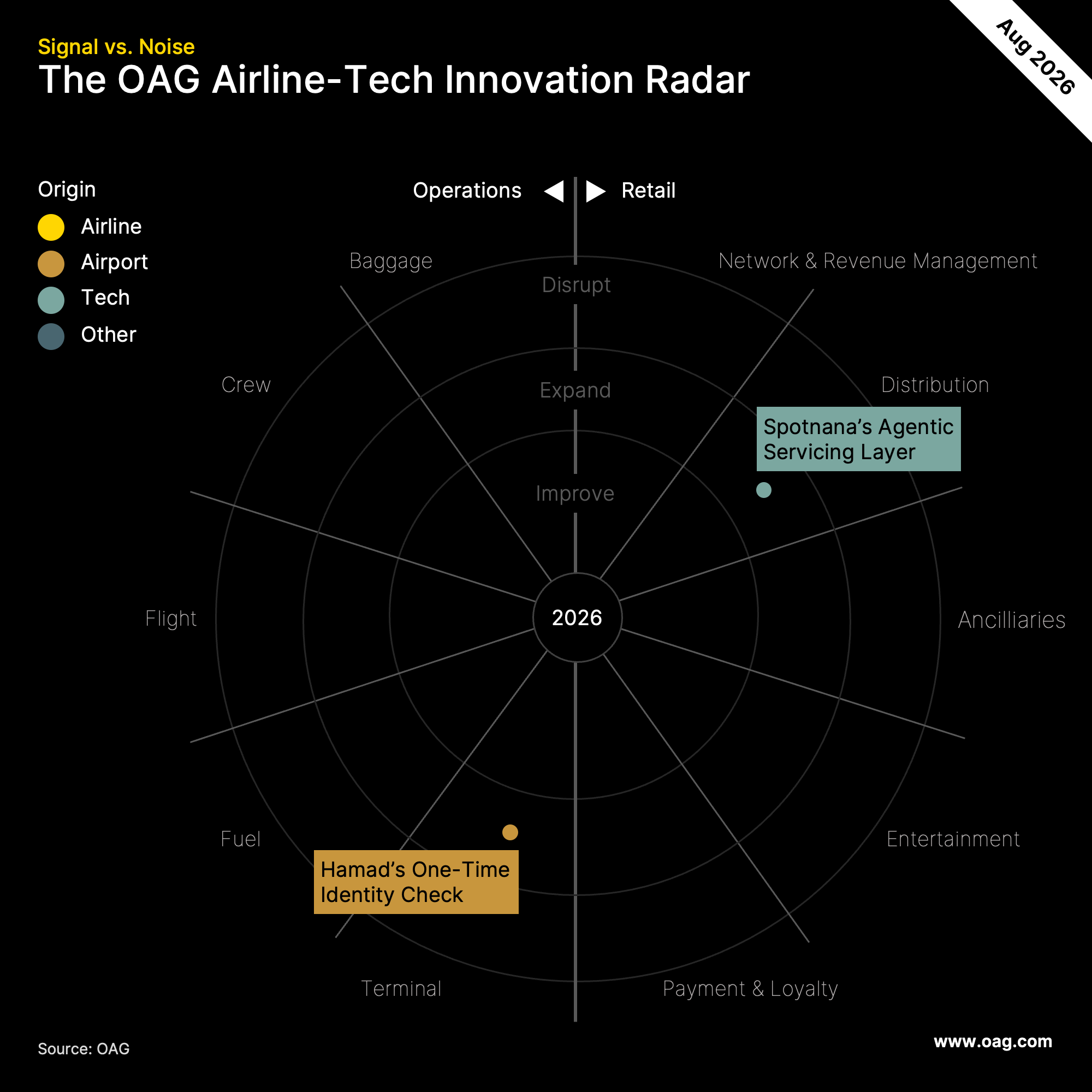
Innovation #2: Hamad International stops checking identity twice
We should acknowledge something up front. Biometrics is the most repeatedly covered category on this radar. We tracked Zurich Airport's AI security scanners in July 2024, Apple's TSA-approved digital passports in July 2025, the TSA PreCheck Touchless ID expansion in our early 2026 edition, and IATA's multi-carrier One ID trial results when the industry turned pain points into products. Qatar Airways is also a familiar name here, most recently for its work with Google on AI-generated in-flight commercials.
So we are not featuring this second innovation because airport facial recognition is new. We are featuring it because of the number attached.
Hamad International Airport, together with Qatar Airways and technology partner SITA, has launched Fast Pass, connecting more than 700 touchpoints into a single biometric journey. Hamad and SITA describe it as one of the largest deployments of its kind globally.
Here's how it works:
- Passengers enrol once, either through the Qatar Airways mobile check-in application or at a self-service kiosk in the terminal, using a valid passport and a photograph.
- The system creates a secure digital identity that links facial biometrics to the passport, boarding pass and journey details.
- From then on, the traveller’s face works as the boarding credential across dedicated biometric touchpoints, including self-service bag drop, automated security gates and self-boarding gates.
- SITA’s self-service bag-drop units use the same facial verification, so the identity check is consistent rather than reimplemented at each touchpoint
- Qatar Airways transfer passengers and other interested airlines operating from the hub are planned for later phases.
Why does this innovation stand out?
The difference is arguably architectural, not technological. Most biometric deployments we have covered in the past install facial recognition at a single touchpoint, such as a gate, security lane or check-in kiosk. Each one independently verifies the passenger, which means the passenger is repeatedly proving an identity the airport already established minutes earlier.
Fast Pass inverts that.
- Identity is resolved once at enrolment and then referenced everywhere, which is why the touchpoint count matters.
- Connecting 700 of them into one journey is a data and systems integration problem far more than a camera problem.
One caveat is worth stating clearly, though. Fast Pass is opt-in, and the eligibility is narrower than the headline figure implies. It currently applies to Qatar Airways passengers on eligible flights departing from Doha, and kiosk enrolment covers only the current trip. Passengers also still need to carry their passport for immigration and backup verification. Transfer passengers, arguably the group with the most to gain at a connecting hub of this scale, are not yet included.
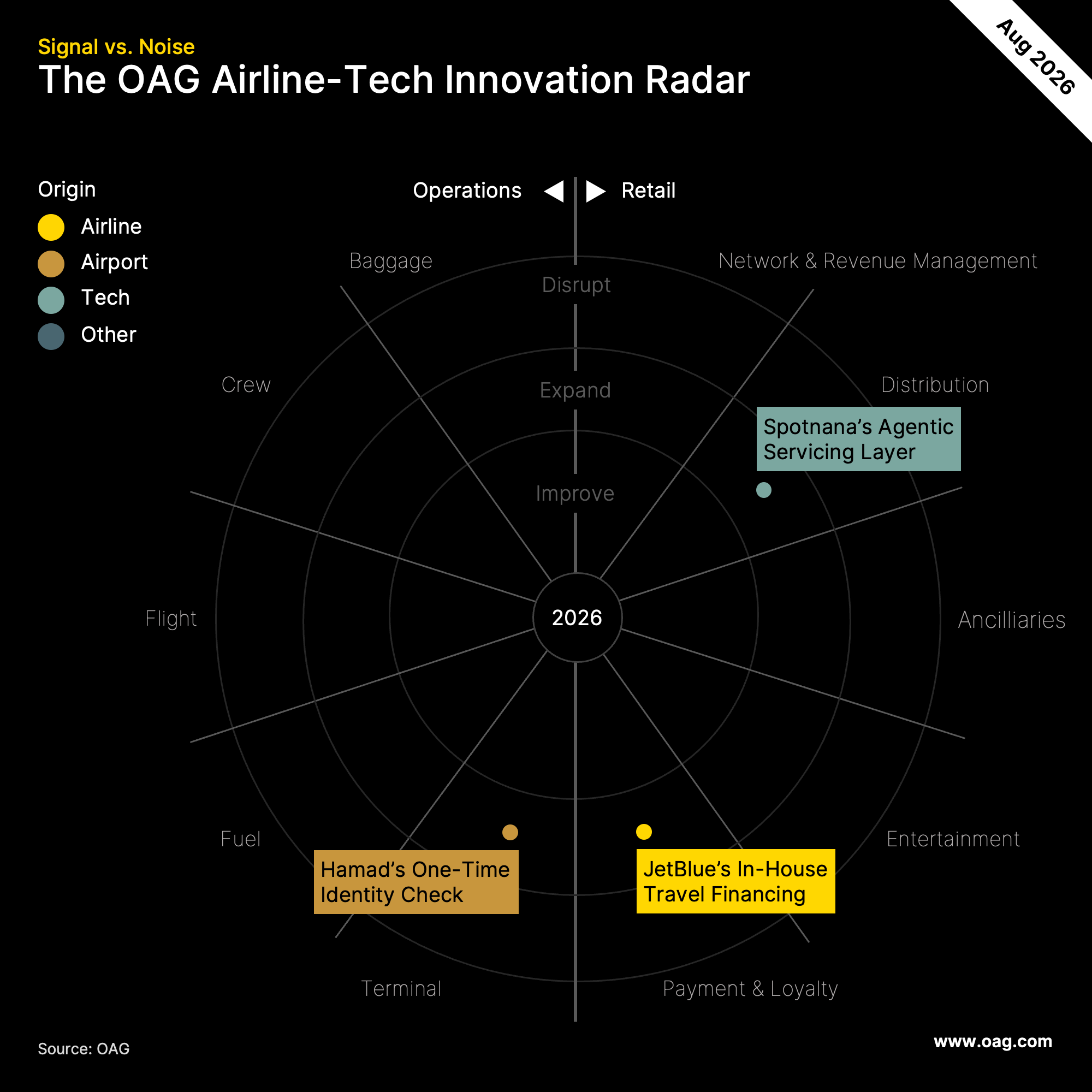
Innovation #3: JetBlue pulls financing inside its own loyalty ecosystem
Buy now, pay later is not new to aviation. We covered Southwest’s partnership with Uplift back in April 2024, and Southwest recently returned to the theme with a long-term Klarna partnership that will bring instalment options to its website and app later this year. On the face of it, instalment payments have become standard airline checkout furniture.
That is exactly why JetBlue’s programme with ClarityPay is the more interesting recent play.
It is not just another payment button. It is an attempt to move financing from outside the airline’s ecosystem to inside it.
Here’s how it works:
- Customers can preview personalised instalment options during the booking flow, with terms ranging from six weeks to 48 months.
- A limited introductory 0% APR offer is available on terms up to 12 months for eligible customers.
- Customers continue to earn TrueBlue points on eligible purchases at launch, with additional points-earning opportunities on ClarityPay bookings expected to follow.
- The platform is white-labeled end-to-end, supporting JetBlue’s own branded experience and giving the airline more room to cross-sell upgrades, ancillaries, loyalty promotions and financial products without handing the customer relationship to a third-party payment brand.
- Multi-merchant capability extends the credit across JetBlue flights, insurance and ancillary services within the same booking journey.
JetBlue’s vice president of loyalty and personalisation describes the goal as growing sales while expanding the loyalty ecosystem. ClarityPay’s framing is sharper: an airline with a powerful loyalty programme has historically had financing sitting outside that ecosystem.
Why does this innovation stand out?
First, because it changes what financing is for.
Presented only at checkout, instalment payments are mostly a conversion tool because they help rescue a transaction that might otherwise be abandoned. Presented earlier in the booking journey, they become a planning tool that shapes what the traveller considers buying in the first place.
A customer who can see a 12-month option while evaluating the trip may choose a different fare, cabin, service, or even destination.
That moves financing from the bottom of the funnel toward the moment where the offer is still being formed.
Second, because of who owns the resulting relationship and data. Every third-party pay-later button hands a slice of the customer relationship, and the behavioural data attached to it, to a fintech company. Folding financing into the airline’s own brand and loyalty currency keeps more of that relationship inside the airline ecosystem. It also creates a new commercial lever: an airline that can price credit terms alongside fares, ancillaries and points has more ways to construct an offer than one that can only discount.
The caution is worth stating, though. Beyond the introductory period, published APRs can range up to 36%, with eligibility determined by the programme lender based on credit and state of residence. ClarityPay also explicitly positions its broader underwriting as extending credit access further than traditional pay-later providers. Widening credit access to buy discretionary travel is a commercially attractive idea and a consumer-protection question at the same time. As airlines take financing closer to their own ecosystem, the reputational exposure moves closer too.
That’s it for this edition.
See you next month, where we will keep tracking how Airline Tech moves from isolated digital upgrades toward systems that remember more, ask less, and make the journey feel more connected.