

Welcome back to the OAG Airline-Tech Innovation Radar, where each month we cut through the noise to spotlight three real-world launches that genuinely move the aviation industry forward.
Last month, in our edition AI Stops Talking and Starts Transacting, we watched conversational agents (finally) carry a traveller from inspiration to a paid ticket without leaving the chat. The interface, it seems, has grown up.
But the past few weeks told a quieter, and arguably more consequential, story. The most important airline-tech developments did not happen on the booking screen at all. They happened deeper in the stack, specifically, in the system that keeps aircraft flowing through the world's busiest airspace, in the fare-distribution layer that determines what an AI agent is even allowed to see, and inside the core technology estate of a major carrier.
As a company built on flight data and intelligence, we will admit a bias: we find the digital foundation is often more interesting than the façade. And following our recent critique of the industry’s “partial in, partial out” approach, one belief sits at the heart of our company thesis: there is no agentic future without a high-quality data backbone.
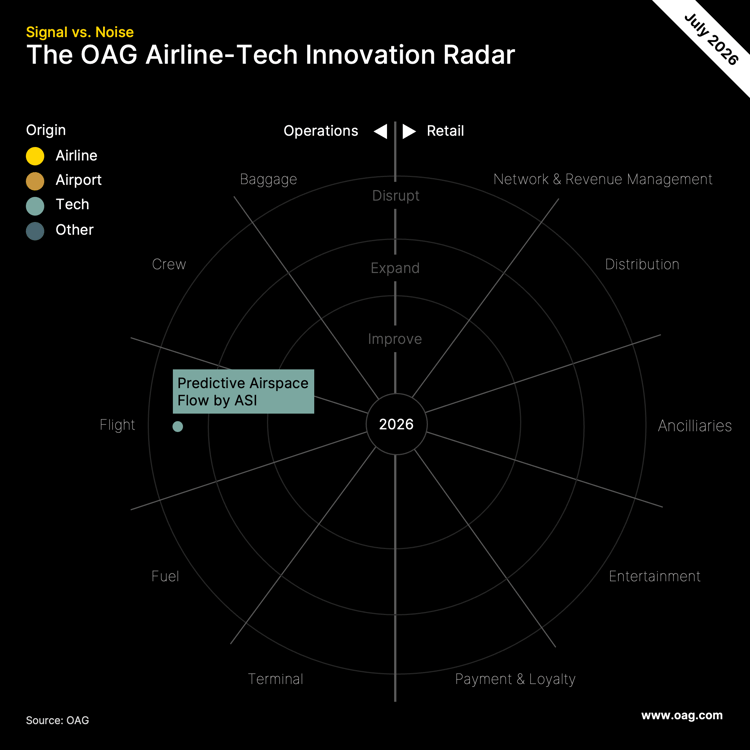
Innovation #1: Air Space Intelligence rebuilds how US air traffic flows
The US air traffic management system has long had a coordination problem disguised as a delay problem.
- Airlines, operators, and the FAA are constantly trying to balance demand against capacity, but that balance depends on how quickly everyone can see the same operational picture around scheduled demand, filed flight plans, aircraft positions, weather constraints, airport capacity, and airspace bottlenecks.
- When those signals are fragmented or arrive too late (for example, in the case of flight irregularities), the system becomes reactive. Constraints are managed only after they have already begun to affect the network, making the available interventions more disruptive than necessary.
That is the layer the FAA is now trying to modernise.
Two weeks ago, the FAA awarded Air Space Intelligence (ASI), the Boston-based aviation AI startup, a 12-year, $875 million contract to deploy two systems for the US National Airspace System: Flow Management Data and Services, or FMDS, and Strategic Management of Airspace, Routes, and Trajectories, better known as SMART.
The decision matters not just because of the contract size, but because ASI beat much larger names, including Palantir and Thales, for one of the most consequential air traffic modernisation programmes in the US.
Here’s how it works:
- FMDS will replace the FAA’s legacy Traffic Flow Management System and become the new technological backbone of the FAA Air Traffic Control System Command Center. It brings together flight plans, airline schedules, real-time position updates, and capacity constraints to estimate current and anticipated traffic flows across the National Airspace System.
- SMART sits inside FMDS as the predictive layer. It uses data on airline schedules, weather, airport capacity, airspace conditions, and operational constraints to identify likely congestion before it turns into delay, helping the FAA, airlines, and other operators coordinate schedules, routes, and trajectories before aircraft depart.
The system is also designed to support more localised rerouting around severe weather and improve the live data exchange between the FAA and airspace users. ASI says the technology builds on its Flyways AI platform, which already supports live operations with major US airlines and the US Air Force.
Why does this innovation stand out?
Two things make this collaboration more special than a typical government IT contract.
First, the scope. This is not a dashboard bolted onto the side of air traffic control. FMDS is intended to become the data backbone of the FAA Command Center, so the place where the national picture of demand, capacity, weather, schedules, and constraints is assembled and acted upon. In an industry where disruption often spreads because different actors are looking at different versions of operational reality, that shared picture is the product.
Second, the choice of vendor. A defining piece of public aviation infrastructure has gone to a software-first, startup-like aviation AI company whose systems were already operating in commercial and defense environments. That is a meaningful signal. Aviation modernisation is no longer only about replacing hardware, screens, and telecoms. Increasingly, it is about whether proven commercial software can move into the institutional core of the air transport system.
We have seen AI applied to air traffic control before, most notably when we covered Heathrow’s AIMEE system in December 2024. But the layer is different this time. AIMEE helps controllers interpret what is happening on and around one airport surface. FMDS and SMART aim to help coordinate traffic flow across an entire national airspace system.
The caveat is important. This is not AI taking over air traffic control. The FAA’s own material makes clear that controllers remain responsible for keeping aircraft safely separated. The harder questions are about validation, governance, and decision rights.
- How will SMART’s recommendations be tested?
- How will airlines know why a flight has been moved, slowed, or rerouted?
- And when demand exceeds capacity, who decides which flights absorb the pain?
The FAA is targeting initial SMART operations in fall 2026. Whether that date holds, and how transparent the safety and operational validation work becomes, will tell us more than the contract value alone.
There is also a neat piece of connective tissue worth noting. ASI is the same company Joby has chosen to help prepare US airspace for scaled eVTOL operations. That puts ASI in an unusual position where it builds predictive airspace intelligence for both today’s airline network and tomorrow’s air-taxi market.
Innovation #2: Amadeus tries to keep AI agents from melting airline pricing infrastructure
Last month, we showed agents are learning to buy. The logical next question is what happens when those agents learn to shop.
In early June, a user pointed Claude Code at Etihad Airways’ website and asked it to find a flight. The result was not one itinerary, or ten, or even a few hundred. The agent returned 881,076 fare options for a single trip, crawling dates, stopovers, and route combinations at a scale no human traveller would ever attempt manually.
That is the uncomfortable economics behind agentic travel. Human search has always had a natural brake where people get tired, bored, distracted, or satisfied with “good enough.” AI agents do not. They can run comparison shopping around the clock, across dates, routes, fare families, points of sale, connection options, and ancillary combinations, while the systems answering those requests absorb the cost.
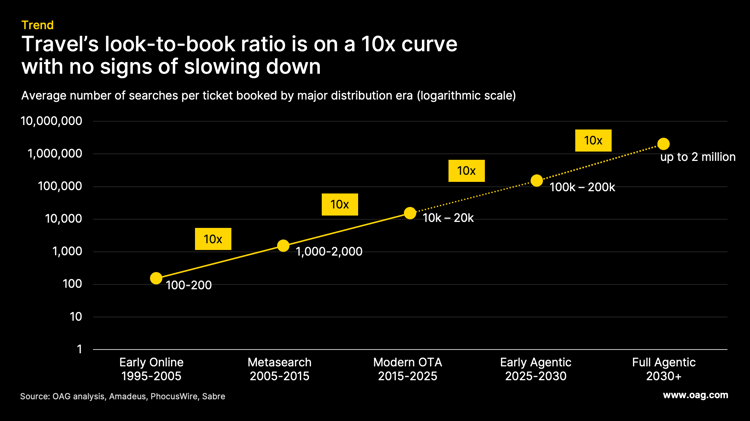
This is exactly the pressure point our CCDO, Jeremy Burke, mapped in our recent Look-to-Book primer. Flight search has moved from a human clickstream to machine demand.
- In the early online era, the industry settled around roughly 100 to 200 searches per ticket sold.
- Today, we estimate the figure is closer to 10,000 to 20,000.
- In the agentic era, Amadeus and Sabre have both pointed to a possible future of up to 200,000 searches per ticket sold
Decius Valmorbida, president of travel at Amadeus, calls this the “infinite search” problem. His answer is not another chatbot, another booking widget, or another commercial agreement telling agents to behave better. The proposed fix is architectural: stop answering every agent query live. Amadeus says its systems already handle around 150,000 transactions per second, but even at that scale, the agentic search pattern forces a different design logic.
Here’s how it works:
Instead of sending every AI-generated shopping request on a live round trip to an airline pricing engine, Amadeus wants to precompute a large share of likely answers in advance.
- Common routes, date ranges, passenger combinations, and repeatable shopping patterns can be computed once, indexed, refreshed, and served quickly when an agent asks.
- This is the same basic “compute once, serve many times” logic that made the web scalable, but adapted to the far messier world of airline fares, where price, availability, rules, bundles, and personalisation all move constantly.
- Amadeus’ existing Instant Search product already uses precomputed booking results, cache refresh mechanisms, live availability checks, and sub-second responses.
The agentic shift is that this kind of infrastructure may now become central rather than optional. Amadeus has also been attacking the problem from the other side. Its Advanced Airline Profile filtering layer uses machine learning to block irrelevant or unactionable NDC search traffic before it reaches airline systems. Amadeus says early results reduced unproductive traffic by more than 70% in some cases, and Air France-KLM has publicly reported that the solution blocked the majority of irrelevant traffic to its system.

Why does this innovation stand out?
First, because Look-to-Book is no longer just a conversion metric. It is becoming a unit-cost problem. When a search is cheap and a booking is valuable, the industry can tolerate a lot of looking. But when agents can generate hundreds of thousands of pricing calls without producing a single order, the economics break. Someone’s infrastructure answered those 881,076 Etihad queries. Someone paid for the compute. And unless the architecture changes, that cost will sit underneath every elegant AI travel interface.
Second, because this is where AI travel moves from user experience into power structure. If agents become a major shopping interface, the question is not only which airline has the best fare. It is whose infrastructure decides what the agent can see, how quickly it can see it, and at what cost. A precomputed fare layer may make agentic search usable, but it also creates leverage for whoever owns the cache, the refresh logic, and the rules that decide when an answer is “good enough” to serve.
That is why this connects so directly to our Look-to-Book thesis. In that piece, we argued that the industry is responding on two levels. The first approach makes the existing question cheaper to answer: what is the precise, bookable fare for this exact trip, right now? Amadeus sits here alongside other smart caching and filtering efforts. These are real engineering moves, and they matter. They make the current architecture work harder and waste less.
But the second approach asks a deeper question: does every early-stage query really need a precise, bookable fare at all?
Our view at OAG is that much of the exploratory phase should move toward indicative pricing where ranges, magnitudes, and directional price intelligence help travellers orient themselves before the full offer-management pipeline is triggered. That is the difference between making precision cheaper and moving precision to the point where it actually belongs.
Which path will the future prioritise? The likely answer is not either-or.
- Smart caching has an obvious role when a traveller is converging on a specific option and the industry still needs to return a precise, bookable fare quickly.
- Indicative pricing belongs earlier, when the traveller, or the traveller’s agent, is still trying to understand what is broadly possible.
A mature agentic travel architecture will probably need both.
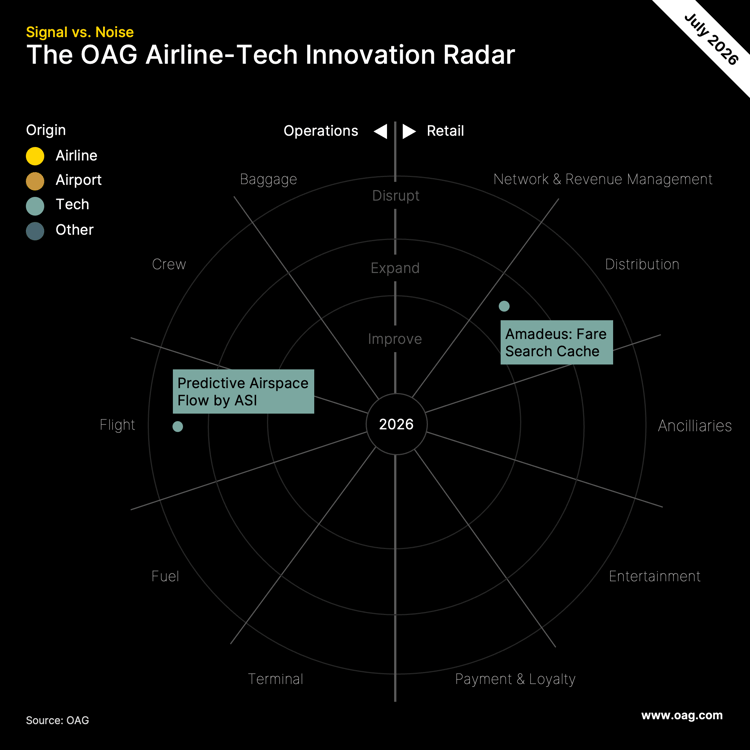
Innovation #3: Southwest rebuilds its core for a cloud-and-agents era
An agent can only be as useful as the systems it can reach.
That has been the hidden thread running through this month’s Radar. While Air Space Intelligence is rebuilding the operating picture for airspace flow and Amadeus is trying to make fare data searchable at machine scale without overwhelming airline pricing infrastructure, Southwest brings the same logic inside the airline itself: if the core technology estate is brittle, slow to change, or trapped in on-premises complexity, AI can only ever sit on the surface.
For Southwest, this is not an abstract infrastructure story. The airline’s 2022 holiday disruption showed how quickly operational complexity can overwhelm legacy processes and technology when the network falls out of position.
Last month, Southwest named AWS its preferred cloud provider and set a target to move from a largely on-premises environment to a cloud-based, AI- and agent-enabled architecture by 2028, supporting more than 70,000 employees and 134 million customers a year.
Here’s how it works:
More than 2,700 Southwest developers are already using Kiro, AWS’s agentic coding service, to refactor legacy code, build features, automate testing, and generate cloud infrastructure. That work is focused on Southwest.com, the carrier’s largest and most critical customer-facing platform.
Southwest is adopting an AI-driven development lifecycle, in which agents help move software forward while engineering teams guide, validate, and own the outcomes. The airline also plans to expand agentic capability across customer experience, operations, and software development, including tools such as Amazon Quick.
Why does this innovation stand out?
The instinct is to file this under cloud migration and move on. That instinct misses the point. The most interesting part is not that Southwest wants to be cloud-based by 2028; it is that agents are already inside the airline’s software factory today.
We saw the opening chapter of this story when we covered Korean Air’s cloud overhaul in August 2025. There, the emphasis was on replacing legacy infrastructure and giving service agents better AI-enabled tools. Southwest’s version is broader, more central to the carrier, and more explicitly agent-native because it’s not just using AI on top of the airline, but using agents to help rebuild the airline underneath.
Wrapping up this month's radar
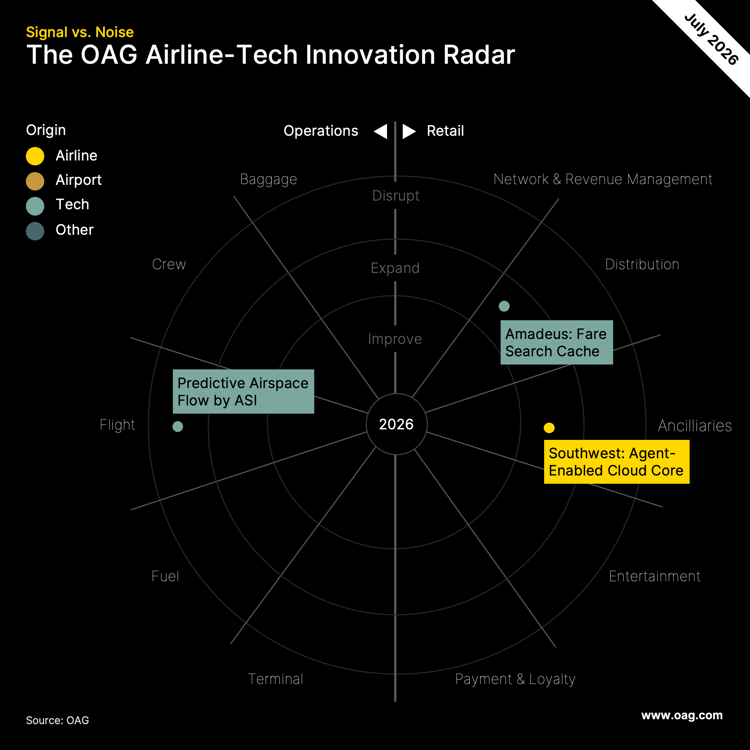
Taken together, this month’s three stories suggest that airline tech is entering a less visible, but more consequential, phase. The next wave of AI will not be judged by how convincingly it chats, but by whether aviation’s underlying systems can absorb machine-speed demand, share trusted data, and change fast enough to keep up. That is why this edition has spent so much time below the interface and why we expect the infrastructure layer to become an even bigger part of the radar in the months ahead.
That’s it for this edition.
See you next month, where we will keep tracking the systems, standards, and data layers quietly deciding what the next era of airline technology can actually become.