


Welcome back to the OAG Airline-Tech Innovation Radar, where each month we cut through the noise and spotlight three real-world product launches moving the aviation industry forward from a tech and innovation point of view.
Last month, in Airline Tech Puts a Price on Memory, we looked at how AI is starting to learn the way an airline actually works, whether by buying an airline’s institutional record, embedding a hyperscaler’s models into operations, or letting an agent resolve overbooking before passengers reach the gate.
This month, we turn to something every traveller knows very well: waiting.
- Some of it happens at the airport, of course. But much of the more tiring waiting happens earlier and less visibly, while travellers are still trying to make sense of their flight options, compare offers, understand what is worth booking, or wait for the system to turn uncertainty into a clear next step.
- Disrupted passengers know this feeling especially well when the journey is already broken, but the alternative hasn't appeared yet.
- Airlines and controllers know a version of it too, especially on difficult operating days, when network pressure builds faster than the system can respond.
That is the thesis behind this October edition:
The most interesting launches of the past few weeks moved the job of watching, comparing, and waiting away from people and onto software.
In each case, a system now keeps an eye on something that used to require human patience. The result is a shift from reacting late to acting earlier.
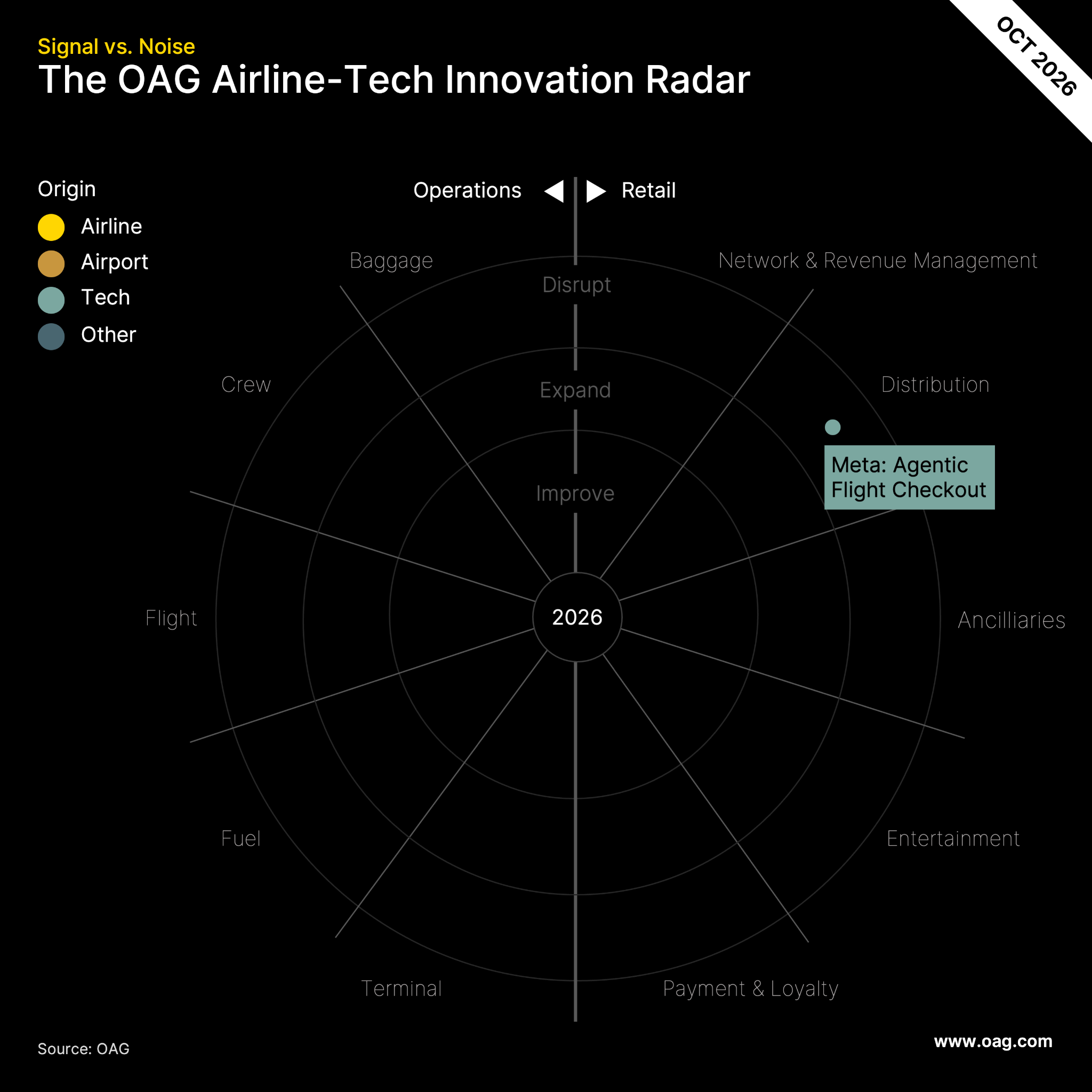
Innovation #1: Meta’s Muse turns a wave of personal agents into a flight checkout
If one thing defined the past few weeks in AI, it was the sheer number of personal agent launches. They arrived almost back-to-back, and travel kept turning up as one of the use cases:
- Instinct, a text-message-based agent that went viral for rebooking flights, applying airline credits, and holding seat assignments over SMS and WhatsApp, closed a $250 million funding round just a few months after launch.
- SpaceXAI’s Grok Bot went after workplace tasks and passed 418,000 weekly users within its first month.
- Amadeus and Anthropic announced a toolkit that puts Amadeus flight and destination content inside Claude Code, plus a Claude Cowork plugin for travel professionals.
- OpenAI closed the run at its developer conference with Dots, always-on agents that keep working towards a goal after the user closes ChatGPT.
In the middle of all this, Meta launched Muse, a personal AI agent available in the US through its own app, WhatsApp, and muse.ai.
Of all these launches, it is the one that sells a flight today, which is why it leads this edition.
Here’s how it works:
- A traveller describes the trip in plain language in the Muse app, on WhatsApp or on the web, and the agent searches live options.
- For flights, Muse connects to Duffel, the London-based flight API and travel infrastructure company, which gives it live inventory and pricing from more than 500 airlines. Through Duffel, travellers can book, cancel and manage trips, with 24/7 human support behind the agent.
- Payment runs through Stripe Link with one-time virtual cards, and the traveller approves every purchase before it completes.
- Muse can also drive an airline’s own website in a browser, with the traveller handling logins and approvals. Hotels currently work only this way, where the agent shops consumer sites such as Expedia and Hotels.com, much like a person with several tabs open.
Why does this innovation stand out so much?
First, Muse moves agentic flight booking from the future tense into the present. In AI Stops Talking and Starts Transacting, we covered Mindtrip, Sabre and PayPal closing the agentic loop inside a travel-native product. Muse does it inside a general-purpose assistant, next to the chats where many people already plan trips with friends and family.
- Skift points out that Meta’s apps reach around 3.6 billion people a day, and Bloomberg Intelligence found that Muse has been downloaded four times as often as Grok Bot.
- Muse is a separate product and US-only for now, so these numbers describe potential rather than proven travel demand. But no online travel agency has ever had a starting point quite like it.
Second, and more important for airlines, Muse makes a structural question visible: how exactly does airline content reach an AI agent?
Right now, there are three emerging routes.
- The first is a contracted API relationship. Muse’s flight path runs through Duffel, which gives the agent access to live airline inventory, pricing, and booking capability through a defined travel infrastructure partner. That means there is a commercial relationship, a technical interface, and a party responsible for the transaction flow. For airlines, this is the path that looks most familiar. It extends the logic of API-based retailing into the agentic world.
- The second route is browser automation. Here, the agent operates a consumer website much like a person would. It searches, compares, fills out forms, and asks the user to step in when it needs a login, approval, or payment decision. Muse already uses this browser path for parts of travel outside its flight integration, and many generalist agents are likely to rely on the same pattern. For suppliers, this is much harder to control. There may be no contract, no agreed rules for how often the agent searches, and no clear commercial model for the cost of being shopped.
- The third route sits somewhere in between: platform-native tooling. This is where travel technology providers put their content directly inside the environments where agents are built or used. The Amadeus and Anthropic announcement points in this direction, with Amadeus flight and destination content moving toward Claude Code for developers and a Claude Cowork plugin for travel professionals. It is still waitlist-only, with no general availability date, so it is too early to judge. But the direction is telling. Instead of waiting for general-purpose agents to scrape, browse, or improvise their way into travel, Amadeus is trying to make its content available inside the agent-building workflow itself.
That difference is not a technical detail. It decides whether airlines negotiate terms with agents, reach them through intermediaries, or simply absorb the cost of being searched by them. Importantly, Muse’s flight path also shows that the industry’s years of investment in API-based airline retailing were not wasted. They are what made the contracted route possible in the first place.
With all that said, the economics are far from settled. Agents that keep searching until a budget is met can inflate look-to-book ratios very quickly, which is exactly the infrastructure problem we explored in our Look-to-Book Deep Dive and in Airline AI’s Real Battle Moves Below the Interface. Always-on agents such as OpenAI’s Dots, which keep working towards a goal in the background, would only add to that load once travel planning becomes part of their active use case.
Servicing is also still thin. Beyond Duffel’s support layer, more complex changes still tend to move back to the airline. Muse does not yet prove that consumers will hand flight purchases to a general-purpose assistant at scale. What it does show is more specific, and more useful: the first Big Tech agent to actually sell flights chose a defined API relationship over pure browser automation. At a moment when every major AI company is racing to give people an agent of their own, that is a precedent airlines will want to help shape.
Innovation #2: United Airlines lets the app stand by for you
From an agent that shops on your behalf, we move to the moment when waiting hurts most: right after a flight has gone wrong.
Few airline moments are as draining as the minutes and hours after a disruption. A passenger rebooked onto a later flight who hopes to get home sooner has traditionally had two options:
- Queue at a service desk to get on a standby list,
- or keep refreshing the app in the hope that an earlier seat appears.
Either way, the passenger does the watching.
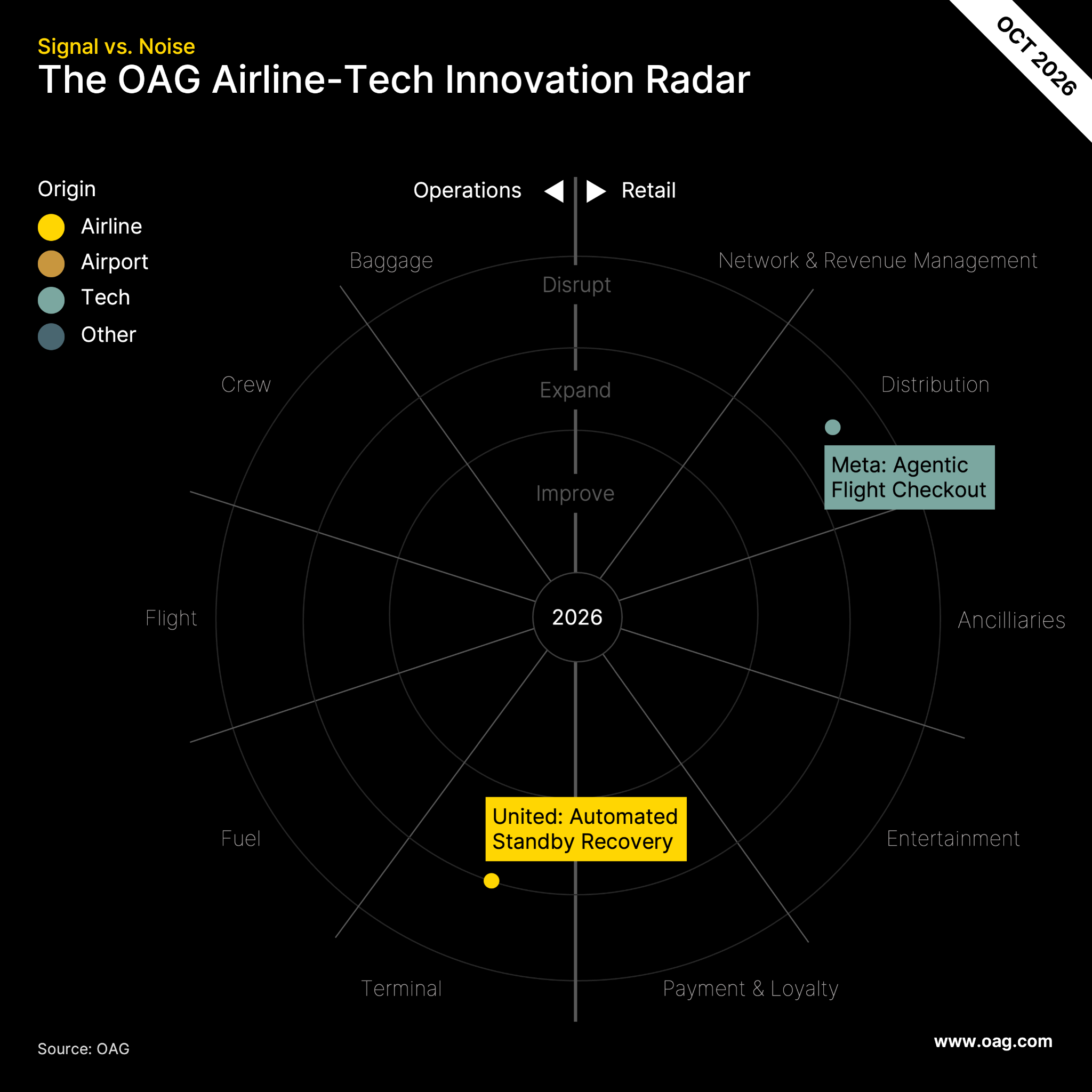
United moved that job into its app, launching the feature just ahead of a busy holiday weekend, when it expected around 3.4 million customers.
Here's how it works:
- When a disruption pushes a customer onto a later flight, the United app lets them join standby for up to three earlier United flights to the same destination.
- The confirmed seat on the later flight stays in place, so standing by carries no risk of ending up with nothing.
- United monitors seat availability in the background, so customers no longer have to keep checking.
- When a seat opens up, the customer receives a text message and can switch to the earlier flight.
- The feature sits alongside United's existing self-service recovery tools (automatic rebooking, meal and hotel vouchers where eligible, and checked-bag tracking), all available without speaking to an agent.
Why does this innovation stand out?
On paper, this is a small feature. In practice, it changes who carries the burden of a disruption. Standby has always required the passenger to ask, to stay close, and to keep checking.
United is turning it into a monitoring task the airline runs on the passenger's behalf, with a confirmed fallback in place.
That is such a structural shift in disruption recovery.
It also builds directly on last month's radar edition, where we looked at systems that stop making travellers repeat information the journey should already know. This is the natural next step: systems that stop making travellers wait for information the airline already has.
United knows when seats free up. Until now, finding out was still the passenger's job.
Reach matters here, too. According to United, more than 85% of its customers use the app on travel days, so a feature like this can reach most of the people affected by a disruption without adding a single agent at the airport. United is a regular on our radar, going back to its AI-written weather delay messages, and disruption communication has been a recurring thread in its innovation work.
In all fairness, the details that decide the real value of this feature have not been published.
- How quickly does a customer have to accept an open seat?
- How is standby priority set between app users and passengers at the desk?
- And how often do seats actually open up on disrupted days, when earlier flights tend to be full?
United calls this an industry first, and we have not seen an equivalent automated version elsewhere. It is also the kind of feature competitors can copy quickly, so the more telling question may be which servicing systems are flexible enough to follow.
Innovation #3: The FAA starts testing SMART on live traffic
After an agent that shops and an app that waits, our third innovation works on a much larger scale: the national airspace.
We should acknowledge something up front. We do not usually return to the same innovation this soon. In our July edition, we covered the FAA's $875 million contract with Air Space Intelligence (a Boston-based aviation AI scaleup) to build its new flow management data backbone and SMART, the predictive layer that runs on top of it.
At the time, we said the launch date would tell us more than the contract value. We also asked how SMART's recommendations would be tested, and how airlines would know why a flight had been moved.
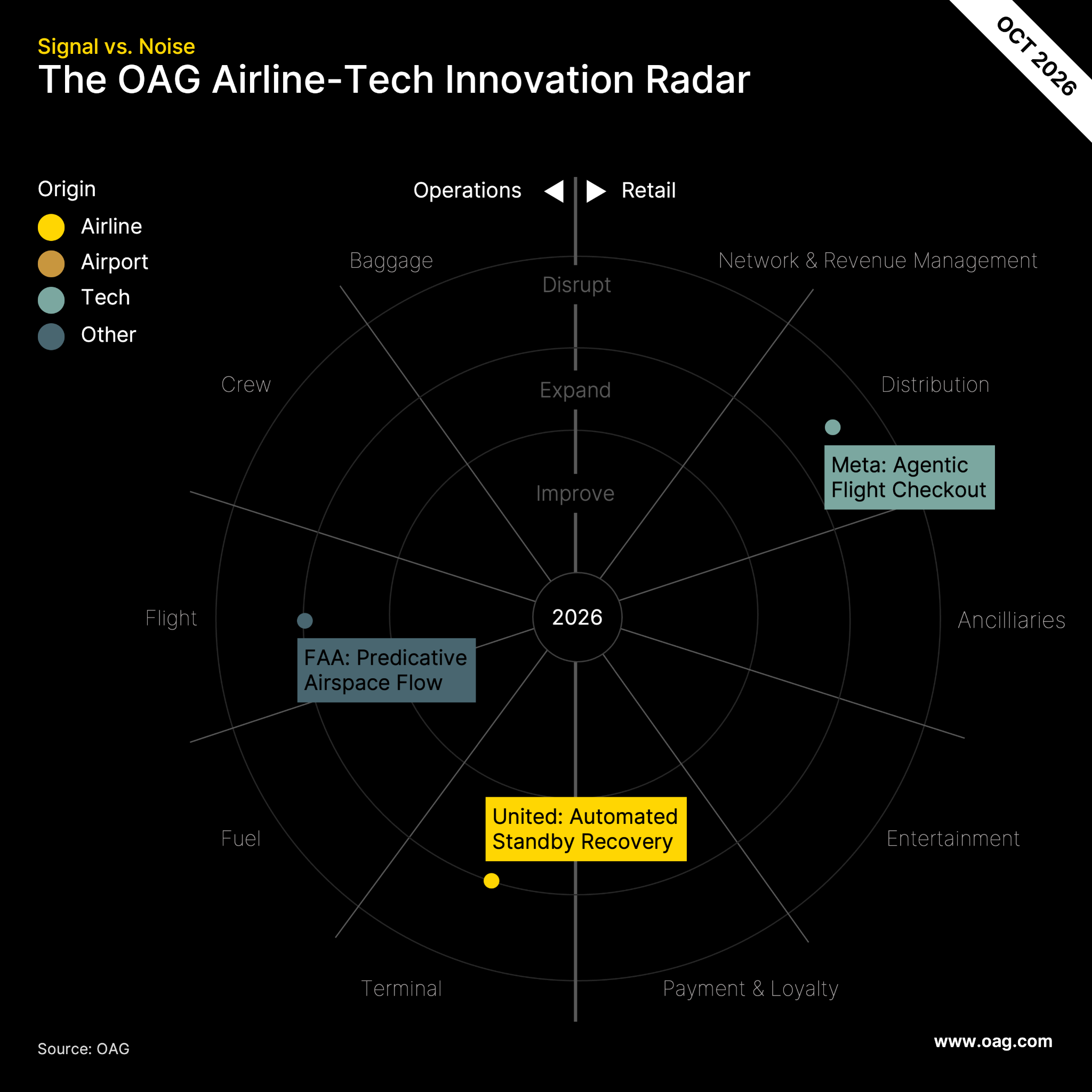
The date held. The FAA began testing SMART in a limited mode, starting in the Washington area, with a 90-day trial before any wider rollout. That is why it earns a second look.
Here's how it works:
- SMART (Strategic Management of Airspace, Routes and Trajectories) brings together roughly 200 data streams, including weather patterns, flight trajectories, traffic flow and controller staffing.
- Instead of only tracking where weather and congestion are, it forecasts where they are heading, giving controllers and aircraft operators a shared view of the airspace before flights depart.
- The aim is earlier, smaller inteventions (adjusting flows before departure) rather than larger ones once holding patterns and ground stops become necessary.
- It is decision support, not automation, because controllers retain authority over the airspace, and the first 90 days focus on testing the predictions' reliability.
What makes this innovation so special?
The airline reaction is the most telling part of this story. Before the trial began, airlines raised concerns that SMART's recommendations, if applied too aggressively, could lead to more cancellations and schedule changes. FAA Administrator Bryan Bedford briefed American, Delta, Southwest, and United. Afterwards, United CEO Scott Kirby said that if it works as expected, it "will do more to reduce delays and cancellations than anything that's happened in decades."
That mindset shift says a lot. The barrier to predictive air traffic management was never only technical. It was trust. That is the waiting question at the heart of this edition. Today, much of the network waits for congestion to form before acting. SMART tries to move that decision earlier, which means asking airlines to accept a small, certain cost in exchange for avoiding a larger, uncertain one.
The 90-day trial is the honest test, and it is worth being clear about its limits.
- It does not (yet) prove that SMART's predictions are accurate enough for airlines to plan around.
- It does not (yet) prove that earlier interventions reduce total delay rather than simply redistribute it.
- And it does not (yet) answer how the system will explain its recommendations to the airline operations teams that have to act on them.
What we can say is that predictive, AI-supported flow management is now running on live US traffic, which is a meaningful step beyond the contract we covered at the time.
Wrapping up this month's radar
That’s it for this edition. In our view, October may be the most significant Airline-Tech Innovation Radar of the year so far. All three launches sit in the disruptive category, because each changes the timing of a decision that used to depend on human watching and waiting. Will they succeed? Only time will tell.
Stay tuned for our next edition in November.