

Welcome back to the OAG Airline Tech Innovation Radar, where each month we cut through the noise of press releases and keynote promises to spotlight the three real-world launches that genuinely move the aviation industry forward.
If our early-2026 editions argued that AI could only matter once the commercial stack beneath it was ready, this month is where that readiness starts to pay off. Over the past few weeks, AI stopped solely suggesting flights and actually began transacting them. And there is more: AI has also quietly pushed past the booking screen toward the actual flight deck.
We will be upfront about one thing: all three of this month's Innovation Radar picks are AI stories. That is definitely not an editorial habit, but an accurate reading of where the current tech energy in aviation is clearly going.
Here's what made our radar this month:
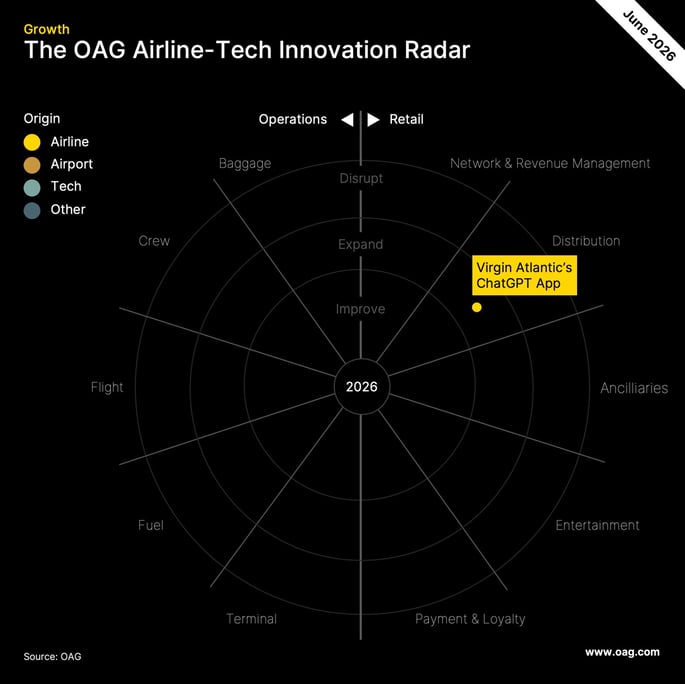
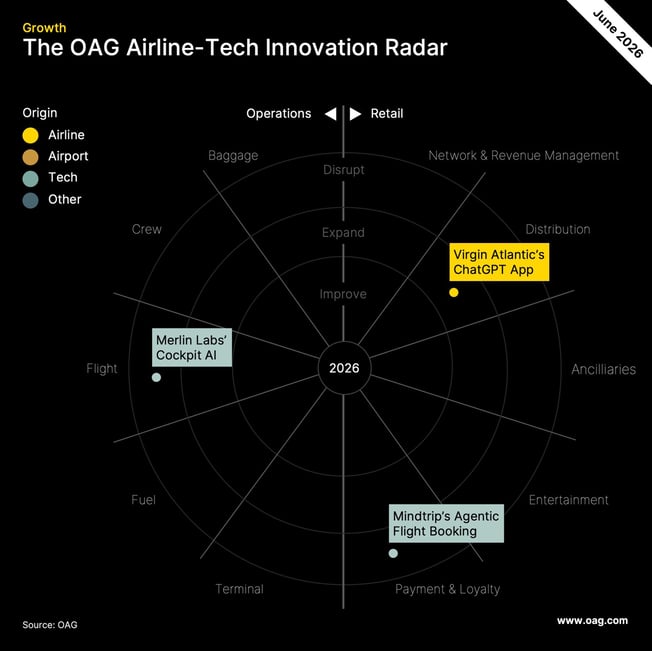
- Virgin Atlantic became the first airline to launch an app inside ChatGPT, moving the start of the booking journey onto the surface where many travellers now begin.
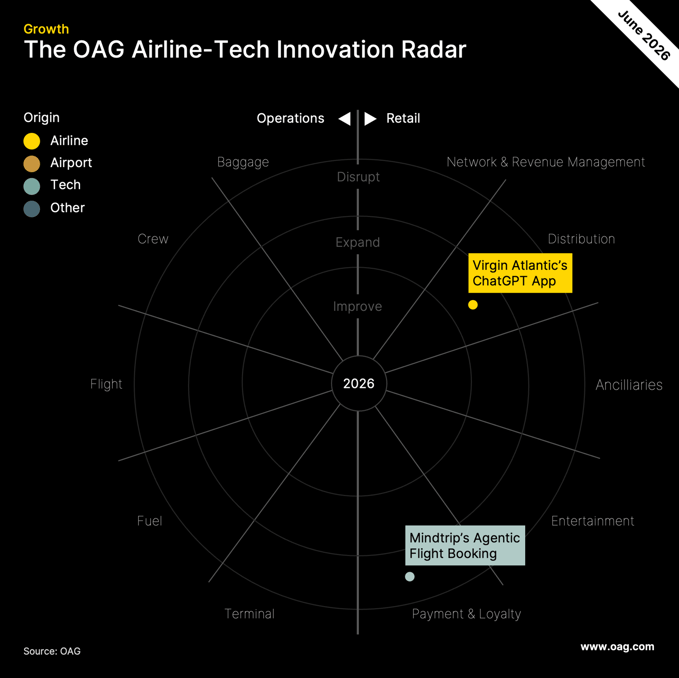
- Mindtrip, Sabre, and PayPal shipped what many believe is travel's first all-in-one agentic flight booking experience.
- Merlin Labs unveiled Condor, bringing certifiable AI autonomy to large aircraft, starting with cargo freighters.
Let's examine each one in more detail.
Innovation #1: Virgin Atlantic moves into ChatGPT
For two years, airline retail has circled the same uncomfortable question:
If travellers increasingly start their planning inside a chatbot, what happens to the airline that waits for them to arrive at its own website? Especially when research from Bain & Company shows that LLMs systematically prioritise sending travellers to OTA websites over airline.com sites.
Last month, Virgin Atlantic gave its answer by becoming the first airline to launch a dedicated app inside ChatGPT itself, built with OpenAI and experience studio Tomoro. Rather than hoping to be found, the carrier planted its flag where the search now begins.
Here's how it works:
- Travellers ask natural-language questions inside ChatGPT, for example, which flights run to Miami in December, and receive a summarised list of route and fare options drawn from Virgin's own network.
- The app builds on Virgin's existing Concierge assistant, which already handles holiday planning, Flying Club loyalty queries, and general travel questions across text, voice, and image
- Importantly, ChatGPT handles discovery only, meaning once a traveller is ready, they are handed off to Virgin's website or mobile app to complete payment and booking.
Why does this innovation stand out?
This is not another generative assistant bolted onto an airline's own app. It is an airline choosing to live inside someone else's platform. The branded chatbots we have tracked for the past year (for example, Delta’s Concierge) all assume the customer comes to the airline. Putting a Virgin Atlantic experience directly inside ChatGPT inverts that assumption and meets the customer at the moment of intent, before they reach a metasearch engine or an OTA.
It also continues a pattern we flagged when Iberia entered the GPT Store in June 2025:
- OpenAI is methodically signing up carriers, and the centre of gravity for flight discovery is drifting toward the consumer AI layer.
- Virgin's move is the most direct expression of that drift so far, because the experience is native to ChatGPT rather than a GPT Store entry.
The obvious limitation is that the booking loop does not close inside ChatGPT. Payment and the final booking still happen on Virgin's own channels, which is sensible for now but leaves the carrier exposed if a rival closes that gap first.
Innovation #2: The agentic loop finally closes
Ever since we covered OpenAI's Operator AI agent in February 2025, agentic booking has been the industry's favourite promise and its most reliable disappointment. Agents could more or less reliably search and compare, but the moment of truth, aka paying for a real ticket on real inventory, kept tripping them up. Last month, however, Mindtrip seems to have closed that loop. Working with Sabre and PayPal, the AI travel platform launched Mindtrip Flights, which it bills as travel's first all-in-one agentic flight booking experience, carrying a traveller from inspiration to paid ticket without leaving the conversation.
Here's how it works:
- Travellers describe a trip in plain language instead of filtering long result lists. The agent weighs tradeoffs such as price against convenience and surfaces the options that matter most.
- Sabre's AI-native Mosaic platform then supplies agentic-ready Air APIs, giving the agent real-time fares, fare-rule awareness, and the ability to actually book.
- PayPal's agentic commerce services let the traveller pay inside the same conversation, so discovery, comparison, and transaction all happen in one place.
Why does this innovation stand out?
Two things make this launch so important and meaningful.
First, it (finally) proves that the agentic stack is indeed operational and not merely theoretical. The missing piece was never the conversation; it was the plumbing: governed access to fares and a trusted way to pay. By stitching together a major GDS and a major payments network, Mindtrip turned a demo into a working purchase path.
Second, the launch shows where the value actually sits. The headline belongs to a startup, but the launch runs on Sabre's rails, so the same provider whose AI-enhanced continuous pricing we featured last November. Sabre also points to an assurance layer in its enterprise AI, built to keep agents from inventing fares or dates and to provide the audit trail that serious commerce requires.
It is worth contrasting this with the much louder AI event last month. At Google I/O 2026 on May 19-20, Google announced that it extended agentic booking to more users and previewed flight and hotel booking. But those travel transactions remain in development, continuing the groundwork for the Universal Commerce Protocol we noted in our early-2026 edition.
Compare this with Mindtrip, which simply shipped. For airlines and online travel agencies, that is the mission-critical signal: when any capable front-end can transact air content through a GDS and a payment agent, the question stops being whether agentic booking arrives and becomes who the agent chooses, and on what terms.
There is a reassuring subplot here, too. Far from being disintermediated, the GDS re-emerges as critical infrastructure for the agentic era. Agents need governed, fare-aware rails, and that is exactly what a modern offer-and-order platform provides.
If successful, this model could let a thousand AI front-ends bloom while the transaction quietly settles on the same few rails beneath.
Innovation #3: AI also reaches the cockpit
After two stories about the booking funnel, it is worth remembering that the most consequential AI in aviation may end up nowhere near a passenger's phone. Last month, Merlin Labs (a US-based aerospace autonomy company focused on developing AI systems that can operate aircraft across military and commercial missions) unveiled Condor, a product family that brings its aircraft-agnostic AI autonomy core to large, multi-crew aircraft, starting with Merlin Pilot for Commercial Cargo.
The newly listed company is taking the cautious, freighter-first route into a problem the whole industry has circled for years: what happens when software, not just autopilot, can fly the aircraft.
Here's how it works:
- An aircraft-agnostic autonomy core handles all phases of flight and uses a natural-language model to listen to air traffic control and respond over the radio.
- Condor targets large multi-crew aircraft, from Part 25 jets to military transports such as the C-130J, and is coming to market first on cargo freighters.
- A human safety pilot remains the legal pilot-in-command under a crawl-walk-run certification path pursued jointly with US and New Zealand regulators.
- The same core is under contract with the United States Special Operations Command, giving the system a demanding military proving ground while civil certification advances.
Why does this innovation stand out?
Commercial aviation has been quietly automating for decades (from fly-by-wire to today's flight management systems), so a degree of scepticism is healthy. What is different here is the ambition and the credibility behind it. Merlin is now publicly listed, has raised more than $200 million, and says it has logged hundreds of test flights across multiple aircraft types. Starting with cargo is a shrewd wedge: freight missions are often flown single-pilot, are high-pressure, and put real strain on crew supply and cost, so precisely where an AI co-pilot can earn its keep without first asking passengers to trust it.
The honest constraint is certification, not technology. Regulators are only beginning to build frameworks for assuring machine learning in safety-critical systems, and pilot unions are understandably firm that two trained, rested pilots remain the most important safety feature on any flight. Merlin's measured framing of keeping a safety pilot in command and treating the military as the first proving ground reads as a company that understands the trust problem as clearly as the engineering one.
If it works, the implications could ripple outward from the cargo ramp. Easing the pilot-supply crunch and reducing the cost of multi-crew operations would reshape freight economics first and, over a much longer horizon, the calculus of passenger flying.
Whether AI in the cockpit truly reshapes operations, or remains a carefully supervised co-pilot for years to come, is still an open question. Either way, it is a reminder that this year's most important Airline-Tech story might not be about how we book at all, but about how we fly.
Beyond the three: What else caught our eye
In all fairness, the last few weeks were not short of non-AI innovation worth noting either.
For example:
- Hong Kong International Airport opened a biometric-first terminal
- And American Airlines committed its 500-aircraft network to Starlink, extending the connectivity race we have tracked since United and Air France went low Earth orbit.
But the agentic milestones mentioned above simply would not let anything else through.
We will see how this develops over the remaining weeks of June, especially as PhocusWright Europe takes place, where we expect much of this agentic debate to move from the page to the stage.
We will be there, we hope you will be too - and you can also catch Filip Filipov on Tuesday 16th June at 16.20 presenting: AI, Disruption and the New Logic of Travel.