
Some months, the quieter signals carry the bigger implications. Last month, we tracked how agentic AI may have crossed a threshold on the distribution side of travel, with Sabre, PayPal, MindTrip, Malaysia Airlines, and Skyscanner all racing to build the booking interface of the future.
This month, the innovation story moves backstage: to the flight deck, the baggage hall, and the airport operations centre. None of these three innovations is a flashy consumer-facing product launch. But all three could change how the industry operates at a structural level.
Key summary:
- American Airlines and Google used AI to cut contrail formation by 62% across 2,400 transatlantic flights - with just a 0.3% fuel penalty - by suggesting minor altitude adjustments to pilots before departure.
- SITA integrated Google's Find Hub into WorldTracer, the global baggage system used by 500+ airlines, letting passengers share their bag's real-time location directly with airline recovery teams via Android.
- Heathrow Airport selected the AIRHART platform to replace its legacy systems with an AI-driven operations platform - unifying gate management, disruption forecasting, and ground coordination in one place.
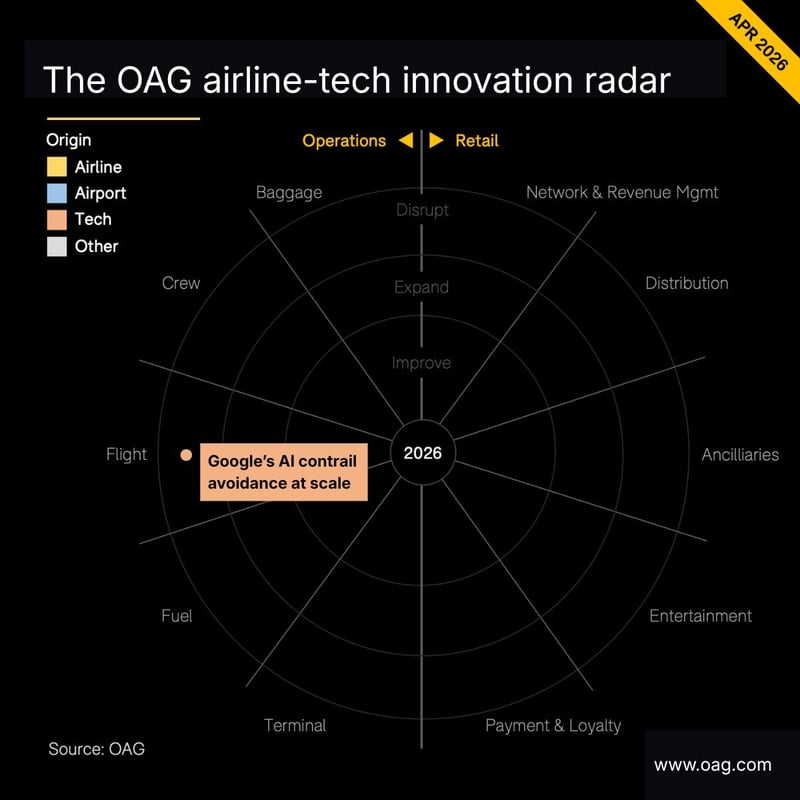
Innovation #1: American Airlines and Google cut contrails by 62% with AI
Aviation’s climate conversation has long been dominated by two topics: Sustainable Aviation Fuel (SAF) and more efficient aircraft. Both are expensive. And both are slow to scale. But there is a third lever that is neither: smarter routing.
American Airlines and Google Research published the results of a landmark trial that could reshape how the industry thinks about its warming footprint. Working alongside flight planning provider Flightkeys and nonprofit Contrails.org (part of Bill Gates’ Breakthrough Energy), the two companies integrated AI-driven contrail forecasts directly into American Airlines’ operational flight planning workflow covering 2,400 transatlantic flights.
Here’s what they did:
-
Google’s AI analysed weather and satellite data to generate “contrail risk maps” that identified atmospheric regions where persistent contrails are most likely to form.
-
These forecasts were embedded in American Airlines’ standard flight-planning software (via Flightkeys), alongside traditional considerations such as turbulence and wind patterns.
-
Dispatchers then suggested minor altitude adjustments, often just 1,000 to 2,000 feet, to pilots before departure to bypass ice-supersaturated regions.
-
The system assigned a “Contrail Forcing Index” on a scale of 0 to 4, functioning like a turbulence forecast but for climate impact.
-
Because only a small share of flights accounts for the majority of contrail warming, rerouting approximately 15% of departures is sufficient to yield a significant climate benefit across an airline’s entire operations.
Why does this innovation stand out?
The numbers speak for themselves. And while we cannot independently verify them, there is little reason to doubt them.
-
Among the flights that followed the AI recommendations, contrail formation dropped by 62%.
-
The estimated warming effect from those flights fell by a staggering 69%.
-
The fleet-level fuel penalty was just 0.3% (a cost that Google's models suggest is more than 20 times outweighed by the climate benefit).
Two things make this trial particularly noteworthy.
First, contrail avoidance is no longer a theoretical lab experiment. An initial proof of concept completed in 2023 involved 70 manually coordinated flights and achieved a 54% reduction in contrails. This 2026 trial embedded the technology into American Airlines' real operational systems, with dispatchers and pilots using it in their normal workflows. That shift from prototype to operational integration is the real story here.
Second, the project addresses a warming factor that is often overlooked. Contrails are responsible for an estimated 35% or more of aviation’s total climate impact. Unlike carbon dioxide, which accumulates gradually, contrails trap heat immediately. And unlike SAF, which requires massive new supply chains and remains expensive, AI-driven contrail avoidance works with existing fleets, existing software, and existing fuel.
The competitive implications are also worth noting. The Contrail Impact Task Force (an industry coalition formed to accelerate the scaling of contrail-avoidance technology) now includes Alaska, American, Southwest, United, and Virgin Atlantic, alongside Airbus, Boeing, and Google Research. Its formation reflects a rare moment of pre-competitive collaboration: airlines and manufacturers aligning around a shared operational and climate objective rather than treating it as a differentiator. Google has confirmed it is working with additional airline partners globally. In Europe, French carrier Amelia and Thales reported that their own contrail avoidance deployment avoided more than 2,000 tonnes of CO2 equivalent in 2025 by modifying just 59 flights out of more than 6,400 operated. Contrail avoidance is a trend that is scaling fast.
Sidenote: Google has appeared on our OAG Airline Innovation Radar seven times since we launched this series in February 2024, which is more than any other actor. But this is the first time Google's innovation sits squarely on the operations side of the radar, not the retail side. Arguably, it is also the most consequential.
Innovation #2: SITA and Google bring Find Hub into aviation's global baggage system
If Innovation #1 shows Google tackling aviation's climate footprint from the sky, Innovation #2 shows the tech giant solving a very different problem on the ground: finding missing bags.
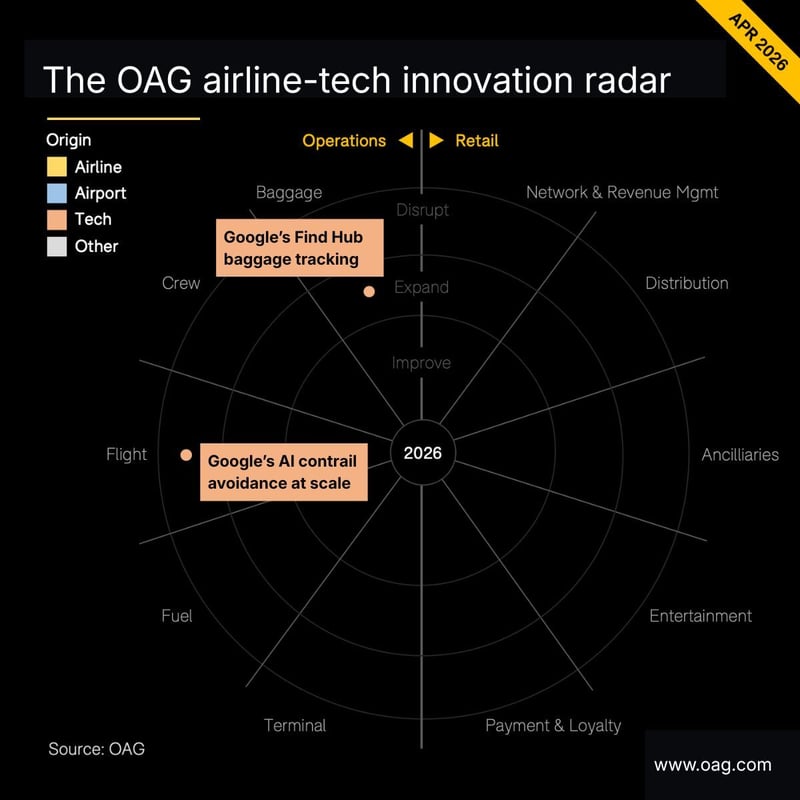
Just a few weeks ago, SITA announced the integration of Google’s Find Hub share item location feature into WorldTracer, the global baggage tracing system used by more than 500 airlines and ground handlers across approximately 2,800 airports. The integration enables passengers to share their bag’s real-time location from Android devices directly with airline recovery teams, inside the same system staff already use to trace delayed luggage.
Here’s how it works:
-
When a bag is delayed, the passenger generates a secure, time-limited link in the Find Hub app on their Android device that shows their tracker’s current position on a map.
-
The passenger shares this link with the airline (via the carrier’s app, website, or baggage service desk).
-
SITA’s integration surfaces the location data within WorldTracer’s existing screens (frontline staff do not need a new tool).
-
Sharing can be stopped at any time by the passenger. Links expire automatically after seven days, and sharing ends when the system detects the bag has been reunited with its owner.
-
Google’s Find Hub relies on a crowdsourced network of millions of Android devices worldwide that anonymously detect compatible Bluetooth trackers.
Why does this innovation stand out?
This is the second major consumer tracking integration into aviation's core baggage infrastructure. We tracked the first in our December 2025 edition, when Apple's AirTag integration with Delta and WorldTracer demonstrated the concept. SITA reported a 90% reduction in permanently lost luggage from the Apple integration alone. The Google rollout extends this capability to the much larger global Android user base.
What makes the Find Hub integration structurally so significant is the scale of adoption. More than ten airlines, including the Lufthansa Group (Lufthansa, Austrian Airlines, Brussels Airlines, and Swiss International Air Lines), Air India, Turkish Airlines, Scandinavian Airlines, Saudia, China Airlines, and AJet already accept Find Hub locations as part of their baggage recovery process. Qantas is expected to join soon. And Google is working with Samsonite to embed Find Hub technology directly into new luggage designs.
The broader pattern here matters: What started as a niche use of consumer Bluetooth trackers has become official aviation infrastructure. SITA and Reunitus (which operates the NetTracer platform) have both integrated the technology. The industry's 67% reduction in mishandling rates over the past two decades (achieved even as passenger volumes more than doubled) is now being accelerated by something airlines never built themselves: the tracking network already sitting in passengers' pockets.
Innovation #3: Heathrow gets an AI-powered digital backbone
For our third and final innovation, we move to the command centre that keeps flights, gates, and ground operations in sync: the airport operations centre.
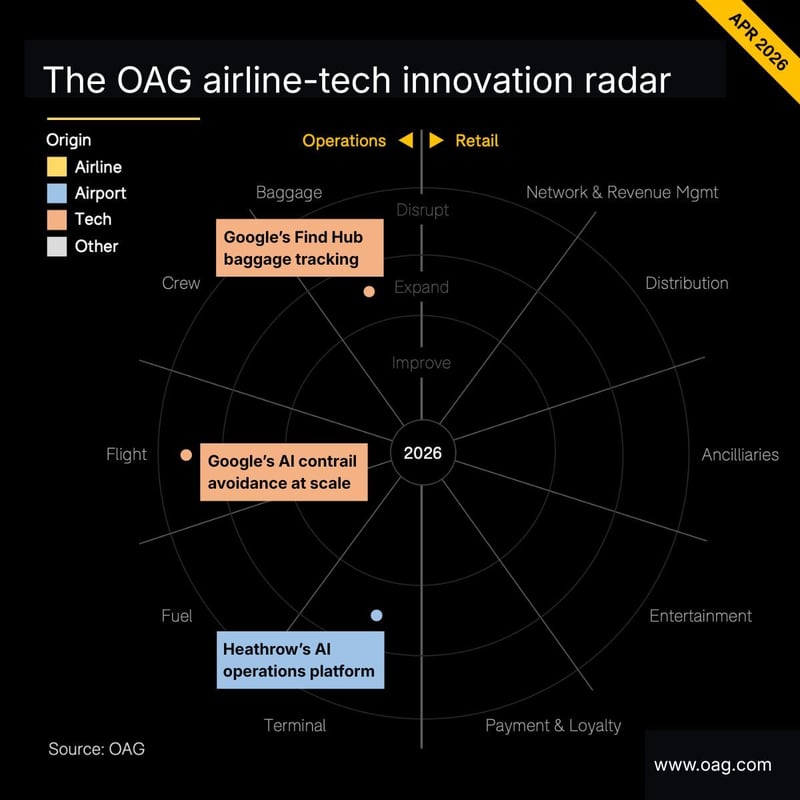
Heathrow Airport recently selected the AIRHART platform from Smarter Airports (a joint venture between Copenhagen Airports and Netcompany) as its new digital backbone. The multi-year program will replace Heathrow's legacy systems with a next-generation orchestration platform designed for AI-driven, data-centric operations.
Here's how it works:
-
AIRHART replaces Heathrow's existing Airport Operational Database (AODB) with a unified, next-generation data foundation.
-
It introduces enhanced Airport Collaborative Decision Making (A-CDM), improving real-time coordination across airlines, ground handlers, air traffic control, and terminal operators.
-
A predictive Airport Operations Plan (AOP) enables continuously optimised operations aligned with European and international standards.
-
The platform provides AI-driven disruption forecasting, anticipating congestion, gate conflicts, and turnaround delays before they cascade.
Why does this innovation stand out?
Obviously, Heathrow is not just any airport. It is the busiest airport in Europe, operating at 99% capacity with just two runways and handling over 84 million passengers annually. Every marginal efficiency gain at Heathrow translates into measurable capacity improvement.
What makes AIRHART's selection strategically so significant is the pattern it confirms. Copenhagen and Munich, both digitally progressive European hubs, have recently adopted the platform.
Now, in all fairness, the transition is anything but simple.
Daniel Ezban, CEO of Smarter Airports, described the implementation as "doing heart surgery while running a marathon," which is a fitting metaphor for replacing the core operational nervous system of an airport that never stops operating. The phased implementation will run legacy and new systems in parallel before completing the transition.
For the broader industry, Heathrow's choice potentially validates a model in which airports stop buying point solutions for individual problems (such as stand management, baggage flow, and gate assignment) and instead invest in a platform layer that coordinates everything. If AI is going to transform airport operations, it needs a unified data foundation to work from. That is exactly what AIRHART provides.
By the way, we featured Heathrow on this radar once before, in December 2024, when we highlighted the AIMEE AI system. Why do we bring this up? Because AIRHART represents the infrastructure layer that systems like AIMEE will ultimately run on.
Wrapping up April’s Innovation Radar
If last month was about the future of how travellers book, this month is about the future of how the industry operates. None of these headlines made the front page. But all three could define how aviation runs in the years and decades ahead.
We hope this edition serves as a reminder that the most consequential innovation does not always happen where customers can see it. That's it for April. See you again in May, when we continue tracking the innovations reshaping Airline Tech in 2026.