Welcome back to the customer interface.
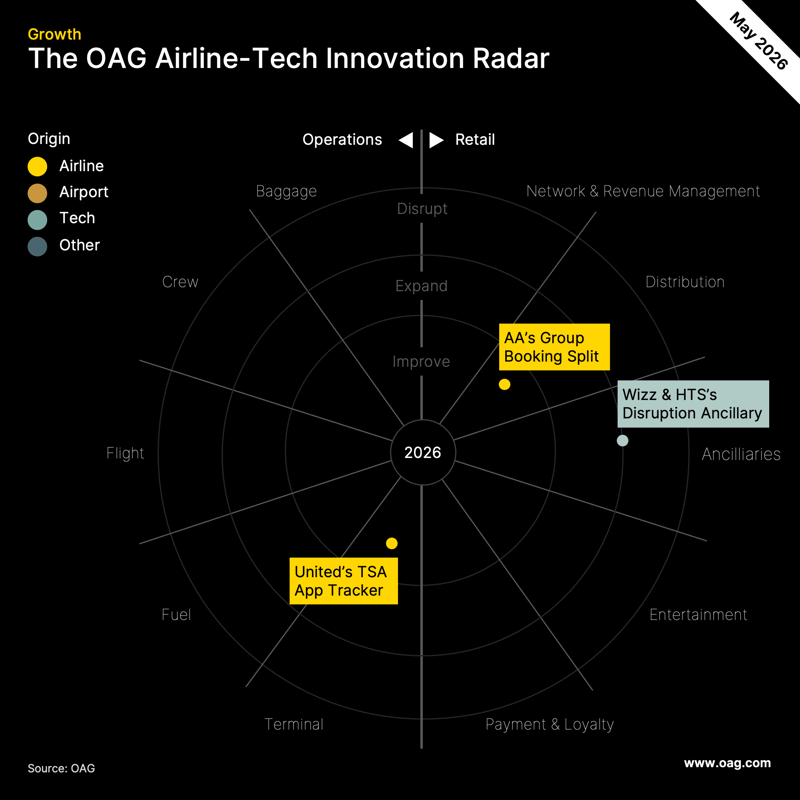
Last month's Innovation Radar edition took us backstage along the flight deck, the baggage hall, and the airport operations centre. The innovations we tracked in April were largely invisible to the traveller, but consequential for the industry's operational foundation.
May brings a different story.
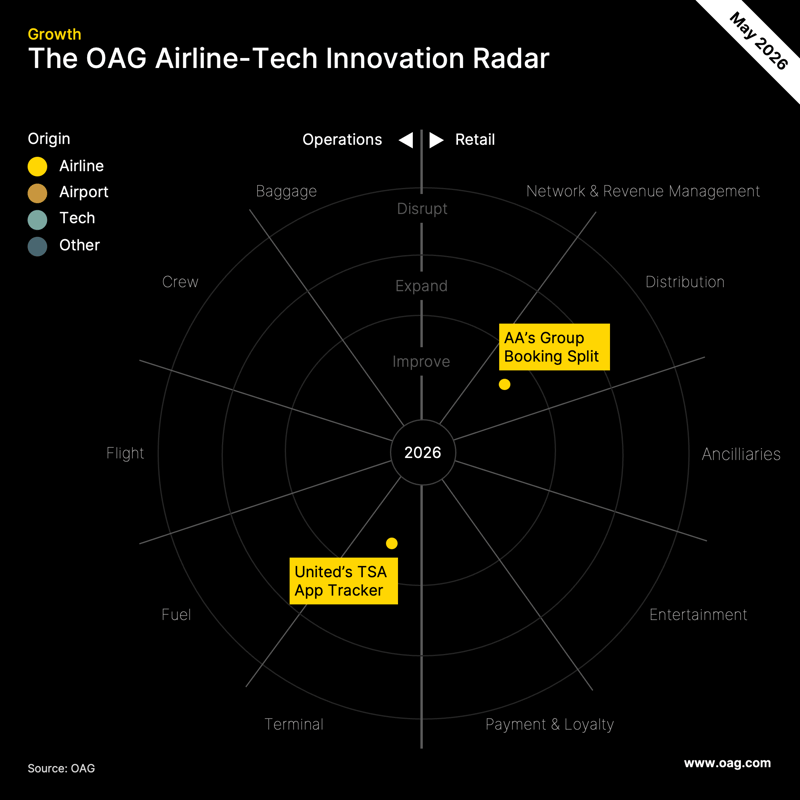
This month, all three innovations sit squarely at the customer interface, and they share a common thread: the industry's most persistent traveller pain points are finally being addressed with serious digital intent.
Waiting times, flight disruptions, and the friction of group travel have been cited as sources of frustration for as long as commercial aviation has existed. What is new is how airlines are responding.
The first two innovations leverage digital self-service to put travellers more in control. The third takes that logic further by turning disruption from a cost centre into a monetisable ancillary.
Innovation #1: United Airlines puts TSA wait times in travellers' hands
If there is one pain point that unites travellers across every region, segment, cabin class, and carrier, it is excessive waiting times. In particular, the anxiety of not knowing how long the baggage drop-off and security line will take before flight departure is nerve-wracking, given the risk of missing one's flight.
United Airlines is now doing something about it. At least, about the latter.
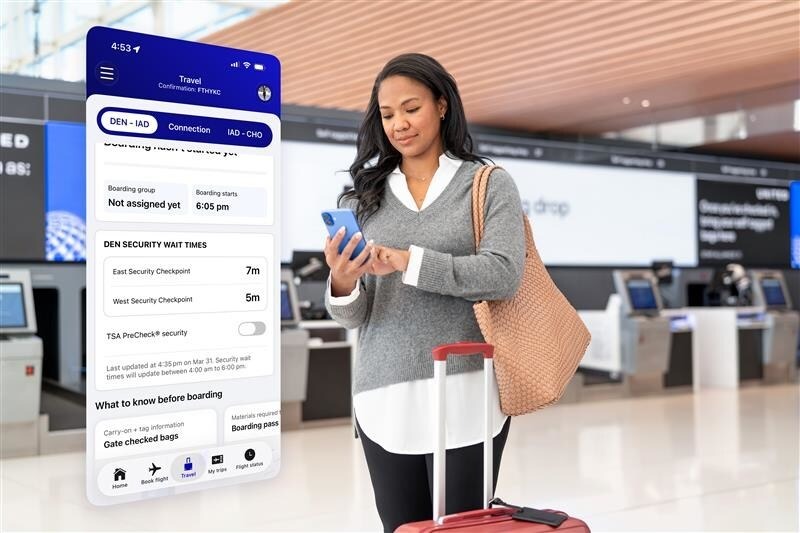
In early April, United announced the addition of a TSA wait time tracker to its mobile app, a first among major U.S. carriers. The feature is live across all of United's U.S. hub airports: Chicago, Denver, Houston, Los Angeles, New York/Newark, San Francisco, and Washington D.C.
Here's how it works:
- The tracker provides regularly updated estimated wait times for TSA security lanes throughout the day, pulling from data collected by the airline.
- It covers specific lane types, including standard security and TSA PreCheck, across terminals serving United customers.
- Travellers access it through the Travel section of the United mobile app, giving them the information before they leave for the airport or while navigating the terminal.
Why does this innovation stand out?
Security wait times are one of the most consistently cited sources of traveller stress. The uncertainty of the queue (not necessarily the queue itself) drives anxiety, poor planning decisions, and missed connections.
What makes this more than a minor feature update is its context within a broader app strategy. United has been quietly building one of the most comprehensive day-of-travel toolkits in the airline industry. The same app now includes a package-delivery-style bag tracker with Apple AirTag integration, turn-by-turn directions to connecting gates with estimated walk times, automatic rebooking with meal and hotel vouchers, and real-time weather radar alerts generated with the help of Gen AI. The TSA tracker is the latest addition to what is becoming a genuine travel operating system.
The timing of the announcement is also worth noting. The feature launched during a period of uncertainty around TSA staffing, with the U.S. Department of Homeland Security shutdown affecting agent pay.
- United's CIO Jason Birnbaum cited this context directly, framing the tracker as a transparency tool for travellers who want to stay informed.
- Whether driven by operational empathy or competitive positioning, the effect is the same: United is giving its customers more control over one of the most stressful moments in any journey.
For the broader industry, this is another signal in the ongoing shift from airline apps as booking and boarding tools to airline apps as end-to-end journey companions.
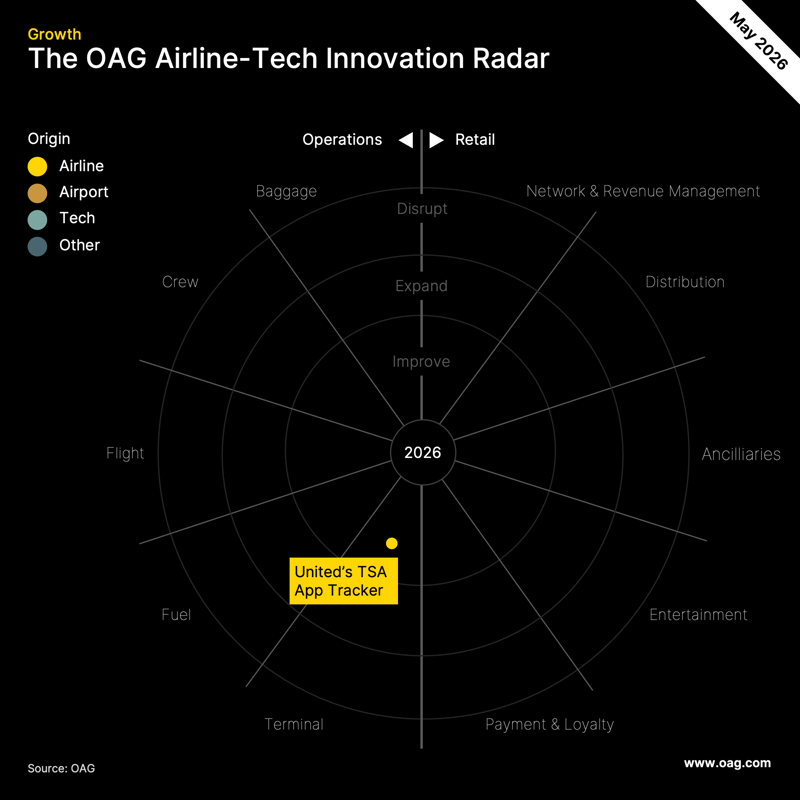
Innovation #2: American Airlines brings group booking flexibility to its app
If Innovation #1 shows United raising the bar on pre-journey transparency, Innovation #2 shows that United is not alone in taking its mobile app to the next level.
American Airlines is moving fast to close the gap on digital self-service disruption management while quietly introducing something the entire U.S. airline industry has never offered before.
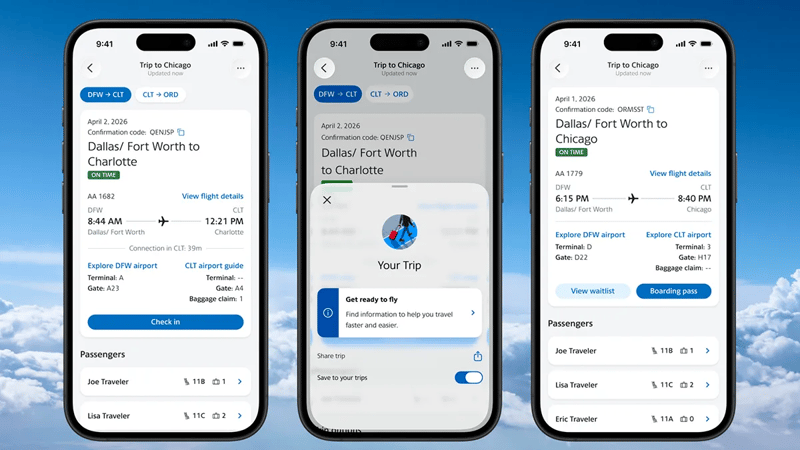
Last month, American Airlines unveiled a significant upgrade to its mobile app, centred on giving passengers more direct control over their itineraries when things go wrong and when travel plans evolve.
Here's how it works:
- Passengers whose flights are delayed or cancelled can now view the specific reason for the disruption and access rebooking options, bag tracking, and digital meal or hotel vouchers in a single in-app hub.
- Gate-to-gate maps with walking time estimates help connecting passengers navigate airports more confidently.
- Expanded in-app purchases include Priority Group 4 boarding and discounted AAdvantage miles during check-in.
- A redesigned interface simplifies seat selection, upgrades, and special requests.
But the standout feature coming in the next few months is the ability to split a joint reservation into separate itineraries directly in the app, allowing one traveller in a group booking to change their plans without affecting the rest of the party.
Why does this innovation stand out?
Most of the disruption management upgrades represent American catching up to where United and Delta already are.
- The Fly Delta app has offered interactive airport maps and real-time bag tracking for many years.
- United's Connection Assistant and automatic voucher pushing have set the industry benchmark for digital recovery.
American's new all-in-one disruption hub brings the carrier to parity, which definitely matters, but it is not the headline.
The true headline is the group booking split feature. And it deserves more attention than it is getting.
- Group travel has been one of the most consistently underserved segments in airline digital products for years.
- The mechanics of a joint reservation (meaning a single PNR shared across multiple passengers) have always created friction the moment one traveller's plans diverge from the group.
- Until now, splitting that record required calling the airline or working through a GDS: a process designed for travel agents, not travellers.
- American is about to change that with a self-service split directly in the app.
This matters because group travel is not a niche use case. Family holidays, corporate off-sites, wedding parties, and sports tours account for a significant share of airline revenue.
And the pain point is well understood: groups are made up of individuals, each with their own preferences, comfort zones, and travel motivators. The inability to manage that flexibility digitally has long been a source of frustration. American's solution acknowledges a structural reality that the industry has been slow to address.
Innovation #3: Wizz Air and HTS turn disruption into a paid ancillary
If Innovation #2 shows American Airlines giving passengers better tools to manage disruption, Innovation #3 takes that logic one step further. Wizz Air and HTS decided they do not just manage disruptions better, they are monetising them.
Flight disruption is one of the most consistently destructive experiences in aviation. It costs airlines money, exposes them to regulatory scrutiny, and burns through customer trust faster than almost any other operational failure.
For most carriers, the response has been reactive: handle the chaos, follow the rules, hope the customer comes back.
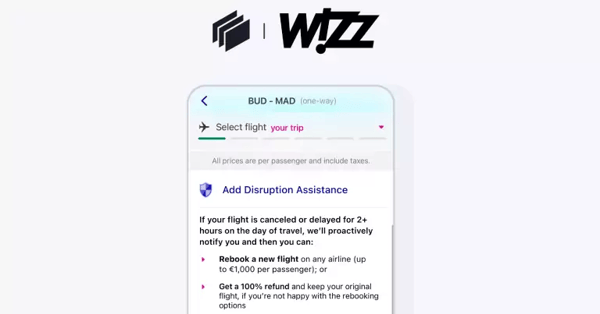
Wizz Air and HTS (Hopper Technology Solutions) announced a different approach less than two weeks ago: Wizz Air becomes the first European carrier to offer Disruption Assistance, a paid ancillary that proactively rebooks passengers, and here is the critical part, including onto competitor airlines, when their flight is delayed two hours or more (or cancelled outright). The service kicks in well before EC261 obligations apply.
Here's how it works:
- Passengers can add Disruption Assistance as an optional ancillary product during the standard Wizz Air booking flow on the website or in the app.
- On the day of travel, HTS monitors the booking in real time. If the flight is delayed by two or more hours or is cancelled, the system automatically notifies the passenger.
- The passenger receives a curated set of alternative flight options to their final destination, including on competitor airlines, free of charge up to a set cap.
- If none of the alternatives work, the passenger can take a full refund while keeping the original booking option open.
So far, HTS reports a 95% customer satisfaction rate and an 82% repeat purchase rate from prior deployments of the product in other markets.
Why does this innovation stand out?
First, it inverts the commercial logic of disruption. For most airlines, a cancellation is an unrecoverable event resulting in legal exposure, customer service overhead, vouchers, refunds, and lost goodwill. Wizz Air and HTS have packaged the worst-case scenario into a fintech-style ancillary product that customers pay for upfront. The disruption itself becomes the trigger for value, not just for cost.
Second, the cross-airline element is the real shift. European passengers can already buy travel insurance, and many major carriers have rebooking tools for their own networks. What is genuinely new here is the willingness to automatically send a paying customer onto a competitor's flight as part of the product promise.
That is a structural break from the way most airlines think about loyalty and inventory.
The timing also matters. Eurocontrol forecasts a 5.8% rise in European passenger demand and a 3% rise in flights for summer 2026, with cascading delay risk well above historical norms. The carriers that find ways to monetise rather than absorb that disruption could shift the economics of European low-cost flying.
We will watch closely whether Ryanair, easyJet, or Air France-KLM follow with similar products in the next two quarters.