

Welcome back to the OAG Airline-Tech Innovation Radar, where each month we cut through the noise and spotlight three real-world launches moving the aviation industry forward from a technology and innovation point of view.
Last month, in Airline Tech Stops Asking Twice, we looked at a simple source of travel friction: passengers are still asked to prove, repeat, or re-enter things the journey should already know. The most obvious case is identity at check-in, identity at security, identity at boarding, and identity at border control. But there are more examples, such as payment details, loyalty context, or servicing history. One of the structural reasons why the traveller journey still feels so unconnected is that almost no one seems to remember the traveller.
This month, we continue that idea and enter AI territory, but we turn the idea around. The key question is no longer only whether airline and airport systems remember the passenger. It is whether AI can learn how the airline itself works.
That is the thesis behind this September edition.
- AI in aviation no longer has a pure capability problem. Models can write, search, plan and, as we covered in AI Stops Talking and Starts Transacting, now even successfully complete a booking.
- What they still lack is the institutional memory of airline operations, such as the judgment calls behind a recovery plan, the reason a Denver departure in high summer may need a payload restriction, the maintenance trade-off that prevents a bigger disruption tomorrow, or the operations-chat argument that ended with the right decision at two in the morning.
That knowledge has always existed, but rarely in one clean place. It sits in airline people’s brain cells, operational systems, email inboxes, crew-planning tools, maintenance records, policy manuals, and years of internal messages. Aggregated together, these individual data points have started to acquire something close to a market price.
Our three September innovations of the month show three different ways of getting hold of that knowledge, by either buying it, embedding external AI into it, or giving an agentic system permission to act on it.
Here’s what made our Radar this month:
- Google agreed to pay $10 million USD for part of Spirit Airlines’ corporate record, including roughly 100 million emails and 500 million internal messages, explicitly for product development and AI training.
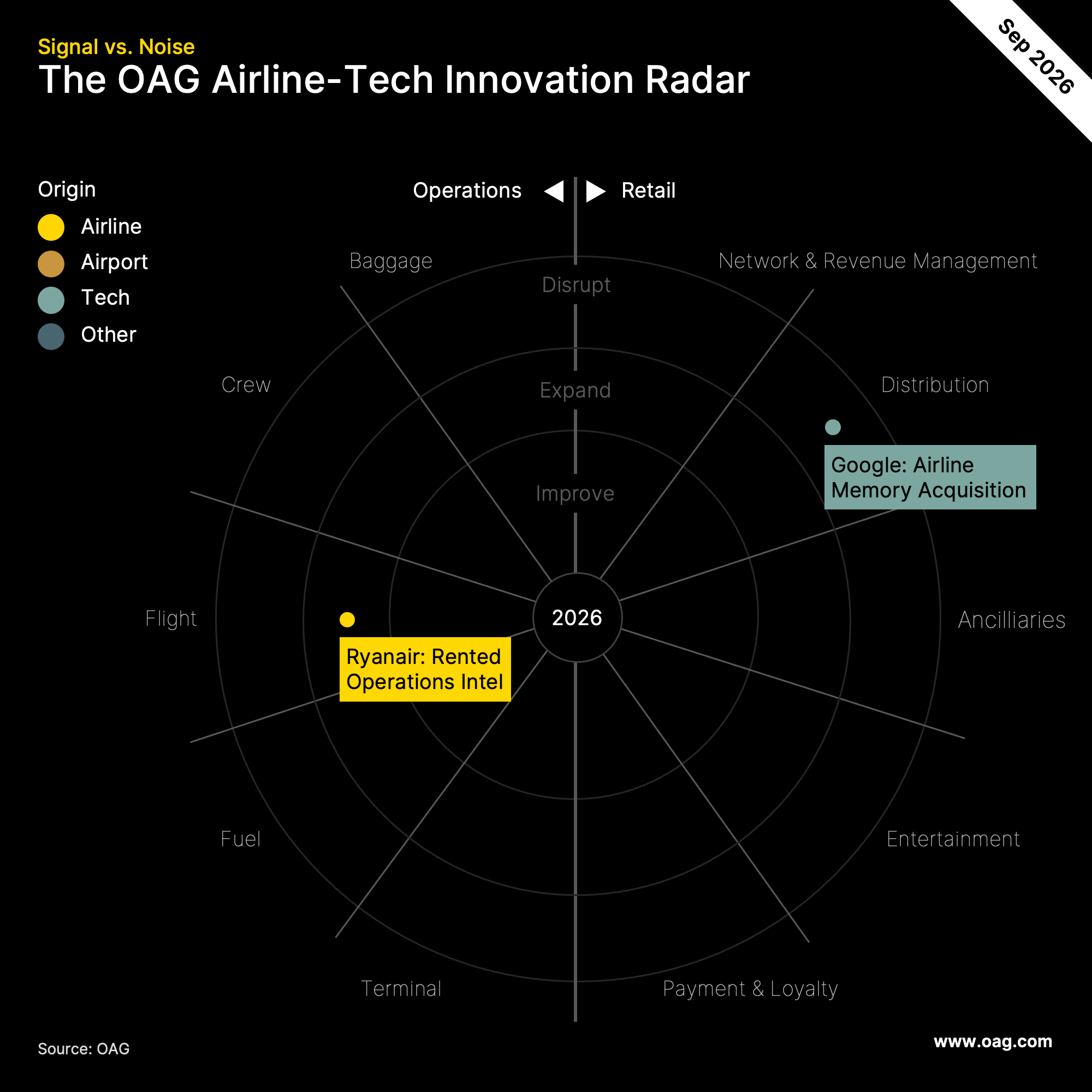
- Ryanair signed a five-year Google Cloud partnership that brings Gemini Enterprise and DeepMind research models into areas such as crew logistics, fleet operations, and maintenance planning across its 35,000 employees.
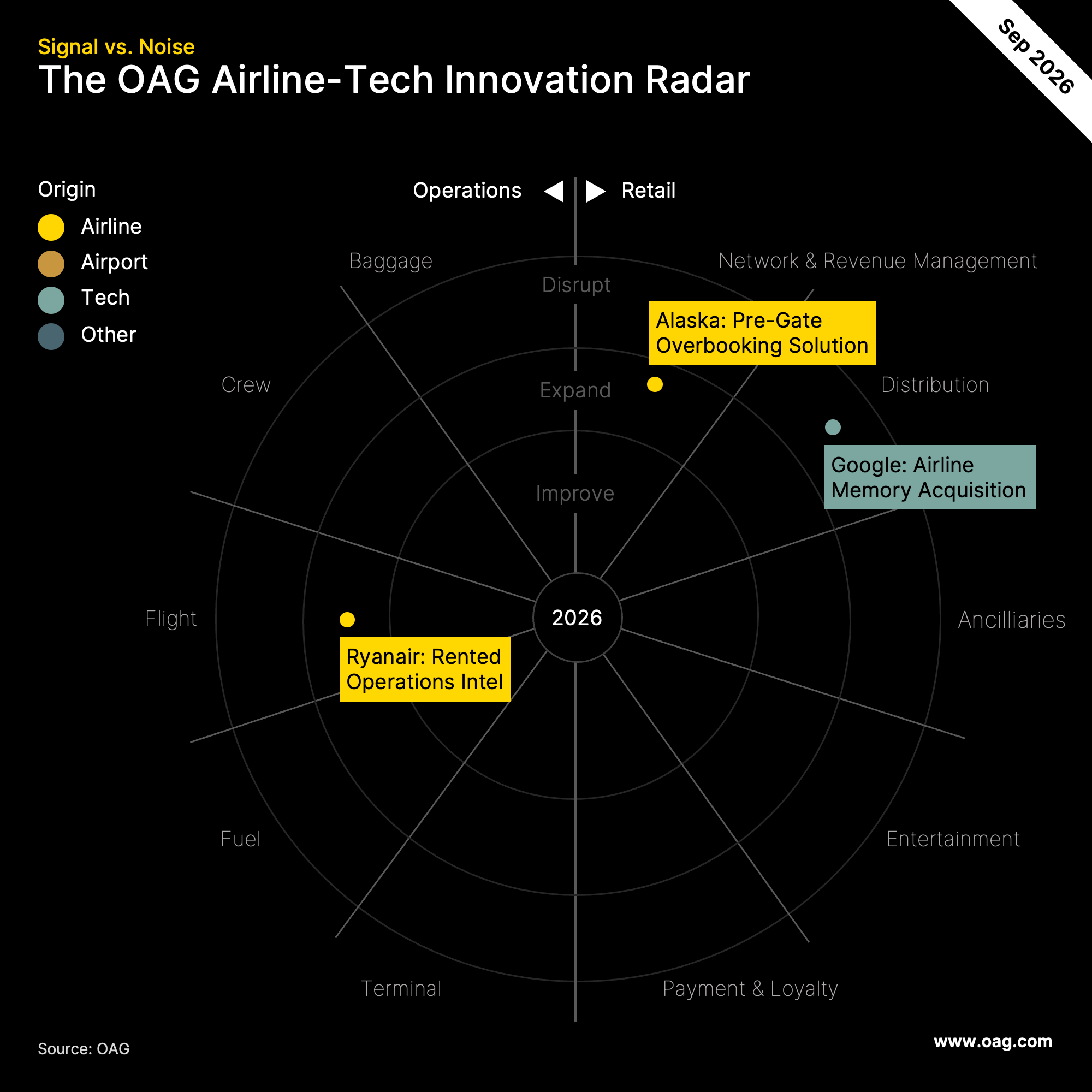
- And Alaska Airlines is using Volantio’s agentic platform to move overbooking and demand-reallocation decisions earlier in the journey, approaching flexible passengers before departure instead of resolving the problem under pressure at the gate.
We start with the most literal version of the trend: an airline’s internal memory becoming an AI training asset.
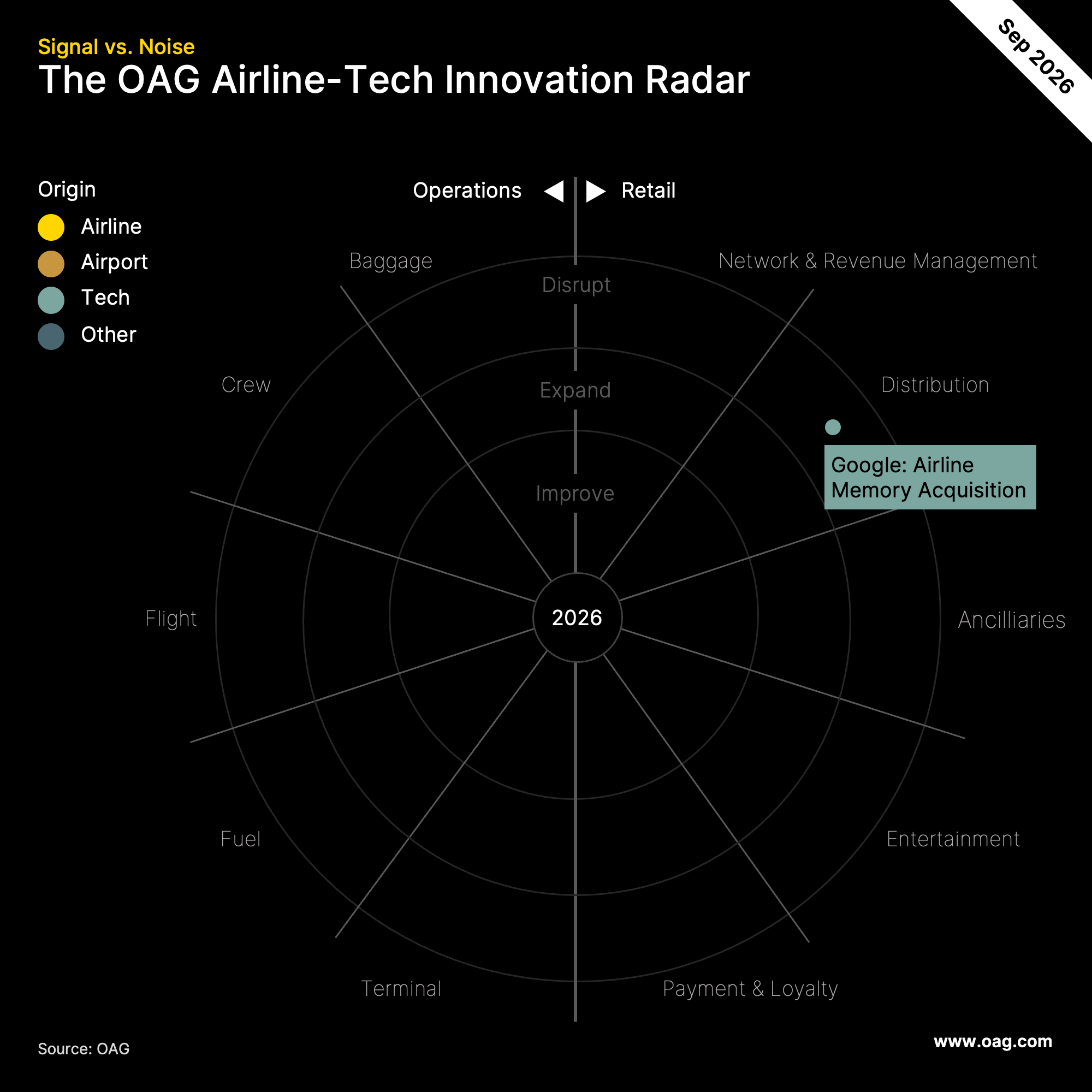
Innovation #1: Google buys a collapsed airline's institutional memory
When an airline fails, the aircraft, the slots and the loyalty programme usually all find buyers.
The email archive, on the other hand, does not usually make the list.
That changed with the case of Spirit Airlines, the US low-cost carrier that ceased operations in May of this year. Google won the auction for Spirit’s corporate data with a bid of $10 million USD, outbidding Mercor, an AI training data company, which had bid $7.5 million USD. A third bidder, Micro1, came in higher at $12.5 million USD, but only after the auction had closed.
So, what does this deal actually comprise?
- The dataset covers roughly 100 million emails, 500 million Microsoft Teams messages, and about 30 million lines of code, alongside finance, revenue and aircraft operations systems.
- A third party de-identifies the corpus before it reaches Google, and Google says it includes no customer information.
- The value is not in the outcomes, but in the sequence: how an operations team argued its way to a decision, not simply which decision it reached.
The intended use is as reinforcement learning material for Google’s own AI models being trained on white-collar work, where authentic enterprise data of this depth is scarce.
Why does this move stand out so much?
Let’s start with what it is not.
Despite rumours in some news coverage, this is not a purchase of 97.5 million passenger profiles.
Consumer data is being stripped out, and treating the sale as a privacy scandal misses the far more interesting thing that is happening here.
Structurally, this sale creates a new asset class. An airline’s institutional memory has always been treated as overhead. Think storage costs, retention policies, or compliance obligations. Pricing it at $10 million USD reframes it as inventory. Every solvent airline now has a reason to ask what its own operational record would fetch, who would want it, and whether the answer changes how they write their data agreements with cloud and AI vendors.
Importantly, that question did not exist a year ago.
Now, what makes airline data specifically interesting for tech players like Google? It is one of the few enterprise environments where messy human coordination produces a very hard, measurable outcome.
- A flight either departs or it does not. As our own assessment by Gemma Timmons in PhocusWire pointed out, what this material teaches a model is the sequence behind an outcome rather than the outcome itself, and that sequence is exactly what general-purpose models have never seen.
- This is the training data equivalent of the point we made in Airline AI’s Real Battle Moves Below the Interface, where we argued that there is no agentic future without a high-quality data backbone. It turns out somebody is willing to buy one.
In all fairness, the caveat is real and unresolved.
The flight attendants’ union has objected that scrubbing personal details while preserving referential integrity, meaning the links that hold the dataset together, may still allow individual employees to be re-identified, particularly given the size of the workforce involved.
A judge has yet to rule. Whether that objection succeeds will shape how the next airline estate gets sold, and who would be interested in buying it, or at least the data part of it.
Innovation #2: Ryanair rents Google’s AI stack for crew and maintenance
If the Spirit auction showed one route into airline knowledge, Ryanair has shown the industry another. It turns out you don’t have to buy a collapsed airline’s corporate record if you already sit on one of Europe’s largest operating machines. Instead, you can bring the intelligence layer to your own data.
That is what makes this announcement more interesting than the average airline cloud deal.
Most cloud partnerships in aviation still read like procurement news dressed up as strategy. A new provider is named, a migration roadmap is sketched out, lower infrastructure costs and better resilience are promised, and innovation gets its obligatory mention. Useful, certainly, but often hard to distinguish from standard enterprise IT modernisation.
Ryanair’s deal with Google Cloud is much more specific. Europe’s largest airline by passenger numbers signed a five-year agreement and named the systems it wants to put to work. The stated target is also clear: support Ryanair’s growth toward 300 million passengers a year by 2034, while improving crew logistics, fleet operations, maintenance planning and infrastructure resilience.
Here’s how it works:
- Gemini Enterprise and Google Workspace will roll out to 35,000 employees, giving staff an agentic platform to connect organisational data, automate workflows and build custom AI agents.
- Gemini Enterprise will be used to support decision automation, improve flight crew logistics and reduce disruption across the operation.
- Google DeepMind models, including AlphaEvolve and WeatherNext, will be applied to fleet operations and maintenance planning.
- WeatherNext gives Ryanair a more advanced weather-forecasting layer, helping the airline plan resources and maintenance activity against expected operating conditions rather than reacting once disruption has already formed.
- Google Cloud will sit alongside Ryanair’s existing AWS stack. This is a deliberate dual-cloud resilience strategy, not a full migration from one provider to another. The idea is that critical services can keep running if one cloud environment has issues.
Why does this innovation stand out?
The structural change here is about where airline intelligence lives.
- For decades, an airline’s edge in crew rostering, fleet planning or maintenance scheduling came from proprietary capabilities, such as bespoke optimisation software, in-house rules, operational experience and tools guarded closely because they sat close to the core of the business.
- Ryanair is describing a different model. The airline keeps the domain knowledge, the data and the constraints, but the optimisation power increasingly comes from a hyperscaler’s AI stack.
That is a reasonable trade if you are chasing a target of 300 million passengers a year and do not want to build a DeepMind of your own. It also means that parts of the operational layer airlines once considered deeply internal are becoming rented.
Two details make this more than a logo swap.
First, Ryanair is naming frontier systems rather than speaking only in broad AI language. AlphaEvolve and WeatherNext are not generic productivity tools. They come from Google’s research ecosystem and are now being pointed at airline operating problems. Putting that kind of capability next to safety-adjacent scheduling is a much bolder use case than adding another chatbot to customer service.
Second, Eddie Wilson framed Google Cloud as much a resilience play as an AI play. That says a lot. After years of airline IT outages, cloud resilience is no longer a back-office concern. It is part of operational continuity. A dual-cloud setup is not glamorous, but for an airline at Ryanair’s scale, avoiding a single point of technology failure may be just as important as squeezing more efficiency out of crew or maintenance planning.
With all that said, we should be careful about how much this proves. It does not (yet) prove that DeepMind models can run airline operations better than existing airline systems. It does not (yet) prove that AI agents can make disruption decisions without human oversight. And it does not (yet) prove that a five-year partnership will automatically translate into measurable operational gains.
A signed contract is not a deployed system. The trade coverage makes it clear that this is a roadmap with a five-year horizon attached. What we can say, though, is that the direction is now explicit and unusually well named. That alone makes this worth watching closely.
Innovation #3: Alaska Airlines settles overbooking before anyone reaches the gate
After Ryanair, we stay in airline operations, but move from the systems that help plan the network to one of the moments where planning failure becomes visible to passengers.
Denied boarding at the gate is one of the hardest airline moments to manage well. Everyone involved is standing up, the aircraft is close to departure, and the negotiation happens under pressure (in public) with very little time left to find a good answer.
Structurally, it is also a forecasting and demand-management problem that has been allowed to turn into a customer service incident.
Alaska Airlines is now trying to move that moment upstream.
The U.S. carrier is a launch airline for Vector, the agentic platform from Volantio – an Atlanta-based airline revenue technology company whose backers include Qantas, Amadeus and International Airlines Group. The premise is simple: if you know a flight is likely to be oversold, do something about it while the passenger is still at home.
Here’s how it works in more detail:
- Vector isn't a human-agent workflow. It is a platform of specialised AI agents that sit on top of airline systems and look for specific demand-and-capacity problems.
- Its overbooking AI agent identifies oversold flights days ahead of departure, selects eligible passengers within airline-defined rules, and sends targeted offers for them to move to lower-demand alternatives. If a passenger accepts, the move can be completed before anyone reaches the gate.
- Its revenue optimization agent looks for constrained flights where shifting flexible passengers to lower-demand services frees up seats that can be resold at a higher value.
- Its demand intelligence agent looks further upstream, reading travel patterns, price sensitivity, and emerging demand before those signals fully show up in the reservations system.
- Airlines can also build custom agents for their own network quirks. One example Volantio has discussed is monitoring midsummer Denver departures, where heat and altitude can create payload-restriction risk.
Crucially, these agents do not act outside the airline’s control. Vector is designed to operate within airline-defined rules and guardrails, with visibility into the decisions it makes.
Why does this innovation stand out?
Network and revenue management is the quietest corner of our Airline-Tech Radar. Given the commercial sensitivity of new approaches in those areas, almost nothing gets announced, and in more than two years of these editions, we have featured it only a handful of times, most recently with Sabre’s continuous pricing engine.
So a named carrier describing an agentic deployment in that discipline is worth stopping for.
What it structurally changes is the timing of a commercial decision.
- Denied boarding compensation is a cost airlines absorb at the last possible moment, at the worst possible price, with a customer who is already unhappy.
- Moving that transaction days earlier turns it into ordinary revenue management, which is cheaper for the airline, voluntary for the traveller, and invisible to everyone else on the flight.
This is also the clearest answer yet to the question we keep asking about agentic AI in operations: what is the agent actually allowed to decide? Here, it decides who to ask and what to offer, while the airline sets the boundaries.
On the proof side, Alaska’s president and chief financial officer Shane Tackett has put the financial impact of the partnership at well over $20 million USD a year, and Air Canada credits the same platform with saving more than 1,200 hours in its first year. Those are the airlines’ own numbers rather than independent measurements, so treat them with a grain of salt.
In any case, they are numbers, attached to named executives, in a category where we usually get adjectives. That alone puts this ahead of most agentic AI claims we read.
Stay tuned for more
That’s it for this edition.
It was a slightly longer Airline-Tech Innovation Radar than usual, but we felt these three moves deserved the extra space. Stay tuned for our next edition in October.