


Overall, capacity for the US international market softened in Summer 2026, with a drop of 2% year over year, equivalent to 4.6 million fewer seats than in Summer 2025.
Beneath that headline reduction however, the regional picture is more nuanced: Africa and Asia Pacific are still seeing capacity growth, while Europe, North America, Latin America, and the Middle East are moving in the opposite direction. According to OAG Analyser data, the decline is concentrated in the Middle East (-1.1 million seats) and Latin America (-3.4 million seats), which together account for 97% of the net capacity losses.
But where are airlines choosing to grow?
-
- Overall market: US international seat capacity is down 2% year over year, equivalent to 4.6 million fewer seats than in Summer 2025.
- Growth markets: Africa, up 6%, and Asia Pacific, up 2%, are the only regions expanding seat capacity year over year.
- Declining markets: Europe and North America are each down 1%, Latin America is down 4%, and the Middle East records the steepest reduction at 16%.
Where is growth still happening?
Africa and Asia Pacific added 541,000 seats between them, roughly a tenth of the capacity lost elsewhere. Africa was the fastest-growing region in the US international market this summer, with capacity up 6% year over year, or 107,000 additional seats compared with Summer 2025. New route launches are the main driver, led by network expansion from Egyptair and Royal Air Maroc.
Egyptair launched two new US routes this summer, connecting Cairo with Los Angeles and Chicago, a route that has been many years in the making. Royal Air Maroc also entered a new market, linking its Casablanca hub with Los Angeles for the first time.
Asia Pacific is the only other region which saw expanded US capacity this summer. Seat capacity was up 2%, by 434,000 seats, with United Airlines and Cathay Pacific contributing a significant share of the increase.
United Airlines added 168,000 seats this summer. The airline launched a new route to Seoul from its hub at Newark and increased capacity on the following services: San Francisco–Manila, Newark–Tokyo Narita, San Francisco–Tahiti, San Francisco–Tokyo Narita and Los Angeles–Beijing Capital.
United's new routes in summer 2026
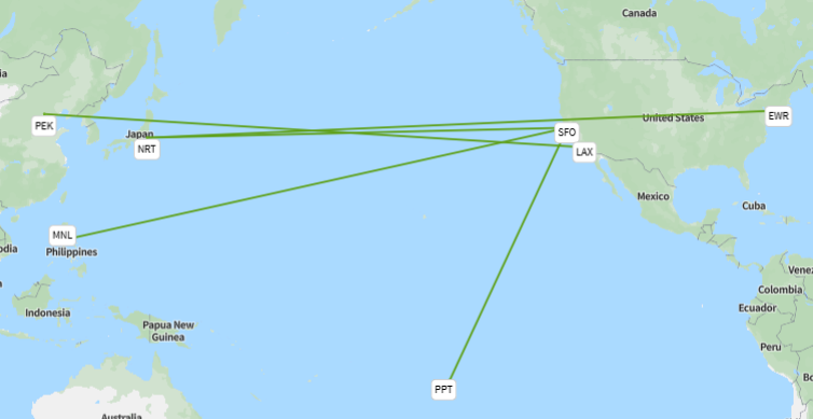 Source: OAG Analyser +
Cathay Pacific added 167,000 seats this past summer season. The airline launched a new Hong Kong–Seattle route and increased capacity from Hong Kong to Dallas, Los Angeles, New York and Boston, while reducing capacity on its San Francisco service.
Other notable airlines with increased capacity in the US – Asia Pacific market are Delta Air Lines, Taiwanese carrier EVA Airways and Korean carrier Air Premia, all operating over 100,000 more seats than last summer.
Alaska Airlines appears in the Asia Pacific market for the first time, following its merger with Hawaiian Airlines, effectively taking the Hawaiian brand's place in the market.
A second relevant consolidation is Korean Air's takeover of Asiana Airlines. Although the Asiana brand is not expected to be replaced until December 2026, the merger has been approved, and the two carriers are already operating as a single airline from a network perspective. Korean Air added 190,000 US seats this summer, while Asiana removed 124,000, leaving the combined entity with net growth of 66,000 seats.
North America and Europe: Headline declines driven by one carrier
Capacity from the rest of North America (essentially Canada) to the US was down this summer, but the decline was the result of one airline. WestJet reduced capacity by 574,000 seats compared with Summer 2025, a 17% drop. Excluding WestJet’s reductions, North American capacity to the US would have grown by 377,000 seats, or 2%.
The European market to the US is also down this summer, again driven by one airline. Norse Airways reduced capacity by 724,000 seats compared with Summer 2025, a 62% drop. Excluding Norse’s reduction, European capacity to the US would have increased by 240,000 seats, or 0.4%, reflecting continued strong US outbound demand for travel to Europe. United operated to the most destinations with 35 points in Europe, ahead of Delta Air Lines, which operated 28. Italy is most popular amongst the US carriers, with 17 routes across 4 carriers, followed by Spain with 12 and the UK with 10.
United has set the pace for Summer 2027 with its largest-ever international expansion, announcing services to nine new European airports, and with growth in Asia Pacific, too. The question is whether Delta, American and others follow.
