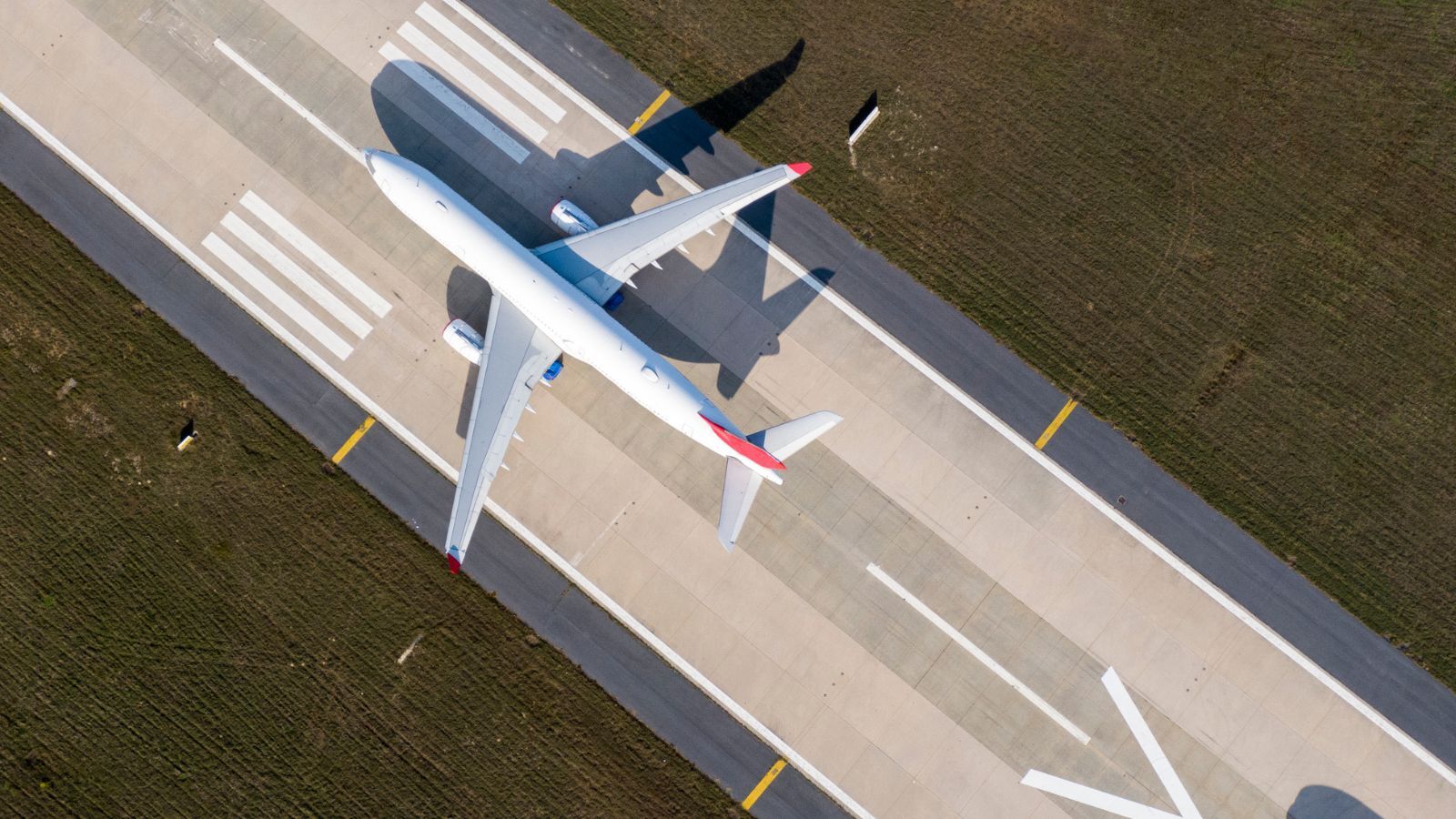

OAG data shows the average distance of the top 10 longest non-stop flights has grown by 14.5% since 2000, powered by a new generation of twin-engine widebody aircraft.
People are flying further than ever before. In 2025, the average distance of the world's top 10 longest non-stop routes reached 14,504 km, up from 13,464 km in 2010 and just 12,667 km in 2000. That represents a 14.5% increase over 25 years. The shift reflects not just airline ambition, but a transformation in the aircraft that make ultra-long-haul flying commercially viable.
The world's longest flights, 2000, 2010, 2025
The world's longest non-stop flight in 2025 is Singapore Airlines' New York JFK to Singapore Changi service at 15,332 km, operated on an Airbus A350-900. Its near-identical sibling, the Newark to Singapore route at 15,329 km, ranks second. Both have been operated by Singapore Airlines for several years, and together they illustrate how a single airline and a single aircraft type can define what is possible.
From the Boeing 747 to the Airbus A350: the aircraft that changed everything
In 2000, the Boeing 747-400 dominated ultra-long-haul flying: nine of the top 10 longest routes were operated on this four-engine workhorse. The only exception was Hong Kong to Toronto, where Cathay Pacific and Air Canada used the Airbus A340-300. The 747-400 had a range of 13,400–15,000 km depending on variant, which set a practical ceiling on how far airlines could go non-stop.
By 2010, the aircraft mix had shifted significantly. The Boeing 777-200LR (Long Range) and 777-300ER (Extenderd Range) had become the aircraft of choice for the longest sectors, with seven of the top 10 routes using a 777 variant. These twin-engine jets reduced operating costs compared to the four-engine 747, making ultra-long routes more economically attractive. The switch from four engines to two was not just a technical milestone: it fundamentally changed the economics of flying 13,000–15,000 km non-stop. The average top-10 distance rose by around 800 km between 2000 and 2010 as a result.
By 2025, the aircraft landscape has diversified further. Five of the top 10 routes operate on an Airbus A350 variant, either the -900 or the -1000. The remainder use the Dreamliner, specifically the B787-900 with a range of around 14,500 km.
Geography shifts: from Africa to Asia-Pacific
The regional geography of ultra-long-haul flying has changed substantially. In 2000, an African airport featured in five of the top 10 longest routes, all involving South African Airways flying from Atlanta, New York, and Cape Town to Johannesburg or onward. By 2010, that had fallen to one (ATL–JNB, operated by Delta Air Lines). In 2025, no African airport features in the top 10 at all.
The Asia-Pacific region has moved in the opposite direction. In 2000, four of the top 10 routes involved an Asia-Pacific airport. By 2025, all ten do. The shift reflects the growth of Singapore, Auckland, and Australian airports as key nodes in the global ultra-long-haul network, as well as the expansion of Gulf carriers whose Middle East hubs connect onward to Asia and Australia.
North America's presence in the top 10 has also evolved. In both 2000 and 2010, a North American airport appeared in every one of the top 10 routes. By 2025 that figure is five, partly because new Qantas routes connecting Europe and North America to Australia have introduced non-North-American city pairs to the upper end of the ranking for the first time.
What comes next: the horizon at 17,000 km
The next frontier is Project Sunrise. Qantas has placed an order for 12 specially configured Airbus A350-900ULR (Ultra long range) aircraft capable of flying approximately 18,000 km non-stop. The airline plans to launch direct services between Sydney and London, a distance of almost 17,000 km, in 2027. The trade-off is significant: the aircraft will carry around 238 passengers, more than 100 fewer than a standard A350-900 configuration, and the journey will take approximately 22 hours. Whether passengers and business economics can sustain that configuration at scale remains to be seen, but the fact that it is technically feasible at all is a direct consequence of the same engineering progression that took aviation from the 747 to the 787 and A350 over the past 25 years.
For airlines, the ability to fly further non-stop translates directly into network advantage. Every new ultra-long-haul route reduces the importance of hub connections and gives passengers more direct options. OAG's schedules data tracks those network shifts in real time, enabling airlines, airports, and investors to understand where capacity is growing and where new routes are commercially viable.