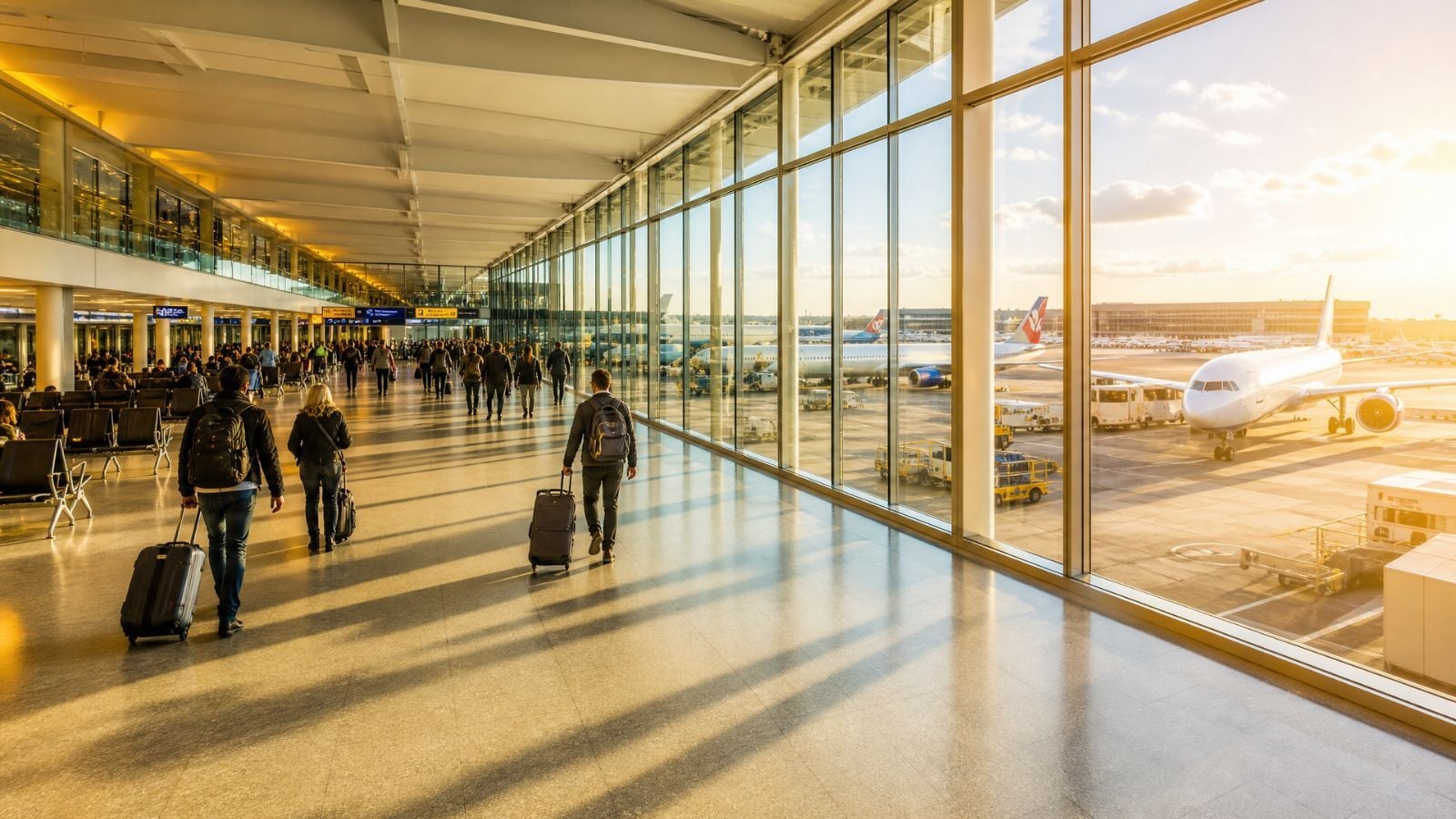
Nothing quite gets an airline and their passengers more excited than the development of a new terminal building with new check-in areas, lounges, tax-free shops and signage sending everyone in the wrong direction!
Moving to a new terminal creates opportunities for an airline to stamp their brand on the facilities and make it feel like home from home. But when an airline is told it must move to what it perceives as an inferior terminal, leaving its partners behind, then quite rightly an airline can get very upset.
That is Delta Air Lines’ situation. They are being asked to relocate from Terminal 3 (T3) at London Heathrow to Terminal 4 (T4). For anyone who hasn’t been to Heathrow, T4 is on the opposite side of the airport from T3, with no direct connection between the two. Once British Airways’ home, T4 now hosts 32 airlines with Qatar Airways the largest operator followed by KLM and Air France. Ten of those airlines operate less than daily services.
For Delta, the move means leaving T3 and Virgin Atlantic, in which it has a 49% share and numerous codeshares, which just feels senseless. For passengers, it would mean a longer journey across the airport for transfers and a repeat visit through security. It is certainly not a move that either airline would want. However, Heathrow feels the move is necessary for operational reasons.
In this blog, John Grant looks at what the data tells us about the operational case and what alternatives might exist.

Plenty of Capacity at Terminal Four
Weekly departures from T4 are less than half of those operated in 2007, when British Airways were the anchor tenant and operated 83% of all departures.
As the chart below shows, current weekly departures are consistently below 2007 levels in almost every hour of the day. The exceptions are the 20:00 hour when there are 45 departures across the week and in the 22:00 hour when there are 23 departures.



Current capacity at Heathrow’s T3
Interestingly, and perhaps contrary to what passing through T3 would suggest, weekly departures there have fallen by 6% since 2007. While in ten out of the sixteen operating hours each day, the number of scheduled departures increased, from 20:00 onwards the number of departures has halved compared to 2007. Looking at scheduled capacity T3 has also seen a reduction from 248,500 a week in 2007 to 224,500 this year, all of which points to there being as much capacity in T3 this year as there was in 2007.
While in T3 the number of departing flights in the 07:00 to 09:00 period has doubled, none of those services are operated by either Delta or Virgin Atlantic and while there may be congestion from arrivals in T3 during those hours, there would certainly appear to be enough aircraft departing to make space available. All of which makes the requirement for Delta to move seem strange, especially when other more commercially attractive options may be available to the airport and its airport customers.
A Sensible Commercial Alternative
If Heathrow needs to move airlines out of T3, then surely moving both Delta and Virgin Atlantic to T4 would make greater sense. Delta’s SkyTeam partners KLM and Air France are already there, so the move would create a larger base for the SkyTeam Alliance.
On the current schedules, Delta and Virgin could comfortably be accommodated without reaching any of the historic 2007 hourly departure rates. And while Virgin may, in the short-term, perceive T4 as an inferior product to their current T3 facilities, a sprinkling of creativity and some red paint could transform the outlook. And if it is good enough for Qatar Airways, it’s good enough for most others.
There may be other operational factors behind Heathrow’s push to move airlines to T4. Certainly a half-utilised terminal is not in anyone’s interest, and although both T3 and T4 seem to function well today, this doesn’t add any of that much-needed runway capacity Heathrow needs so badly.
Delta isn’t alone in its frustration, other airlines such as Finnair and Japan Airlines are equally unhappy about relocating from T3 to T4. And quite how China Southern gets access to T5 raises a whole set of other strategic questions, not least how BA feels when it still has a large part of its operation in T3.
Moving airlines from one terminal to another is a big ask, and this “initiative” has not gone down well with the airport’s airline customers who are not moving quietly; indeed they are being dragged across the tarmac. It may be the first such move since 2014 and could have been in the planning for quite some time, but with a closer look at the data, the airport could reconsider the wishes of its customers, who seemingly are happy with the status quo.