AI IN TRAVEL
Travel 2045, six months in
Grading our ten bets on travel's AI future

A Phocuswright Europe 2026 progress check on the long-term forecast we made six months ago.
By Filip Filipov
Six months ago, at the beginning of the year, we did something the travel industry rarely does. We ignored the next twelve months.
Instead of another annual trend list, we published Travel 2045: a twenty-year outlook built around 10 long-term bets on how AI would reshape travel. The entire point was distance. When you look 20 years out, you stop reacting to quarterly noise. You start thinking about the structural forces that actually decide who leads and who fades in travel’s AI era.
Phocuswright Europe 2026 is around the corner now. And it raises a question we honestly did not expect to be asking this soon.
The bets were built to play out over two decades. But six months is a long time inside an AI super-cycle.
So, how much has already moved?
That is what this piece sets out to answer. We went back to each of the 10 bets and asked how far the industry has already “travelled” toward them.
To keep the verdict honest and comparable, we kept the scoring deliberately simple. For each bet, we weighed the happenings that genuinely mattered over the past six months: the launches, deals, partnerships, and behavioural shifts. Then we settled on a single judgment, expressed as one Harvey Ball, scored from empty to fully filled.
How have the 10 bets that will shape the next 20 years in travel progressed?
On this front, 2026 already settled the question.
- Klook's Travel Pulse survey of 11,000 travellers found that 91% are now using AI tools to plan.
- And even if the concrete percentages differ by source, ChatGPT, Gemini, Claude, and Perplexity have quietly become the front door to travel inspiration.
- The research burden is being outsourced exactly as we predicted.
However, the booking burden is not. GetYourGuide reports that 69% have used AI to plan a trip, yet only 17% to book an activity. On a similar note, Expedia found just 8% comfortable letting AI complete a booking. When even OpenAI retreated from in-chat checkout toward routing traffic back to merchants, it read as an admission that the back of the booking funnel is harder than the front.
But the gap is being attacked from both ends. Expedia launched natural-language planning and in-feed AI. Booking is pouring $700M into AI, already cutting service cost per reservation by 10% while lifting bookings. And as we outlined in our latest Aviation Tech Innovation Radar, Mindtrip, Sabre, and PayPal just shipped what many believe is travel's first all-in-one agentic flight booking experience.
What all of this means: Research is solved. Transaction is now the frontier. That is why this bet sits at three-quarters, not full.
Have we seen product launches supporting this? Plenty, though mostly on the infrastructure front.
- Coforge, the global IT services firm with a deep travel practice, launched FlightFlex.AI, an agentic platform built for autonomous disruption recovery.
- IBS Software, Tech Mahindra, Teneo, and PROS all shipped IROPS tooling of their own.
And travellers are ready for it. Ada found that half of US travellers no longer care whether a fix comes from a human or a machine, as long as it comes.
Money is flowing into disruption management, too, and it is actually moving faster than the tooling.
- Long Lake Management agreed to take Amex GBT, the world's largest TMC, private for $6.3B, a price that rests explicitly on the thesis that AI will rebuild its disruption layer.
- CEO Alex Taubman points to "proactive disruption resolution" and "frictionless travel administration," and Amex GBT's Paul Abbott called the direction "the future of B2B services."
Even the adjacent proof points are landing. Booking's OpenTable concierge handled 80% of diner questions at launch, and Agoda has cut service cost per booking by double digits – a sign that AI is meaningfully easing the everyday hiccups of customer servicing.
And yet the thing this bet actually rests on has not happened. None of these moves shows AI autonomously recovering a disrupted flight at scale, and flight disruption is the part that matters most. It sits at the top of the travel chain, so when a flight collapses, everything downstream collapses with it, whether it’s the connection, the hotel night, the rental car, or the meeting on the other end. That is the exact moment a "stress buffer" would earn its name.
So the tooling exists, the money is committed, the first customer-service wins are real, but the core problem (think of the cancelled flight at 11 pm with 180 passengers to rebook) remains untouched in live operations. Until it shows up in production, this bet holds at half.
What’s the progress on this front?
The engine for more personal AI-powered pricing is definitely being built.
- Fetcherr had a strong year, winning the BIG Innovation Award, presenting its "AI Brain" at Davos, and adding Royal Air Maroc to a roster that already included Virgin Atlantic, Azul, and Delta.
- Lufthansa expanded its PROS-powered dynamic offer engine, and Amadeus credited part of an 8.6% rise in Air IT revenue per passenger to uptake of its Nevio retailing platform.
So the back-end capability is real and shipping.
The trouble is what happened when it met daylight.
AI-driven personalised pricing drew heavy public backlash, with the suspicion being that "personal" was a polite word for charging each traveller the most they would pay.
As a consequence, Delta walked back the framing entirely. The US Congress kept the Delta-Fetcherr deployment under scrutiny. And the EU's AI Act Omnibus agreement pushed high-risk compliance out by 16 months, giving vendors more runway but also a clear signal that a regulatory ceiling is forming over exactly this use case.
There is also a quieter problem. For the ordinary traveller booking a flight today, nothing feels more personal than it did a year ago. The capability exists in the back office, but it has not yet reached the screen. The promise was a tailored price, and at the point of contact, that promise remains unmet.
One path through the trust problem is worth watching, though. Quad Advisory is building tensor-based microsegment models that personalise without identifying the individual, thereby pricing to a pattern rather than a person. If that approach holds up, it could let carriers personalise without tripping the privacy wire that is currently holding everyone back.
For now, capability without trust or visibility earns this bet a quarter.
Bet #4
Humans are control freaks (so AI will recommend, but we will make the final decision)
We bet that people would let AI do the legwork but keep a hand on the final click. Agents recommend, humans decide.
Progress: 100%
●
Six months later, and this is the bet running furthest ahead of where we expected consumer trust to be.
The clearest proof looks, at first glance, like the opposite:
- Skift found that only 2% of leisure travellers are willing to let AI book a trip without their sign-off. Sounds like a rejection of the whole idea of AI. But it isn't. It is the bet, almost word for word.
- Phocuswright tells the same story from the other direction. Readiness for fully autonomous booking sits at around a quarter, while AI use for inspiration and shortlisting runs three to four times higher.
People are glad to let AI narrow the field. They just want to be the one who says yes. And they are saying yes. TakeUp found that 78% of AI users have booked travel based mainly on an AI recommendation, and 94% now trust those recommendations at least as much as traditional sources.
So the recommend-and-approve loop is not travellers settling for a compromise. It is how they want to shop for travel in the first place.
What seals it at full is that this behaviour is now hardening into infrastructure. Google's Agent Payments Protocol lets travellers set the rails up front, naming specific brands, specific products, and hard spending limits, with tamper-proof digital mandates keeping the agent inside those lines. The Long Lake and Amex GBT deal framed the same principle for the corporate world, "AI and human agents working seamlessly together on behalf of every traveller," now priced at $6.3 billion.
We conclude: Humans set the boundaries and agents move within them. That is exactly what we predicted, and six months in, it is already being built into the plumbing. A full ball.
There are some light, anecdotal signs that a few players are chasing this serendipity-on-demand:
- Mindtrip, for example, expanded into creator-led inspiration and acquired Thatch.
- A wave of seed-stage players like Airial and Layla.ai are pitching themselves explicitly on off-the-beaten-track discovery.
So, on the surface, the serendipity engine is here.
Look at what comes out of it, though, and the picture changes.
A study in Current Issues in Tourism ran 420 AI-generated recommendations from ten systems across fourteen queries, and the diversity simply was not there. The models kept funnelling travellers toward the same iconic and semi-iconic places. Even sustainability prompts produced earnest green language without sending anyone anywhere new.
That is the catch at the heart of this bet.
- The tools are designed to broaden horizons, but the models underneath them are trained to reinforce popularity, and popularity is the opposite of surprise.
- An AI that has read the whole internet will tell you to go where everyone already goes.
- The magic is the hard part, and it is the part still missing.
There is one early attempt to fix it at the root. NC State's People-First Tourism AI Protocol steers recommendations toward community-based, culturally specific places rather than the usual marquee names, and early testing does show more varied suggestions, even if the underlying bias has not gone away. It is the first real intervention at the model layer, which is encouraging.
But one research protocol is not yet a booking pattern. Until a major AI travel platform can show real diversification in where people actually go, this bet stays at a quarter.
Dive deeper
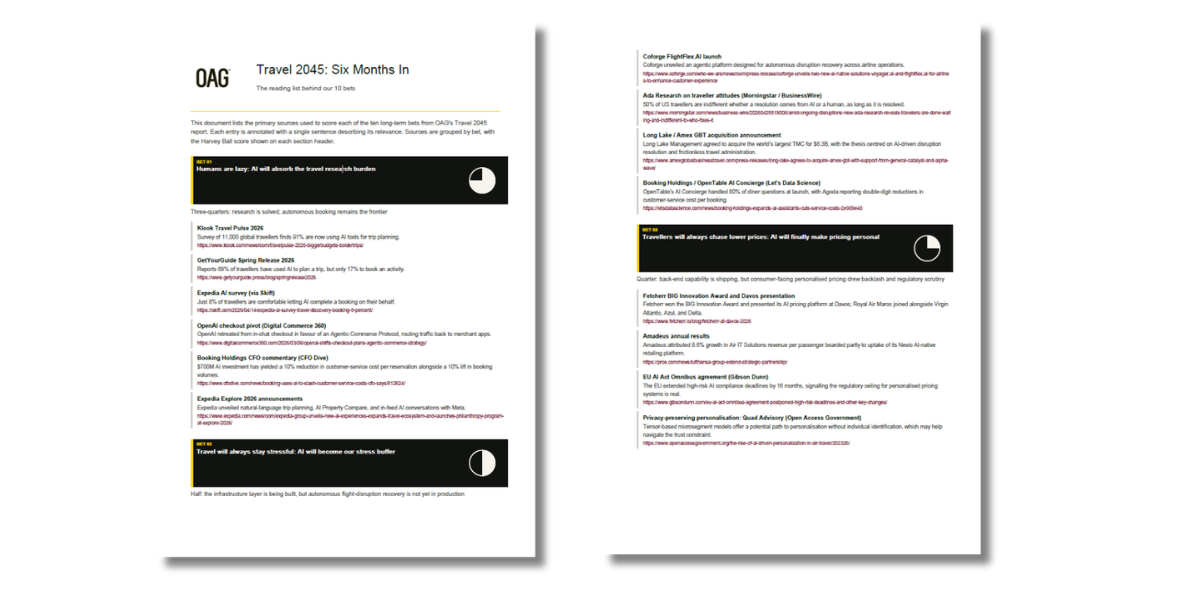
We've curated the 30+ research articles used to grade our ten bets' progress into a single reading list. Download and save for later by clicking below.
Reading list instant downloadTravel supply will remain fragmented (but AI will finally make it feel seamlessly connected)
We bet that travel's supply would stay as fragmented as ever, with a thousand airlines, hotels, and rail lines that have never spoken the same language. AI, we argued, would be the thing that finally made it all feel like one connected whole.
Progress: 75%
◕
Of all ten bets, this is the one where the groundwork moved fastest in our view. The breakthrough is a piece of connective tissue called the Model Context Protocol, a shared standard that lets AI agents plug directly into a supplier's inventory.
In barely fourteen months, it has gone from idea to default.
- Sabre, Amadeus, and Travelport all run MCP servers in production today.
- Expedia's own B2B server is launching in the coming months, opening its inventory to partner agents.
- Cendyn pushed hotel direct rates into AI search through it, and Lighthouse used it to open hotel discovery to ChatGPT and Perplexity.
- Google then blessed the whole direction with its Universal Commerce Protocol, naming hotel booking as the next vertical and lining up Wyndham, Booking, and Expedia as launch partners.
This is definitely more than a handful of pilots. And the connective work is happening at the physical layer too.
Amadeus spent the year building a parallel identity stack through three acquisitions (Vision-Box, SkyLink, and Idemia Public Security), stitching together one verified traveller identity across airlines, airports, rail, and car rental.
So why not a full score? Because all of this is still “just” infrastructure. Pipes, standards, and servers are not the same as a trip that actually feels seamless, and the everyday traveller has not felt the difference yet. The connections that matter still break at the seams between providers, exactly where they always have. So while the plumbing is largely built, water is not yet running through it for the person on the journey.
That gap is the whole distance left to travel, and it is why this bet sits at three-quarters rather than full.
Infrastructure won't scale with demand (but AI will unlock hidden capacity)
For bet #7, we predicted that the physical world would not keep up. Runways, gates, and terminals cannot be poured fast enough to match travel demand in the future, so the only way to grow is to run what already exists far more intelligently. That, we argued, is where AI would quietly add capacity nobody could build.
Progress: 75%
◕
This is the bet with the firmest evidence under it. Let’s start with the airports:
- Heathrow picked the AIRHART platform from Smarter Airports as its operational backbone, joining Copenhagen and Munich.
- Schiphol's Deep Turnaround system is now fully operational, with Frankfurt and Vancouver rolling out their own versions.
These are the systems that squeeze more aircraft through the same concrete by reading gate activity, ground movement, and turnaround timing in real time.
What sets this bet apart from the others is that the wins are now measurable (not just promised). United's ConnectionSaver has reportedly saved roughly 54,000 missed connections in Denver alone so far this year, bringing the total to more than 3.3 million since 2019. The airline is now expanding it to connecting passengers across Denver, O'Hare, and Newark.
American is running the same playbook with Connect Assist, which is already live across six of its largest hubs. This is hidden capacity made visible: flights that would have been missed, caught instead, with no new infrastructure poured.
One result stands slightly apart and is worth dwelling on. In a trial with Google across 2,400 transatlantic flights, American cut contrail formation by 62% on AI-guided routes, at a fuel cost of about 0.3%. That is not throughput capacity; it is environmental headroom, with AI buying climate margin rather than extra seats. It’s also a reminder that "capacity" has more than one meaning, and AI is unlocking versions of it we did not list six months ago.
What keeps the bet at three-quarters is reach. Almost all of these wins have thus far been concentrated in a handful of major hubs in North America and Europe. The mid-sized airports and regional carriers, so the long tail where most of the world actually flies, are still mostly running pilots.
We conclude: the proof exists. It just has not spread yet. When these gains show up across that long tail, this bet moves to full.
Travellers will keep crowding the same places (and AI will guide us to new frontiers)
Next, we bet that overtourism would persist, and that AI would become part of the cure, nudging travellers away from the overrun hotspots and toward the places that rarely make the itinerary. Six months in, this is the bet in the most trouble, and it is worth being plain about why.
Progress: 0%
○
The problem is the same one that undercut Bet #5; only here, it bites even harder. The Current Issues in Tourism study found that AI systematically steers people toward the same iconic destinations – the exact opposite of dispersion. The bet asked AI to send travellers somewhere new. Its default behaviour is to send everyone to the place that is already famous. We are asking the technology to work against its own grain, and so far, the grain is winning.
Dispersion is happening, to be clear. Skyscanner found that a third of travellers have run into overtourism and are now shifting when they travel. But look at what is driving that change and AI is nowhere in it. The lever is price and policy:
- Kyoto raised its top accommodation tax roughly tenfold.
- The Netherlands pushed tourism VAT to 21% (from 9% before).
- Japan tripled its exit tax, and visitor caps are spreading across European cities.
Travellers are being redirected by tax codes and turnstiles rather than by intelligent agents.
There are people trying to close that gap.
- The AI Opener for Destinations programme, run by Group NAO and the City Destinations Alliance, has signed up more than 120 destination organisations specifically to build AI tools for visitor dispersion.
- As mentioned before, the NC State's People-First Tourism Protocol is attempting the same correction inside the model itself.
Both are real, and both are early. Whether either can override the popularity bias baked into consumer AI is the open question that will decide this bet.
For now, the honest read is that the mechanism we predicted has not materialised thus far. Until we can point to dispersion driven by agents rather than marketing language and regulation, this bet stays empty. There is a plausible path forward through genuine personalisation, but it is not the path the industry is on today, and we would rather say that clearly than dress up a zero.
We bet that trust would remain the deciding factor in travel, and that in the AI era, it would be earned above all by the quality of the underlying data.
A word of disclosure before the evidence, because it matters here. This is the bet that sits closest to OAG's own business. We build flight-data infrastructure on the premise that accuracy becomes a differentiator rather than a commodity. So when we grade this one, we are grading a trend that runs in our favour, and we would rather say that out loud than let it sit unspoken. Read the evidence with that in mind.
And the evidence is genuinely strong on one side.
Awareness of data quality as the make-or-break factor has surged across the industry:
- Phocuswright now frames governance as the trust layer of the agentic era.
- A study in the Wiley Journal of Consumer Behaviour, running two experiments across more than a thousand consumers, found that AI hallucinations measurably cut perceived accuracy, usefulness, and trust, and left travellers more reluctant to use the tools at all.
- CNBC made hallucination the central story of consumer AI travel tools.
- Sabre, Amadeus, and Travelport have all bolted data-validation layers onto their MCP servers, and 95 to 98% accuracy thresholds have quietly become standard language in procurement contracts.
That conviction is being priced, not just stated. Amadeus paid €1.2B for Idemia Public Security – the largest single bet on the trust layer yet – extending verified identity across the physical and digital journey and pointing at a €50B market.
Google's Agent Payments Protocol builds verified payment straight into the agentic stack. The EU Digital Identity Wallet is holding its deadline. Even Expedia wired CLEAR into its booking flow. The money agrees that trust is the battleground.
So why only half?
Because all of this proves that the industry has woken up to data quality, not that AI has actually gotten better at telling the truth. Those are different things. The surge is in awareness, investment, and the validation layers built around the models. The models themselves have not solved their core flaw. Large language models hallucinate by design, not by accident; producing confident, fluent answers is what they do, and being reliably correct is a separate problem that better data wraps around but does not cure.
Until that underlying accuracy genuinely improves, awareness alone earns this bet a half.
Scale will remain the decisive advantage (so AI will favour incumbents over startups)
Ultimately, we bet that AI would not be the great leveller everyone hoped for. Many argued that AI would finally let emerging startups compete on equal terms with incumbent businesses. We predicted the opposite. The advantages incumbents already held around scale, data, integration, and distribution would only compound in the AI cycle rather than dissolve. The big would get bigger.
Progress: 100%
●
On the face of it, that is exactly what is happening:
- OpenAI walked back its in-chat checkout and built the Agentic Commerce Protocol to route shoppers back to merchants, handing the transaction to the players who already own it.
- Booking.com's CEO told analysts that agentic commerce reinforces the large OTAs rather than disintermediating them, and put $700M into AI behind that conviction, projecting $400M in incremental revenue.
- When Google launched its Universal Commerce Protocol, the launch partners were the same names that have run travel distribution for twenty years.
Quite clearly, the incumbents are not being bypassed by AI. They are absorbing it.
But the more interesting development is what happened to the word "incumbent" itself.
Long Lake's $6.3B take-private of Amex GBT is the clearest sign. It was backed by General Catalyst, the firm behind Anthropic, Stripe, and Anduril, alongside Alpha Wave, Koch Equity Development, and $2.5B of committed debt from JPMorgan, Bank of America, Citi, and MUFG. Skift called it the largest corporate travel deal in years. What makes it matter is the logic of the price. The world's largest travel management company was valued as an AI distribution business rather than a services one.
The same week, Amadeus ran the opposite playbook, using its own cash flow and balance sheet to bolt on AI capabilities directly through the Idemia acquisition. Two routes to the same destination: AI-native scale, inside a single window.
So the thesis holds at full, with a wrinkle we did not fully anticipate. Scale still wins. But "scale" now means something sharper than market share or distribution reach. It means the capital and capability to become AI-native fast, whether you buy your way there or build it in-house. The incumbents are winning the AI cycle, just as we predicted. The definition of who counts as one is being rewritten in real time, though.
Conclusion: The conversation continues at Phocuswright Europe 2026
Six months ago, we made the bets. The scorecard above shows where they stand today, but it's a snapshot, not the final word. These are early readings on long-term calls, and the more interesting question is what comes next.
That conversation continues at Phocuswright Europe 2026.
This year, the opening Centre Stage interview belongs to OAG. Our CEO, Filip Filipov, sits down with Mitra Sorrells for "AI, Disruption and the New Logic of Travel." It is exactly the moment to take these ten bets to the industry: to add the nuance a scorecard can't capture, to pressure-test the calls we've made, and to argue out where travel's AI future goes from here.
We hope to see you there.
Diver deeper into the reading list
Add your email for instant access to a curated list of the 30+ research articles used to grade our ten bets for travel's AI future.
About Filip Filipov
Filip Filipov is Chief Executive Officer (CEO) at OAG, where he leads the company's strategic direction and drives innovation in products and technology for the travel ecosystem. His career spans roles across data analytics, product innovation, and travel technology, giving him a unique perspective on how data powers smarter decisions in aviation and beyond.