SHOPPING DATA
When machines do the shopping,
what happens to the demand signal?
By Filip Filipov, CEO and Nils Gelbjerg-Hansen, CDO
Take it with you
Add your email, and we will send you a link to the report.
In June, a developer pointed an AI coding agent at an airline's website and asked it to find a flight. The agent came back with 881,076 fare options for a single trip.
The agent had crawled every date, every stopover, every route combination it could reach. A single traveller (and its agent) caused nearly a million search queries. Now imagine the 5.2 billion passengers IATA expects to fly in 2026, each sending an agent to do the same.
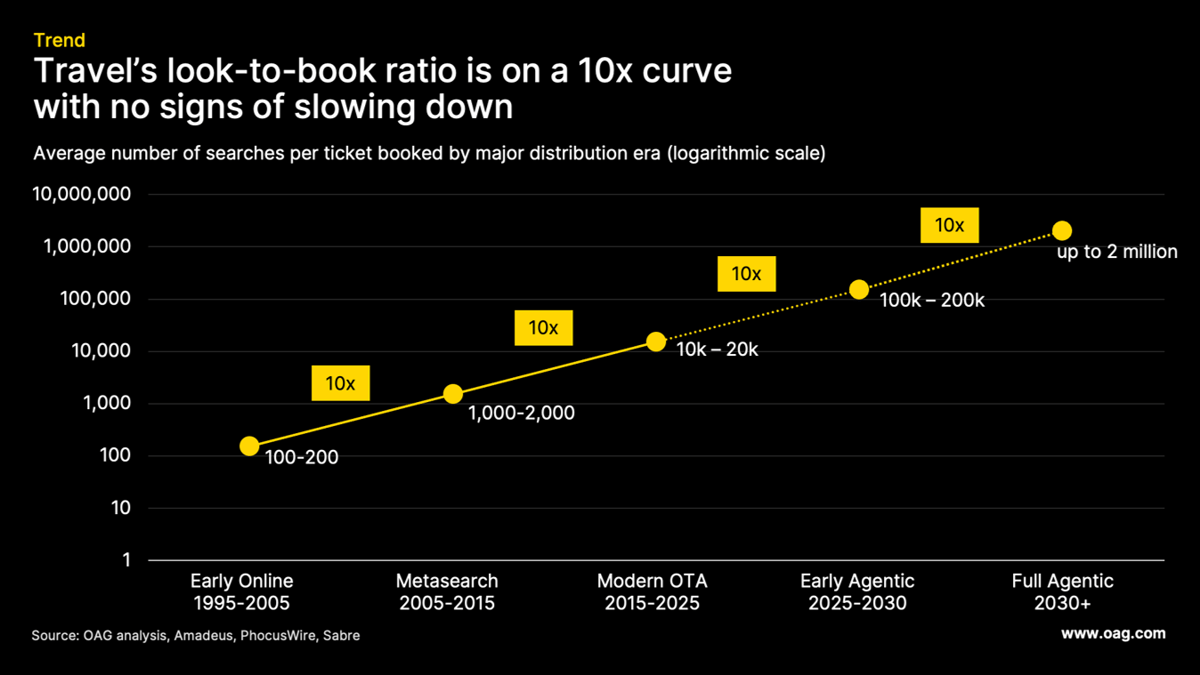
The travel industry has a name for this dynamic. Look-to-book, the ratio of searches to actual sales, sat at roughly 100 to 200 searches per ticket in the early online era. Today, it runs closer to 10,000-20,000. At OAG, we project the next step to be around 200,000 searches per booking as AI agents shop tirelessly on our behalf. It is a trajectory PhocusWire picked up in July, and one that voices from Amadeus and Sabre have independently landed on as well.
Almost all industry discussion treats this as a cost problem. Fair enough. Serving those queries is expensive, and the race to serve them more cheaply is well underway. But there is a second layer hiding underneath the cost problem, and it matters just as much.
What happens to shopping data as a signal when most of the shoppers are machines?
What is shopping data?
Shopping data is the data generated when real travellers search for flights. It captures the searches themselves across airline websites, OTAs, and metasearch, as well as the offers returned in response, including itineraries, fares, fare brands, and ancillaries. Where API-based fare collection takes scheduled snapshots, shopping data is created by traveller intent in the moment.
In its raw form, it may contain personal data, which is why all of it is anonymised and aggregated before it is processed or made available, without exception. Individual travellers cannot be identified, tracked, or profiled through it.
Shopping data has always had two components:
There are the searches travellers perform, which reveal interest and demand.
And, even more importantly, there are the fares displayed in response, which reveal pricing.
Machine traffic pulls these two components in opposite directions:
The demand component becomes harder to read. For two decades, the volume of searches served as a tolerable proxy for the strength of demand, because behind every query stood a person weighing up a journey. That assumption has quietly collapsed.
An agent sweeping through a month of departure dates on a traveller's behalf produces the statistical silhouette of a crowd in which only a single intention exists. The consequence is that owning search data now matters less than being able to interpret it, and interpretation is demanding work.
Whoever hopes to read demand from this traffic must trace each query back to its origin, strip out the duplication, and reconstruct the individual human decisions buried underneath the machine-generated noise. The more of this traffic there is, the less each search tells you, and the more it is worth knowing which searches still have a person behind them.
The pricing component, meanwhile, gets richer. Every query (whether from a person or an agent) returns a real fare quoted by a real carrier in a real market context. Agents sweep routes, dates, and cabin combinations that no human would ever bother to check.
In a sense, coverage widens and freshness improves. The observed picture of what the market actually charges (as opposed to what has been filed) becomes sharper precisely because traffic has exploded.
Consider what happens when we search online ourselves:
- A traveller planning an October city break from Munich to Lisbon might check a Tuesday departure, glance at the weekend either side of it, compare two or three websites, and move on. By the end of the session, perhaps thirty fares have been displayed, covering a handful of dates on a single route.
- Now hand the same trip to an agent. It queries every departure day in October, pairs each one with every possible return, tests the neighbouring airports, checks each cabin, and then repeats the whole exercise an hour later to catch any price movement. It is the same story, told a thousand times faster.
So the fare side of shopping data emerges from the machine era stronger than it entered. The demand side enjoys no such luck, and this is where an airline's instincts can mislead it.
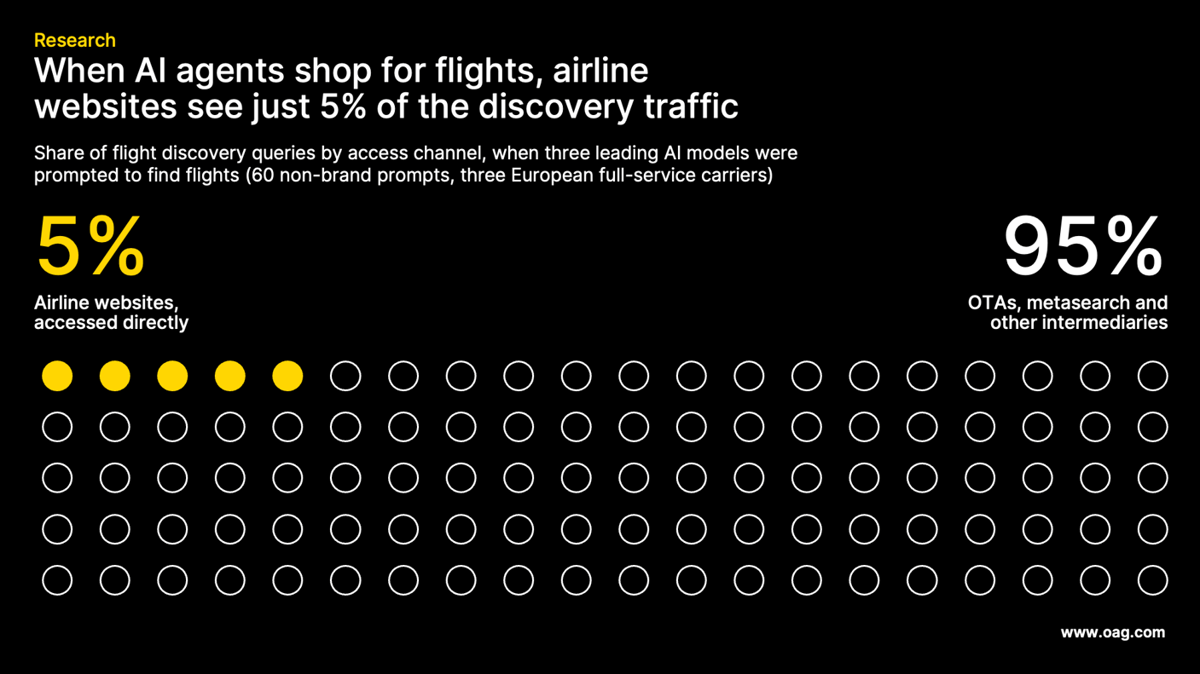
An airline might conclude that the safest place to read demand is its own website. At least there, it can see the searches firsthand. The evidence suggests that window is narrowing too. When Bain & Company tested leading AI models against real airline websites earlier this year, the agents reached those sites directly only around 5% of the time. The remaining 95% of discovery flowed through intermediaries, mostly OTAs. Demand is increasingly forming in places airlines cannot observe from their own front door.
The reasons for this are structural. An agent is, by design, an economical creature:
Every page it visits and every token it processes costs its operator money and time, so it is built to reach an acceptable answer in as few steps as it can.
One visit to an OTA, which lays out dozens of carriers side by side, will always beat ten separate visits to ten airline websites.
And the preference runs deeper than convenience.
OTA and metasearch sites were built to make comparison effortless for human shoppers with consistent formats and prices that can be scanned in seconds.
It turns out that what makes a page easy for a person to compare also makes it easy for a machine to parse.
Airline websites, built for a different job, such as telling one brand's story to one visitor, and often guarded by systems designed to keep automated traffic out, are comparatively hard work.
The agent holds no grudge against airlines. It goes where the reading is easiest.
The demand signal, in other words, faces pressure from two sides at once. It is getting noisier and moving out of sight.
What does this mean going forward?
The industry will spend the next few years working out how to answer machine traffic more cheaply.
But what is all that traffic telling us, and who can still hear it?
This is where OAG's Shopping Data programme starts from a structural advantage, and answers each of the two pressures in turn.
The first is noise.
The data enters our Shopping Data programme at the source, directly from airline and partner systems. That does not make it immune to machine traffic.
An agent querying an airline's website appears in a shopping data feed just as a person does. But collection at the source means every search arrives with its context attached, such as the channel it came through, the market it was made in, the session and pattern it belongs to. That context is the raw material for telling an agent's sweep apart from a person's deliberation.
The second is blindness.
No airline can fix its narrowing window alone, because its own channels are precisely what the window has narrowed to.
Our Shopping Data addresses this through its network, because participating airlines and partners across the booking funnel contribute their search traffic, and so the pooled picture spans channels no single carrier could observe on its own. In return for what it shares, each participant accesses market intelligence drawn from across that network, and it is anonymised, aggregated, and deliberately delayed. What no airline can see from its front door, the network sees together.
One distinction matters more than any other here, and it is easy to get wrong.
When a traveller hands their search to an agent, the thousand queries that follow are still an expression of one person's demand. The question was human. Only the asking was automated. Filtering out machine traffic entirely would therefore discard the very demand it carries.
The real task is therefore subtler: collapsing each agent's sweep back to the single question that launched it.
In the agentic era, where one question can become a million queries, the scarce asset is the ability to find the question again. That is the signal worth building on.
That work is less new to us than it might sound. Since 1929, OAG has helped the industry see itself, assembling what no single airline could gather on its own – from the first printed schedules to the live status of every flight in the sky.
Shopping data extends that role to demand itself, and we are building it the way we have always built, namely in close collaboration with the world's leading airlines, airports and travel-tech providers. There is much more to come from us on this in the months ahead, and in the meantime you can explore the programme here.
Shopping Data: built with airlines, governed by airlines.
Organically generated consumer flight search data capturing real traveller intent, fare offers and ancillaries from search to booking.
.png?width=196&height=126&name=shopping%20data%20%20(1).png)
About Filip and Nils
Filip Filipov
Filip Filipov is Chief Executive Officer (CEO) at OAG, where he leads the company's strategic direction and drives innovation in products and technology for the travel ecosystem. His career spans roles across data analytics, product innovation, and travel technology, giving him a unique perspective on how data powers smarter decisions in aviation and beyond.

Nils Gelbjerg-Hansen
Nils Gelbjerg-Hansen is OAG's Chief Data Officer (CDO), overseeing the quality, integrity, and growth of its aviation datasets. Co-founder of Infare, which OAG acquired in 2023, he brings over two decades of expertise in airfare intelligence and data strategy. Nils is the driving force behind OAG's commitment to data that is trusted, precise, and built to power real decisions.