

Direct Shopping Data built with airlines, governed by airlines
For twenty years, airline revenue management was built around one question: am I cheaper?
That question no longer wins. The airlines gaining ground today are asking a different one: is my product better,
and do my customers know it? Shopping data is how you answer it.
Potential value unlock for airlines over 5 years through modern retailling
More pricing data points with shopping data vs API/web alone
Of the world's largest airlines already engaged with OAG Shopping Data
Revenue management has changed, the data powering it hasn't kept up
For the past two decades, airline distribution was shaped by one dynamic: the internet turned everything into a price comparison game. Customers who landed directly on airline.com had already chosen you. Everyone else was still shopping around, and whoever was cheapest got the click. Revenue management systems were built around that reality. They were fit for purpose.
Then two things changed at once.
Airlines began competing on product, not just price. If you are an airline that has invested billions over the last decade to build a premium experience, to make your brand mean something, your goal is no longer simply to show you are the cheapest option. Your goal is to show what you are worth at a higher price. The question revenue management now needs to answer is not just "am I cheaper?" but "is my product better, and do customers know it?"
Price is now one input among many. Product, value, and relevance become the deciding factors.
The tools built for era 1 were never designed to answer era 3 questions.
01. Yield and optimisation
THE FOUNDATION ERA
Revenue management began as a supply and demand problem. Airlines had seats. Customers wanted seats. The job was to fill the right seat at the right price, using 26 booking classes and historical booking curves to manage inventory.
02. Fare families and the branded offer
THE PRODUCT ERA
Airlines began differentiating on product, not just price. Basic Economy. Standard. Flex. Business. Each fare family bundled different conditions, baggage allowances, rebooking rights and ancillaries. Suddenly, pricing wasn't just about the seat. It was about the offer. And understanding which offer customers wanted, at which price point, required a different kind of data.
03. The experience economy
WHERE WE ARE NOW
A flight is no longer a commodity. It's an experience, shaped by cabin, service, brand, and ancillary offer. To price it correctly, airlines need to understand not just what competitors are charging, but what customers are searching for, which products are winning at the shopping stage, and what intent signals look like before a single booking is made. Legacy revenue management tools were built for era 1. Most airlines are still using them to compete in era 3.
To understand customer willingness to pay, you need to understand the product being offered and the intent behind the search. Pricing an experience without that signal is guesswork. Shopping data is the missing input.
A problem that isn't waiting
The shift from price comparison to product and value comparison is not a future concern. The infrastructure cost of doing nothing is already measurable, and AI is about to make it significantly worse.
The look-to-book ratio has grown every decade, and AI is about to accelerate it to levels the current infrastructure was never designed to handle.
1990. Green-screen era
Max LTB 1:5 · Total airline cost ~$0.1B
2000. Internet arrives
Max LTB 1:200 · Total cost $1.5B
2010. Bots & NDC
Max LTB 1:3,000 · Total cost $15B
2020. AI era: the inflection point
Max LTB 1:300,000 · Total cost projected $90B, with 80% of spend driving <25% of bookings
Sources: IATA (2023-2024), Phocuswright (2024), McKinsey (2023), OAG proprietary data
What is shopping data?
Shopping data is the organically generated data produced when real consumers search for flights, across airline.com, OTAs, metasearch engines, and TMCs. Unlike API-scraped fare data, shopping data is created by actual traveller intent in the moment.
It spans the full booking funnel: from the first route search, through the fare offers returned, capturing what passengers looked at, what prices they were shown, which fare brands and ancillaries were included, and, ultimately, what converted.
This is not a replacement for existing pricing intelligence. It is a richer, near real-time layer of demand signal that complements what airlines already have, and reveals what has never been visible before. Where API and web-scraped data provides scheduled price snapshots, shopping data identifies price changes as they occur, delivers the full fare spectrum across cabins and brands, and feeds directly into existing revenue management systems.
Shopping data does not include personally identifiable information. All data shared through OAG's programme is anonymised and aggregated, with strict governance applied at every stage.
The shopping data funnel
Step 1:
Traveller Intent: Shopping Request Origin & Destination · Dates · Passenger types
Step 2:
Offers: Flights & itineraries · Fare brands · Pricing
Step 3:
Direct Bookings: Order ID (ticket) · Order items (ancillaries)
The revenue opportunity is measurable
The industry has spent years discussing dynamic pricing. The data on what it is actually worth, and what is still being left on the table, is now clear.
$45B
Potential value unlock for airlines over 5 years through modern airline retailing
$13B+
Of that $45B comes from New Offers alone, where shopping data is a critical enabler
15%
EBITDA uplift potential for individual airlines adopting truly dynamic offers
1 in 4
Flight offers sold in 2024 were dynamically created, meaning three quarters are still static
Sources: McKinsey and OAG
The difference between dynamic pricing and truly dynamic pricing is the data that powers it.
2-3%
Up to 10%
Six things you can do with shopping data that you cannot do without it
Shopping data doesn't just improve existing analysis. It unlocks decisions that were previously impossible, because the signal never existed before purchase.
01. Anticipate competitor sell-outs
When a competitor's inventory starts thinning at the shopping stage, their pricing shifts before availability data confirms it. Shopping data surfaces those signals in near real time, giving your revenue management team the window to reprice and capture demand before the market moves.
02. Read demand before it becomes bookings
Booking curves are a lagging indicator. Search intent is a leading one. Rising search frequency on a route, weeks before departure curves typically move, gives revenue management teams earlier and more confident grounds to adjust pricing, seat allocation, and capacity strategy.
03. Identify network opportunities
Sustained search intent on routes you don't operate, or search patterns that suggest demand for increased frequency, provides real consumer evidence for network planning decisions. It transforms route development from analysis of historical bookings into forward-looking demand intelligence.
04. Benchmark your products
OAG's Brand Buckets standardise fare families across airlines into comparable categories based on what's included: bags, rebooking flexibility, refundability, cabin class. For the first time, you can see exactly how your Basic or Flex product compares against a competitor's equivalent offer, not just against their lowest available fare.
05. Optimise ancillary pricing
Which ancillary bundles are winning at the shopping stage, across the whole market, not just on your own channel? Shopping data shows which combinations of fare conditions, bags, and flexibility are converting in real customer searches, informing both product design and ancillary pricing strategy.
06. Drive true profitability
Link search intent, offer presented, and conversion outcome to understand which fare products and price points are actually driving revenue, not just traffic. This is the complete picture that true revenue management requires: from the moment of search, to the offer shown, to what the customer chose and why.
Scale that only OAG can deliver
OAG already operates the world's most comprehensive airfare data platform, collecting and structuring pricing intelligence from APIs and web sources across airlines worldwide. Shopping data doesn't replace that. It multiplies it, increasing daily pricing data points tenfold.
This scale, combined with OAG's existing data governance, normalisation capability and distribution infrastructure, is what makes this programme possible.
Daily pricing data rows: OAG platform
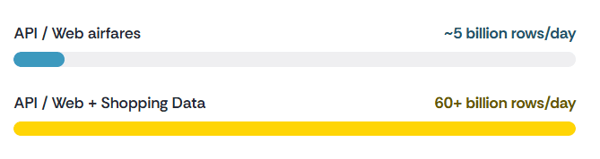
OAG platform data. Reflects growth from initial airline participants in the shopping data programme.
10x more data. The same revenue management teams. The same systems. No integration required on the airline side – shopping data feeds directly into existing OAG data delivery infrastructure.
Why share your shopping data with OAG?
Airlines are already generating this data with every consumer search. The question is whether it's working for you – or simply disappearing.
Cut infrastructure costs
Reuse organic passenger searches instead of generating new API calls, reducing API costs by up to 20%. As your data collection needs grow, Shopping Data scales with them. Delivering richer intelligence without adding to your infrastructure overhead.
Enrich your pricing intelligence
Complement existing scheduled fare data with live consumer search behaviour. See real demand by route, fare brand performance, ancillary uptake, and competitive positioning, including intra-day price fluctuations your competitors are making.
Reveal true demand
Today's revenue management tools work from booking data, a lagging signal. Shopping data reveals intent before purchase, enabling better yield decisions, improved forecast accuracy, and conversion optimisation that booking data alone cannot deliver.
Stay in control
A give-to-get model means you access only the level of competitive data you contribute. No personal passenger data, no proprietary exposure. Structured, governed intelligence shared within a framework built around airline control.
Shape the industry standard
Airlines who engage early help define how shopping data is structured, governed, and used across the industry. That is not just access. It is influence over the standard that will underpin airline retailing for the next decade.
Integrate without friction
OAG's approach integrates with existing infrastructure. Shopping data feeds directly into the same data delivery channels airlines already use, removing the most common barrier to participation.
Built on trust, by design
The OAG Fairness Engine. At the heart of OAG's shopping data programme is a set of rules and controls that govern precisely what each airline can access, based on what they contribute. No airline ever sees more than they give. Access is matched contribution-for-contribution, route-for-route, at the same level of competitive detail — down to timing, aggregation, and complexity. These controls are applied automatically and consistently across every participant in the programme. You always have full visibility of your own data. Shopping Data is generated by real passengers, and what you can see of the broader market is determined entirely by what you share.
Data anonymisation
All personally identifiable information is removed before any data enters the programme. No passenger can be identified, traced, or profiled through any data OAG holds or shares.
Reciprocal access
You access only what you contribute. The level of competitive intelligence available to you is matched directly to the data you share. Fairness is enforced at every level of detail.
Data latency
A deliberate time delay is applied between when data is generated and when it becomes available to the programme. This prevents any airline from using shared data to react in real time to a competitor's live pricing decisions.
Data aggregation
Data is handled according to its type and sensitivity. Where individual airline data could be identifiable, it is combined into summaries before being shared. The level of detail accessible to any participant is governed by what they contribute.
The industry is moving. Are you part of it?
Fifty of the world's largest airlines are already engaged with OAG Shopping Data, not because the product is fully launched, but because they understand that early movers will compete differently from those who simply adapt. Airlines have recognised that shopping data is the next frontier of pricing intelligence, and that the give-to-get model is the right framework to unlock it.
The airlines engaging now will help shape how this is built. Those who wait will adapt to something built without them and compete against peers who had a head start on the data that powers it.
In aviation, data advantages compound. An airline with richer shopping intelligence makes better pricing decisions today, which generates more revenue to invest in better systems tomorrow. The window to participate on equal terms is now.
Ready to be part of it?
Fifty of the world's largest airlines are engaged with OAG Shopping Data. The question isn't whether shopping data will reshape airline pricing intelligence. It's whether your airline helps define how.