

Whistleblower Policy
|
PURPOSES |
|
|
WHISTLEBLOWING CHANNEL |
raiseyourconcern@oag.com or anonymous on the www.oag.com website |
|
PRESCRIBED PERSONS |
2 members of the Legal Team |
|
SCOPE |
This Policy applies to all OAG employees (whether permanent or temporary), contractors, officers and directors of OAG, its subsidiaries and joint venture companies under OAG’s control |
I. Introduction
|
1. |
We are committed to conducting our business with honesty and integrity, and we expect all employees to maintain high standards. However, all organisations face the risk of things going wrong from time to time, or of unknowingly harbouring illegal or unethical conduct. Fostering a culture of openness and accountability is crucial to preventing such issues and effectively addressing them when they arise. |
|
2. |
The VP of People and Culture has overall responsibility for the effective operation of this Whistleblower Policy (the Policy), and for reviewing the effectiveness of actions taken in response to concerns raised under this Policy. |
|
3. |
You are responsible for the success of this Policy and should use it to report any suspected danger or wrongdoing. Also, you are invited to comment on this Policy and suggest ways in which it might be improved. |
|
4. |
The outcome of this Policy is that reported cases are handled discreetly and resolved with necessary actions taken. We always encourage you to share your concerns with your Line Manager, the People & Culture Team, the Legal Team, or the heads of OAG companies, and to escalate potentially problematic cases promptly. |
|
5. |
The reporting channel can be used for various types of reports, but whistleblower protection and the procedure outlined in this Policy apply only to cases falling under the Whistleblower Protection Laws. Reports concerning personal grievances (e.g., dissatisfaction with employment decisions such as transfers, promotions, or disciplinary actions), interpersonal conflicts, or minor non-compliance with internal procedures will be handled under the applicable internal policies, not this Policy. |
|
6. |
If there is uncertainty about whether the reported conduct falls within the scope of this Policy, the Whistleblowing Investigation Team (WIT) will evaluate the case and make a determination. |
The Policy sets the rules and guidelines on how whistleblower notifications are investigated internally focusing not only to the aim to eliminate the potential problem, but also to support and protect the whistleblower in such process.
II. Definitions
|
7. |
For the purposes of this Policy, the following definitions apply:
|
III. Who does this policy apply to?
|
8. |
This Policy applies to and therefore whistleblowers under this Policy may be:
|
IV. What is whistleblowing and what can be reported?
|
9. |
Whistleblowing is the disclosure of information which relates to suspected wrongdoing or dangers at work. |
|
10. |
Any past, present, or likely future reportable conduct will fall within this Policy if it concerns one or more of the following categories:
|
|
11. |
Before reporting, the Notifier should ensure that there are reasonable grounds to suspect reportable conduct. "Reasonable grounds to suspect" refers to the objective reasonableness of the suspicion. In practice, mere allegations without supporting information are unlikely to meet this standard. While evidence is not required, reports must not be made with the intent to cause harm or with knowledge that the allegations are false. |
|
12. |
The Notifier does not need to prove allegations. In addition, the disclosure can still qualify for protection even if the disclosure turns out to be incorrect. |
Employees should never investigate the matter themselves and should not seek evidence to build a case. We guarantee that no disciplinary measures or other actions will be taken against a person if a genuine concern turns out to be mistaken or misguided.
V. How to report?
|
13. |
Reports can be made by sending a free-form notice via email or by completing online notification form available on the website www.oag.com. The notification form is also attached as Annex 1 to this Policy. Notifications should be sent to: raiseyourconcern@oag.com. The Channel is designed, set up and operated in a way that ensures the confidentiality of the Notifier. Unauthorized employee members do not have access to the Notifications submitted through the Channel. |
||||||||||
|
14. |
If the Notification concerns reportable conduct involving any member of the Legal Team, the regular email should be sent to the VP of People and Culture, who will organize the investigation. |
||||||||||
|
15. |
You should provide all the necessary information available regarding the reportable conduct:
|
||||||||||
|
16. |
Notifier may choose to waive the requirement to apply confidentiality to the Notifier’s identity by providing consent. |
||||||||||
|
17. |
We do not encourage employees to make disclosures anonymously, although we will make every effort to investigate anonymous disclosures. You should be aware that proper investigation may be more difficult or impossible if we cannot obtain further information from you. It is also more difficult to establish whether any allegations are credible. |
||||||||||
|
18. |
If a Notification is submitted anonymously, the WIT will make every effort to investigate the matter. Therefore, it is strongly recommended that the anonymous Notifier provide as much detailed information as possible about the issue. Where feasible, the WIT will attempt to communicate with the anonymous Notifier while preserving their anonymity and will provide confirmation of receipt and any necessary feedback. |
||||||||||
|
19. |
The aim of this Policy is to provide an internal mechanism for reporting, investigating, and addressing any wrongdoing in the workplace. In most cases, reporting externally should not be necessary. While we do not prohibit or discourage you from reporting to external authorities and will not influence your decision, we strongly encourage you to seek advice before reporting any concerns externally. |
It is forbidden to use the Channel for information that is manifestly untrue or is based on manifestly untrue information. A person who has provided knowingly false information may be held liable under legal acts (in case such information was provided by the employee, it will be considered as a serious breach of employment duty). Note that requirement to maintain confidentiality of Notifier’s identity does not apply in such cases.
VI. Identity protection
|
20. |
Where Notifier make a disclosure, their identity (or any information which could identify Notifier) will only be shared where:
|
||||||
|
21. |
However, in certain circumstances the WIT does not need Notifier’s consent to share information about investigation if:
|
Whistleblowers will enjoy protection of their identity under the Whistleblower Protection Laws and this Policy.
WIT may share the information on reportable conduct with a limited number of people on a strictly need-to-know basis and only disclose it outside this small group if it is required to do so by law or if an important public interest is at stake.
Note. Should the Notification be determined as non-qualified whistleblowing, the Notifier identity may not be protected.
VII. Investigation process
|
22. |
The process set forth below pertains only to information from which it may be concluded that reportable conduct threatens or harms the public interest. |
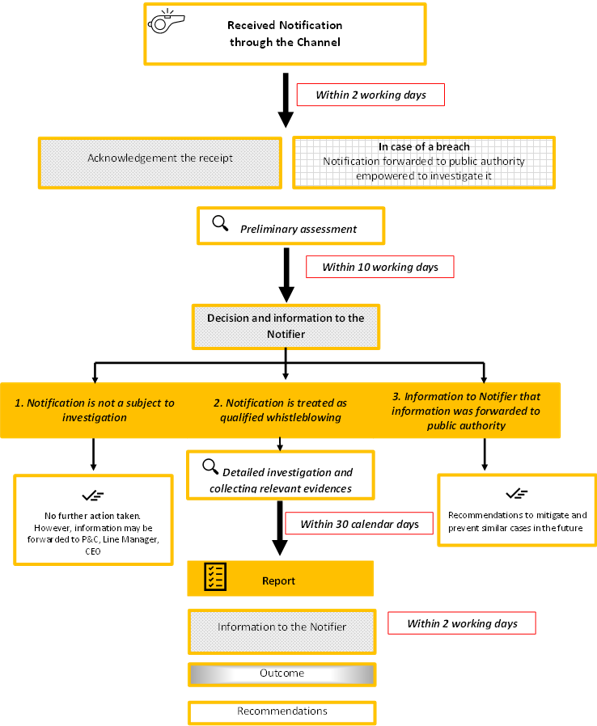
Figure 1 Reporting scheme
|
23. |
The investigation process outlined in this Policy is designed to allow fair treatment of any individuals mentioned in the Notification:
|
||||||||||
|
24. |
The WIT shall investigate every case in accordance with set standards to ensure the right quality and speed of response. |
||||||||||
|
25. |
The WIT shall:
|
||||||||||
|
26. |
Additional security measures will be taken to ensure protection of the confidential data stored. |
||||||||||
|
27. |
The first decision by WIT will be to decide whether the reportable conduct is to be treated as qualified or non-qualified whistleblowing. |
||||||||||
|
28. |
In case the information received gives reason to believe that a criminal offense, administrative misconduct or other serious breach is being planned, committing or committed, the WIT will immediately inform VP of People and Culture and not later than within two (2) working days of receiving it forward the information to public authority empowered to investigate it. |
||||||||||
|
29. |
If WIT resolves that it is a non-qualified whistleblowing, the case is immediately closed with no further actions. Received information can be forwarded to line manager, People & Culture Team, CEO of company related (for example, if it is determined that the Notification is related to exclusively personal interests regarding the violation of employment rights). |
||||||||||
|
30. |
The WIT shall inform the Notifier within ten (10) working days of the acknowledgement of Notification about the decisions taken:
|
||||||||||
|
31. |
The investigation process will vary depending on the precise nature of the conduct being investigated. |
||||||||||
|
32. |
The WIT may contact employees involved to request additional information or conduct oral interviews, which will be documented in minutes. If the interview is audio recorded, the individual will be informed in advance. Employees must cooperate fully and answer all legitimate questions honestly and completely. Deliberately withholding information, providing false information, or delaying or obstructing the investigation may result in disciplinary action. Anyone who becomes aware of the investigation must maintain strict confidentiality. |
||||||||||
|
33. |
In cases where the WIT determines that a Notification cannot be investigated objectively on its own (e.g., it requires specialized expertise, involves a large volume of documents, or suggests serious damage), the WIT will establish a committee with relevant investigative experience or subject matter expertise. The committee will consist of at least three (3) members, including WIT members, with a WIT member appointed as the chairman. |
||||||||||
|
34. |
During the investigation process, a decision to terminate the investigation could be taken if determined that provided information is manifestly untrue or the information has already been examined. |
||||||||||
|
35. |
The investigation should be completed, and its outcome finalised within thirty (30) calendar days from the date of the decision to treat Notification as qualified whistleblowing. The investigation time limit may be extended in special cases by a reasoned decision. |
||||||||||
|
36. |
The report prepared by WIT must describe the actions taken, circumstances investigated, findings whether the infringement has been committed. If the outcome is that infringement has been committed, the report must specify:
|
||||||||||
|
37. |
The outcomes of the investigation are reported to the VP of People and Culture. If the infringement is related to the VP of People and Culture activities, the report will be forwarded to the CEO of OAG Aviation Worldwide Ltd. If the infringement involves the CEO, the report should be sent to the Board of OAG Aviation Worldwide Ltd. They will review the report and determine the appropriate actions. Additionally, measures will be taken to mitigate or prevent similar incidents in the future. |
||||||||||
|
38. |
Upon completion of the investigation, the WIT shall without delay (in 2 days) notify in writing the Notifier about the decision made, the investigation results and actions taken or planned to be taken. |
||||||||||
|
39. |
Upon establishing the fact of an infringement, the WIT shall inform the Notifier about the liability applied to the persons who have committed the infringement. |
||||||||||
|
40. |
While we cannot always guarantee the outcome you are seeking, we will try to deal with your concern fairly and in an appropriate way. If you are not happy with the way in which your concern has been handled, you may contact Chief Executive Officer. |
If misconduct has indeed taken place, appropriate measures will be taken in accordance with relevant laws. Individuals reporting a concern that implicates their own conduct will not be given automatic immunity from investigation, disciplinary action, criminal prosecution and/or civil liability.
VIII. Notifier protection
|
41. |
It is understandable that Notifiers are sometimes worried about possible repercussions. We aim to encourage openness and will support employees who raise genuine concerns under this Policy, even if they turn out to be mistaken. |
|
42. |
Notifiers must not suffer any detrimental treatment as a result of raising a concern. Detrimental treatment includes dismissal, disciplinary action, threats or other unfavourable treatment connected with raising a concern. If you believe that you have suffered any such treatment, you should inform the COO immediately. |
|
43. |
Adverse effect shall not be considered the adoption of decisions unfavourable to the Notifier which are not related to the provided information about reportable conduct. |
IX. Final provisions
|
44. |
This Policy does not form part of any contract of employment or other contract to provide services, and we may amend it at any time. |
|
45. |
All information should be deleted or anonymised within two (2) months of the end of the reportable conduct investigation unless legal / disciplinary proceedings have been started. The final report should be kept for five (5) years. |
|
46. |
Generally, once a year the WIT shall summarize all data on reported and investigated reportable conduct and will provide summary of depersonalized information to VP of People and Culture. |
|
47. |
Taking into account the Notifications via Channel, the WIT shall propose to the VP of People and Culture to apply appropriate measures to mitigate or/and prevent similar cases in the future. |